


London/New York – The escalating crisis in the Middle East has sent investors scrambling for safety once again, reigniting a fierce debate over which assets truly offer protection in times of geopolitical stress.
The choice is unusually complicated, as traditional refuges behave unpredictably. Gold has swung sharply, government bonds have failed to attract typical safe-haven flows, and the dollar—out of favor for much of the past year—has staged a powerful comeback.
Here’s how the leading candidates are stacking up.
The Greenback Passes the Test
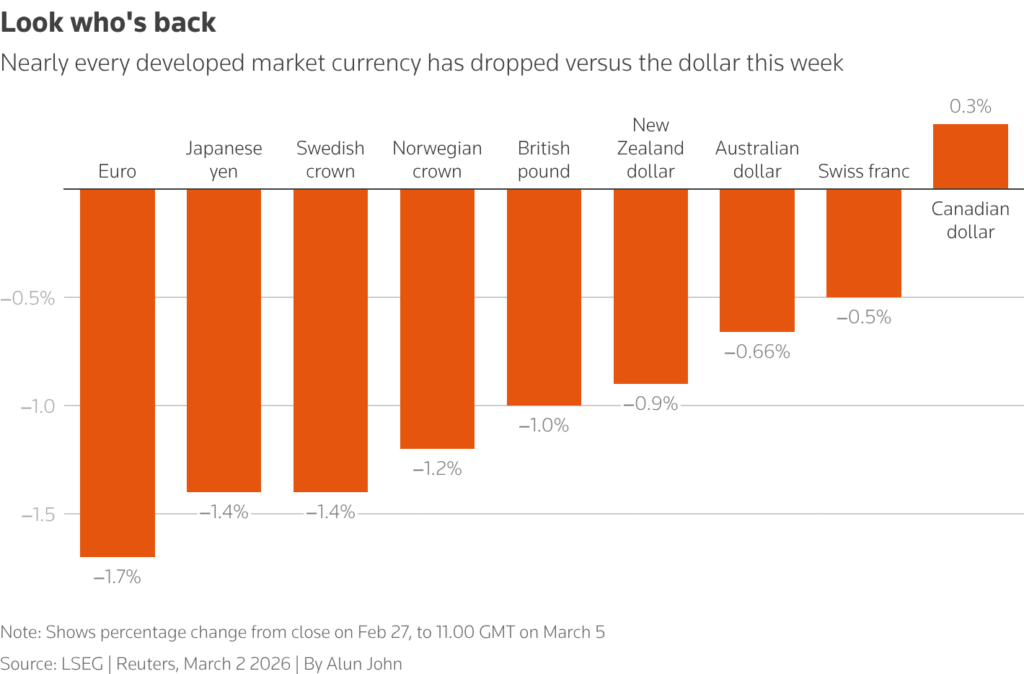
The dollar has arguably been the best performer among safe havens this week.
The dollar index, which tracks the US currency against six major peers, is up 1.5%. Notably, the dollar has gained even against the Swiss franc and Japanese yen—currencies that typically outperform during market stress.
This strength is particularly significant given that the dollar weakened when stocks fell during last April’s tariff turmoil, raising questions about its safe-haven status. Flow data suggests it’s short-term dollar cash in demand, not necessarily other dollar assets.
“The dollar has some safe-haven characteristics, but it is context specific,” said James Lord, head of FX strategy at Morgan Stanley. He cautioned that US policy uncertainty has eroded some of the currency’s defensive qualities, meaning this outperformance won’t always be the case.
A key contextual factor: the US is a net energy exporter, so a crisis that sends benchmark Brent crude above $80 a barrel provides a structural tailwind.
No Safety in Sovereigns
Government bonds have struggled to attract the kind of safe-haven flows typically seen during geopolitical shocks. Investors are trading them primarily on the inflation outlook rather than their defensive qualities.
Fiscal considerations—such as Germany’s relaxation of its debt brake and broader worries about heavy government borrowing—have outweighed haven appeal. Yields on Germany’s 10-year Bunds, the euro zone benchmark, have jumped 14 basis points this week.
“Germany is a flight-to-quality kind of investment, but you don’t really want to be playing around at the long end of the bull market if they’re raising more debt,” said Bryn Jones, head of fixed income at Rathbones.
Gold’s Safe-Haven Credibility Solid
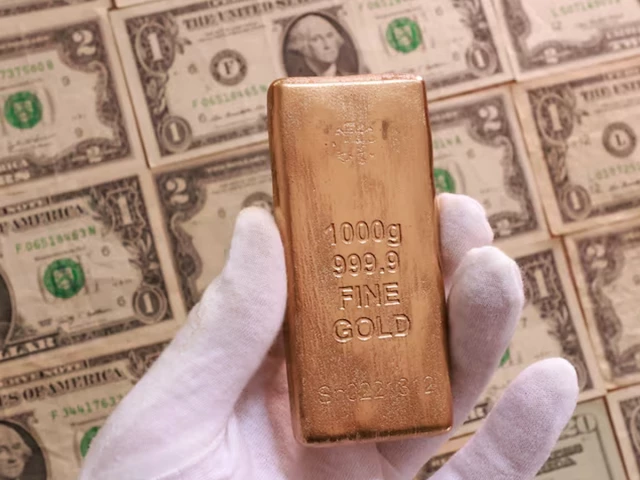
Gold’s safe-haven credentials remain strong, judging by its 240% surge so far this decade. Yes, it’s proving volatile—falling sharply on Tuesday. Analysts attribute that to investors selling top-performing assets to cover losses elsewhere as Middle East concerns whacked market sentiment.
But this shouldn’t detract from gold’s status, given persistent worries about inflation, geopolitics, and high debt levels.
State Street notes that gold remains under-owned in portfolio terms, with gold ETF allocations still under 1% of global fund assets—far below the 5–10% range it cites as a strategic allocation.
“As a base case, $6,000 is more likely than $4,000 this year, and we’re just above $5,000,” said Aakash Doshi, head of gold strategy at State Street Investment Management. “That’s a clear point to make.”
Classic Currency Refuges Tested
The Swiss franc and Japanese yen, long regarded as currency havens, have slipped 1.2% and 0.8% respectively this week.
“The one that looks relatively attractive from a valuation perspective is still probably the Japanese yen,” said Justin Onuekwusi, chief investment officer at St James’s Place. “It stands out to me as one that can provide protection in this environment.”
However, political uncertainty has added risk to the yen’s outlook after reports that Japanese Prime Minister Sanae Takaichi has voiced reservations about further rate hikes.
Meanwhile, the franc’s upside may be constrained by the Swiss National Bank’s warning that it stands ready to intervene to curb excessive strength.
“Elevated SNB intervention risks would likely diminish its haven attributes during the current shock,” said Teresa Alves, strategist at Goldman Sachs.
Defensive Stocks Aren’t Helping
Stocks often perform poorly during market stress, though defensive sectors like utilities or consumer staples typically see smaller declines. That hasn’t happened this time.
- S&P 500 utilities: down 1% this week
- S&P 500 consumer staples: down 2.8%
- European utilities: down 3%
- European consumer staples: down 4.5%
This is partly because they’d already been performing well. Until the war began, a major investment theme was buying “hard assets” like infrastructure and industrials.
“When you’re investing in the classically defensive sectors at the level of current interest rates, you have to be much more disciplined about relative prices,” said James Bristow, portfolio manager at Templeton Global Investments.
He offered a practical example: “I own shares in Pepsi… it isn’t the highest quality company, but the starting point was very low. That’s a different margin of safety from if you’re buying shares in, say, Nestle.”
The Bottom Line
In a crisis where traditional relationships are breaking down, investors face a complex calculus. The dollar is surprising to the upside, gold’s long-term story remains intact, bonds are failing their safe-haven test, and defensive stocks are proving anything but defensive. The only certainty is uncertainty.