
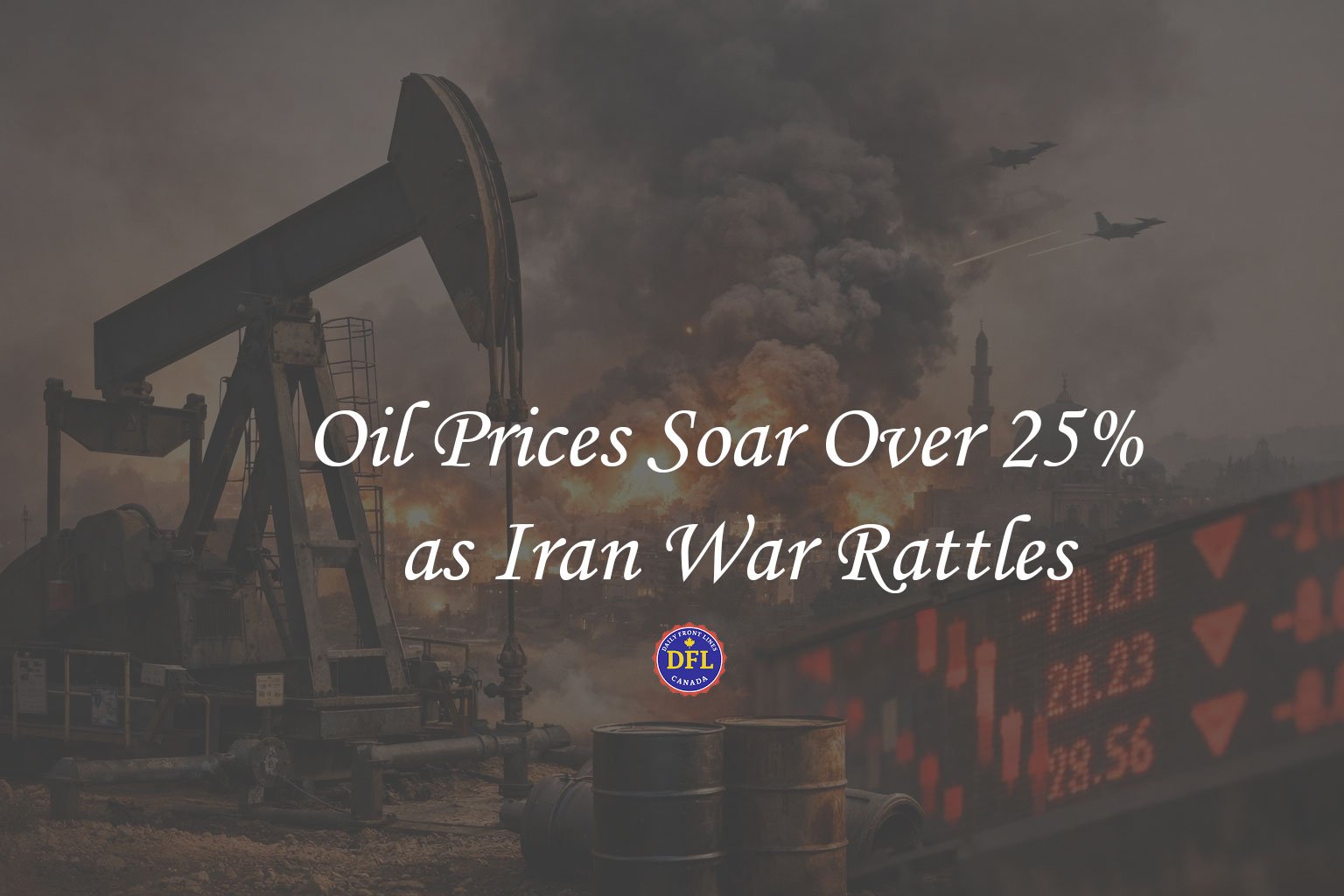
Singapore/London – Global oil prices experienced a historic surge on Monday, soaring more than 25% to their highest levels since mid-2022, as the expanding war between the US-Israeli alliance and Iran rattled energy markets and choked off supply through the world’s most critical oil artery.
The crisis, unfolding around the Strait of Hormuz, through which roughly one-fifth of the world’s oil supply normally passes, has triggered supply cuts from major producers and left Asian buyers—heavily reliant on Middle Eastern crude—particularly vulnerable.
Unprecedented Spike
Brent crude futures were up $24.96 (27%) at $117.65 per barrel, while US West Texas Intermediate (WTI) crude futures climbed $25.72 (28.3%) to $116.62. Both benchmarks are on track for the biggest-ever jumps in a single trading day. Earlier in the session, WTI hit a high of $119.48, and Brent touched $119.50.
This latest surge builds on last week’s dramatic gains, where Brent had already climbed 27% and WTI 35.6%.
“Unless oil flows through the Strait of Hormuz resumes soon and regional tensions ease, upward pressure on prices is likely to persist,” said Vasu Menon, managing director for investment strategy at OCBC in Singapore.
Supply Chains Fracture
The physical impact of the war is now being felt in production hubs. Iraq and Kuwait have begun cutting oil output, adding to earlier liquefied natural gas reductions from Qatar.
Iraqi production from its main southern oilfields has fallen by 70% to just 1.3 million barrels per day as the country is unable to export oil via the Strait of Hormuz. Crude storage has reached maximum capacity, an official with the state-run Basra Oil Company confirmed.
Kuwait Petroleum Corporation began cutting output on Saturday and declared force majeure on shipments, without specifying the amount of production shut in.
Analysts expect the United Arab Emirates and Saudi Arabia will also have to cut output soon as they run out of oil storage capacity. Iran’s attacks on regional infrastructure continue, with debris from an interception sparking a fire in the UAE’s Fujairah oil industry zone and Saudi Arabia intercepting a drone heading to the Shaybah oilfield.
The Khamenei Factor
Adding to the bullish sentiment is the political news from Tehran. The appointment of Mojtaba Khamenei to succeed his father as Iran’s supreme leader signals that hardliners remain firmly in charge, dashing any immediate hopes for a change in Tehran’s strategic posture.
“With the appointment of the late leader’s son as Iran’s new leader, US President Donald Trump’s goal of regime change in Iran has become more difficult,” said Satoru Yoshida, a commodity analyst with Rakuten Securities. “That view accelerated buying, as Iran is expected to continue its closure of the Strait of Hormuz and attacks on other oil-producing nations’ facilities.”
Yoshida predicted WTI could rise to $120 and then $130 a barrel in a relatively short period.
Weeks of High Prices Ahead
Analysts warn that consumers and businesses worldwide face weeks or months of elevated fuel prices, even if the conflict were to end soon. The damage to facilities, disrupted logistics, and elevated shipping risks will take time to unravel.
“The next flag will be whether it eventually gets to a point where they have to start shutting in oil wells, which not only impacts output even further, but it also delays a response once the conflict eases,” said Daniel Hynes, senior commodity strategist at ANZ. “That would potentially sustain those prices for much longer.”
Political Pressure Mounts
As oil prices surge, political pressure is building in Washington. US Senate Democratic Leader Chuck Schumer called on President Trump to release oil from the Strategic Petroleum Reserve (SPR) .
“President Trump should release oil from the SPR now to stabilise markets, bring prices down, and stop the price shock that American families are already feeling thanks to his reckless war,” Schumer said in a statement.
Trump has previously stated that the US Navy could escort ships in the Gulf, but Iran’s Revolutionary Guards have challenged him to do so, saying they “await” any US presence in the strait.