Prime Minister Mark Carney has announced that Canada will keep troops in Latvia through to 2029

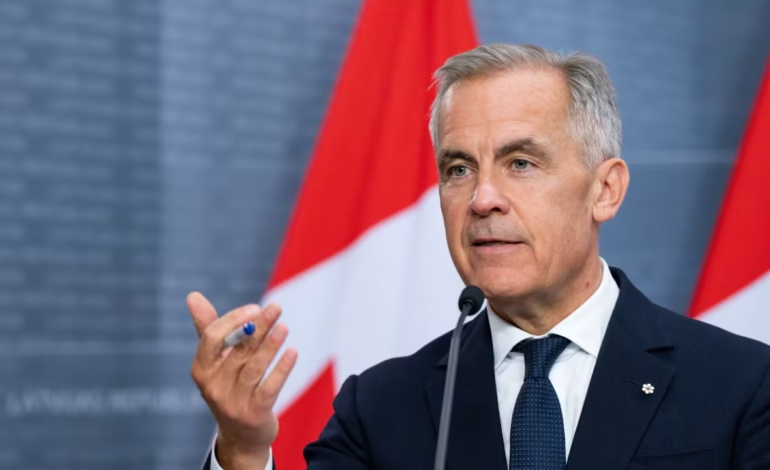
“We must deter and fortify, and that is the way that we can provide true reassurance,” Carney said Tuesday at a news conference in Riga, flanked by Latvian Prime Minister Evika Silina.
Carney’s office said there are now 2,000 Canadian Armed Forces troops in Latvia as part of Operation Reassurance, which is Canada’s largest overseas mission.
Prime Minister Mark Carney has announced that Canada will keep troops in Latvia through to 2029, as part of a mission to deter Russian aggression in Europe that has given Ottawa an outsized role in the transatlantic alliance.
“We must deter and fortify, and that is the way that we can provide true reassurance,” Carney said Tuesday at a news conference in Riga, flanked by Latvian Prime Minister Evika Silina.
Carney’s office said there are now 2,000 Canadian Armed Forces troops in Latvia as part of Operation Reassurance, which is Canada’s largest overseas mission.
Canada is co-ordinating the role of soldiers from roughly 10 countries in Latvia, to shore up the country’s defences and to train Latvian soldiers, according to Carleton University professor Stephen Saideman.
“We’re punching above our weight,” he said in an interview. “We’re basically being treated by the rest of NATO as equal to the U.K. and Germany,” who are co-ordinating similar multinational brigades in Estonia and Lithuania respectively.
Putin ‘afraid’ to meet Zelenskyy: Carney
Earlier Tuesday, Carney said in Berlin that Russian President Vladimir Putin is afraid to sit down with Ukrainian President Volodymyr Zelenskyy, after U.S. President Donald Trump said the two should talk directly about how to end the war.
“We see President Putin putting conditions and conditions, and stalling and stalling, and being afraid of having this
meeting,” Carney said.
Marcus Kolga, a senior fellow with the Macdonald-Laurier Institute, said Canada’s mission in Latvia is a major contribution.
“It’s probably one of the most important international missions that we’ve been engaged in since the liberation of the Netherlands in World War II,” he said.
“It allows them to go on living their lives normally, even though that threat is right at their doorstep,” he said, adding
this applies to Latvians as well as neighbouring Estonians and Lithuanians.
“It demonstrates that Canada is active, and it won’t be pushed around by Vladimir Putin,” he said.
Global Affairs Canada’s profile on Latvia says both countries “share a close relationship grounded in shared fundamental values, such as support for democracy, human rights and the rules-based international order.”
Latvia has deep scars over violence meted out on the population both during the Nazi occupation and during Latvia’s time as part of the Soviet Union.