



China’s top diplomat Wang Yi calls on the US to “manage differences” and return to a path of mutual respect, warning that a “new Cold War” would be a historical regression as tensions escalate over trade and global conflicts.
Beijing – China’s Foreign Minister Wang Yi has issued a stark call for the United States to “manage differences” and return to a path of “mutual respect,” warning that the current trajectory of trade wars and geopolitical confrontation risks plunging the world into a “new Cold War.”
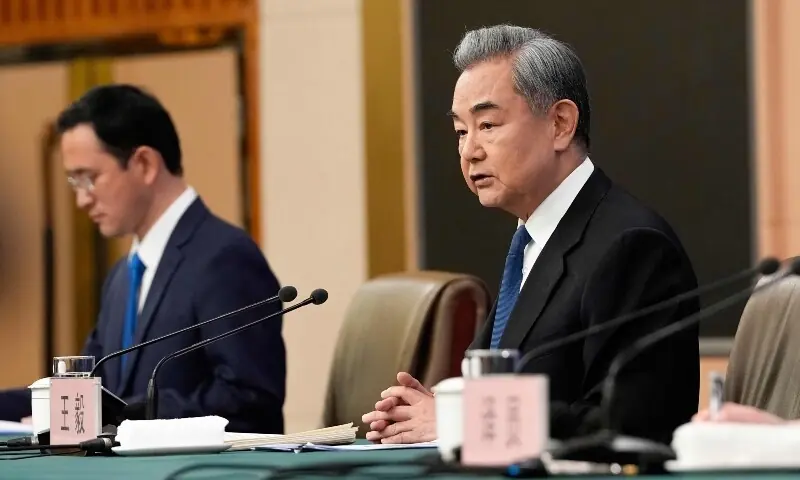
Speaking at a press conference on the sidelines of the National People’s Congress on Friday, Wang Yi outlined Beijing’s vision for global stability, directly addressing the deteriorating relationship with Washington.
“China and the United States stand to gain from cooperation and lose from confrontation,” Wang Yi stated. “We urge the US side to cease suppressing China in the name of competition, to respect China’s core interests, and to work with us to manage differences.”
A ‘Historical Regression’
The Chinese Foreign Minister’s comments come at a time of intense global friction. The US and China remain locked in protracted trade disputes, while simultaneously clashing over a range of issues including technology, human rights, and territorial claims in the South China Sea.
“The attempt to roll back China’s development is a historical regression,” Wang warned. “A ‘new Cold War’ would be a disaster for the entire world. We must not allow the law of the jungle to prevail.”
Wang’s rhetoric sought to position China as a force for stability amidst the chaos of ongoing conflicts, including the war in Ukraine and the escalating crisis in the Middle East.
The Taiwan Question
A central point of contention remains Taiwan. Wang reiterated China’s stance that Taiwan is an inalienable part of its territory and warned against any external interference.
“Taiwan’s return to China is a historical fact,” he asserted. “Any attempt to change that is a violation of international law. We advise the US to abide by the One-China principle and not to play with fire on the Taiwan question.”
Geopolitical Context
Wang Yi’s plea for stability comes as the US and its allies are increasingly coordinating policies to counter China’s growing influence. Simultaneously, Washington is deeply entangled in a widening war in the Middle East, a conflict Beijing has repeatedly called for restraint in.
“We are ready to play a constructive role in promoting peace in the Middle East,” Wang added, subtly contrasting China’s diplomatic approach with US military involvement.
The Foreign Minister concluded by emphasizing China’s commitment to multilateralism and the United Nations, stating that Beijing would “always be a builder of world peace.”