



Tehran – As the Middle East war entered its second week on Saturday, Iran struck a dual tone—issuing an unprecedented apology to neighboring states while its military continued to target US bases across the Gulf, as President Donald Trump warned of further “hard hits” and dismissed Tehran’s overtures as surrender.
Tehran’s Diplomatic Pivot
In a remarkable shift, Iranian President Masoud Pezeshkian issued a personal apology to regional countries affected by Iran’s retaliatory strikes, urging them not to join US-Israeli attacks on the Islamic Republic.
“I personally apologise to neighbouring countries that were affected by Iran’s actions,” Pezeshkian said. He announced that Iran’s temporary leadership council had agreed to suspend attacks on nearby states unless strikes on Iran originated from their territory.
The comments caused immediate political ripples in Tehran, prompting his office to clarify that Iran’s military would still respond firmly to attacks from US bases in the region.
Hours later, Iran’s Revolutionary Guards announced drone strikes on a US air combat center at Al Dhafra Air Base near Abu Dhabi and targeted US forces at a base in Bahrain. Blasts were also heard in Doha, a Reuters witness confirmed.
Trump: ‘Hit Very Hard’
President Trump dismissed Iran’s apology as a sign of weakness, declaring that the country would be “hit very hard” on Saturday and warning that the US could widen its attacks to areas and groups not previously designated as targets.
Speaking at an event in Miami, Trump claimed the US had knocked out 42 Iranian navy ships in three days. He reiterated his demand for Iran’s “unconditional surrender,” which Tehran’s leadership has dismissed as “a dream.”
The Toll of War
According to Iran’s UN ambassador Amir Saeid Iravani, US-Israeli attacks have killed at least 1,332 Iranian civilians and wounded thousands. Iranian retaliatory strikes have killed 10 people in Israel, while at least six US service members have been killed.
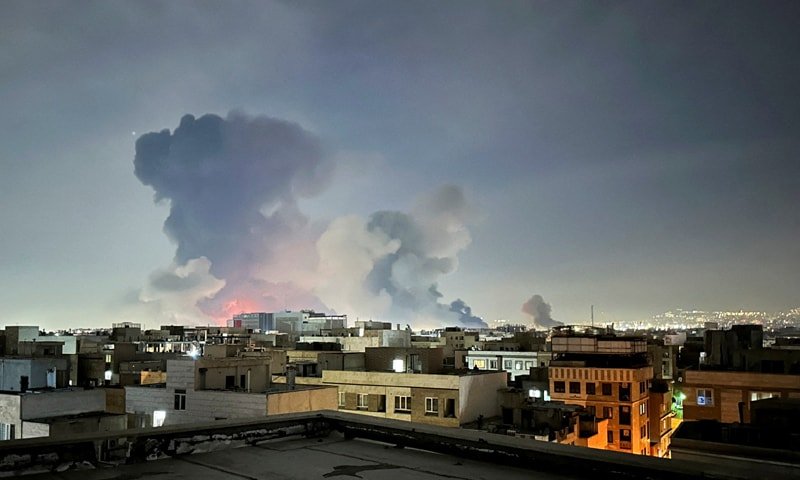
Israel’s military reported conducting approximately 3,400 strikes on Iran since the war began a week ago, dropping roughly 7,500 munitions. On Saturday evening, it announced a new “wave of strikes” in Tehran, targeting Revolutionary Guards aircraft at Mehrabad airport and military sites across the capital and central Iran.
Gulf States Under Fire
Gulf nations have voiced mounting outrage as their civilian infrastructure—hotels, ports, and oil facilities—has been struck.
- UAE: President Mohammed bin Zayed Al Nahyan declared his nation “no easy prey” in his first public comments since the strikes. Air defenses intercepted 15 missiles and 119 drones on Saturday; video footage showed one projectile crashing into Dubai airport.
- Saudi Arabia: Defense Minister Prince Khalid bin Salman urged Iran to “avoid miscalculation.” The kingdom thwarted missile launches at an air base housing US personnel and drone attacks at a major oil field.
- Turkiye: Foreign Minister Hakan Fidan warned Iran against firing more missiles toward Turkish airspace after NATO defenses destroyed an incoming missile. Ankara is considering sending F-16s to Northern Cyprus as a security measure.
Regional Diplomacy
The Arab League will hold an emergency meeting on Sunday to discuss Iranian attacks on member states, the bloc’s assistant secretary-general told AFP.
Turkish President Tayyip Erdogan told British Prime Minister Keir Starmer that there are still opportunities for dialogue on Iran, emphasizing Ankara’s peace-focused efforts.
Iran’s military, meanwhile, called on neighboring Azerbaijan to “expel the Zionists” from its territory to preserve regional security, a day after Baku accused Tehran of plotting attacks.
Intelligence Assessment
A classified report by the US National Intelligence Council, summarized by The Washington Post’s John Hudson, found that even a large-scale assault would be unlikely to oust Iran’s entrenched military and clerical establishment.
“The report says the prospect of Iran’s fragmented opposition taking control of the country is ‘unlikely,'” Hudson wrote, “raising doubts about Trump’s declared plan to ‘clean out’ Iran’s leadership structure and install a ruler of his choosing.”
Global Impact
The war has roiled global markets, with oil prices hitting multi-year highs as the Strait of Hormuz remains effectively shut. About one-fifth of global oil moves daily through the strait.
Iran’s Revolutionary Guards hit a Marshall Islands-flagged tanker in Hormuz on Saturday. Trump has offered US Navy escorts for ships, but Iran’s Guards “welcomed” and said they were “awaiting” any US presence in the strait.
‘Hands Off Iran’ March
In London, thousands of protesters marched through the city calling for an end to US and Israeli strikes. Between 5,000 and 6,000 people turned out for the “Hands Off Iran” march, chanting: “Stop the bombing now, now, now.”