
Quebec reports first case of tick-borne Rocky Mountain spotted fever

Potentially deadly disease already found in Ontario and Quebec this year.
Quebec has reported its first case of the potentially deadly tick-borne disease Rocky Mountain spotted fever. The disease has also been reported in dogs in Ontario.
Here’s what you need to know about preventing, identifying and treating the disease.
What is Rocky Mountain spotted fever?
Rocky Mountain spotted fever is a disease caused by the bacteria Rickettsia ricketssiae. Symptoms in humans can include fever, headache, nausea or vomiting, stomach pain, muscle pain and lack of appetite.
The disease is named for the red rash that develops two to four days after the fever begins.
The disease can be treated with the common antibiotic doxycycline, and most people make a full recovery.
But it can be deadly in five to 10 per cent of cases in the U.S. even with treatment, reports the U.S.-based Cleveland Clinic. Without treatment, one in four people die of the disease.Dogs can also get Rocky Mountain spotted fever.
Dr. Scott Weese, director of the Centre for Public Health and Zoonese at the University of Guelph, said symptoms in dogs include fever, malaise, enlarged lymph nodes, loss of appetite and muscle aches that make the animals reluctant to move. The rash can sometimes be seen inside the dog’s mouth.
As with humans, the disease can be deadly in dogs, and Weese said one of the first dogs identified with the disease in Ontario died of it.
How is it transmitted?
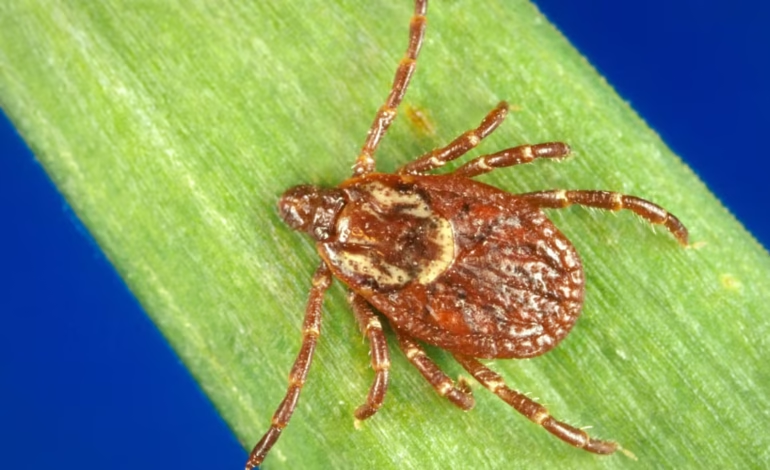
It can’t be transmitted from person to person. It’s only acquired from tick bites — typically the American dog tick (Demacentor variabilis), which is found from eastern Alberta to Nova Scotia, especially in the southern parts of those provinces.

Ticks can also hitch-hike between dogs or from dogs to humans — something Weese thinks happened to him the other day with his own dog at home.
Other ticks that can carry Rocky Mountain spotted fever include the Rocky Mountain wood tick (Dermacentor andersoni) and the brown dog tick (Rhicephalus sanguineus).
Where is the disease found?
The U.S. sees 6,000 cases per year, especially in North Carolina, Tennessee, Missouri, Arkansas and Oklahoma, the Cleveland Clinic reports.
In Canada, the disease was known but rare in B.C., with an incidence of one case per 500,000 people in 2019.
There have been occasional cases of Rocky Mountain spotted fever reported in other parts of the country. A 73-year-old woman was diagnosed with the disease in 2023 after travelling from Saskatchewan to Ontario, and being in contact with her son’s two dogs in Ottawa.
The Ottawa doctors who saw the case said the disease’s expansion north into areas where it hadn’t been seen before was likely linked to milder winters and hotter, drier summers linked to climate change, which allow ticks to expand their range.
Earlier this year, a cluster of cases in dogs was linked to Long Point Provincial Park on Lake Erie in Ontario. Weese said such a large group in a small area was a surprise. “That would suggest that this is quite well-established, at least in some areas.”