


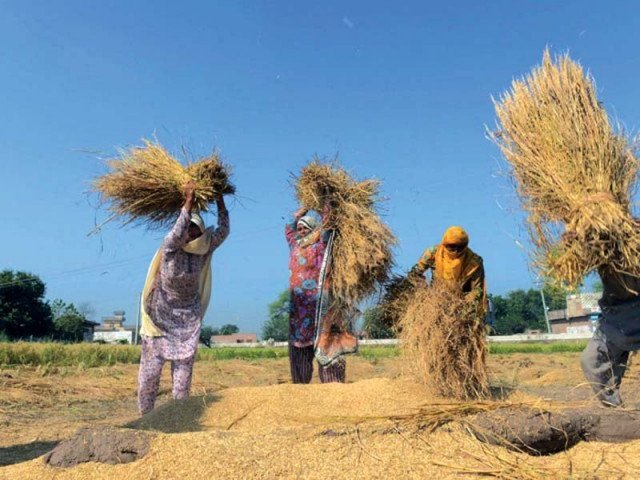
MULTAN: Pakistan’s agriculture sector, often described as the backbone of the national economy, heavily relies on the hard work and dedication of rural women, whose role in farming activities is indispensable.
Leaders of the farming community have asserted that without the participation of women, the country’s agricultural system cannot function effectively.
Pakistan Kissan Ittehad Chairman Khalid Mahmood Khokhar, while speaking in connection with International Women’s Day, said Pakistani women are working shoulder to shoulder with men in almost every field of life, but their contribution to agriculture is particularly remarkable.
He said that in rural areas women could be seen working in fields from early morning till evening, actively participating in various stages of crop production. “From weeding crops to cotton picking and from harvesting wheat to managing vegetables, women perform some of the most labour-intensive tasks in agriculture,” he added.
Khokhar said that the role of women farmers is often overlooked despite their remarkable contribution to strengthening rural economies and ensuring food production. “Without their tireless efforts, sustaining the country’s agriculture sector would be extremely difficult,” he maintained.
He paid rich tribute to women farmers, acknowledging their dedication and resilience in supporting farming families and contributing to the country’s food security.
Farmer Malik Muhammad Arif Kalroo also praised the role of women in agriculture, saying that rural women not only manage household responsibilities but also spend long hours working in the fields.
He observed that women’s labour remained largely under-recognised despite being a key component of agricultural productivity. “If women farmers are provided better facilities, training and access to modern agricultural knowledge, Pakistan can surely enhance its agricultural output,” Kalroo said.
The Invisible Workforce: Quantifying Women’s Contribution
While the statements from these agricultural leaders highlight the undeniable presence of women in Pakistan’s fields, the broader picture reveals a complex reality of underrecognition and untapped potential. According to the Food and Agriculture Organization (FAO), women comprise nearly 50% of the agricultural labor force in developing countries, yet they own only a fraction of the land and receive minimal access to resources, credit, and training.
In Pakistan specifically, the situation is even more pronounced. The Pakistan Bureau of Statistics reports that while only about 25% of women are officially counted in the labor force, agricultural economists estimate that the real figure—particularly when including unpaid family labor and subsistence farming—is significantly higher. Rural women are involved in everything from seed selection and sowing to fertiliser application, weed control, harvesting, and post-harvest processing.
Beyond Field Work: The Triple Burden
What the speeches at this Multan gathering subtly referenced but didn’t fully explore is the concept of the “triple burden” faced by rural women. Farmer Malik Muhammad Arif Kalroo touched upon it when he noted that women “manage household responsibilities” while working long hours in fields, but this reality deserves deeper examination.
A typical day for a rural woman in Pakistan’s agricultural heartland begins before sunrise. She prepares food for the family, collects water if the village lacks piped supply, tends to livestock, and then heads to the fields. After a full day of physically demanding agricultural labor, she returns home to more domestic responsibilities: cooking, cleaning, and caring for children and elderly family members.
This relentless schedule means that women in farming communities often work 15-18 hour days, particularly during peak seasons like wheat harvest or cotton picking. The physical toll is immense, yet this labor remains uncounted in GDP calculations and largely invisible in policy discussions.
Cotton Picking: A Case Study in Gender Disparity
Cotton, one of Pakistan’s crucial cash crops, provides a stark illustration of gender dynamics in agriculture. Women perform the vast majority of cotton picking—a backbreaking task that requires bending for hours under the hot sun, often with no access to clean drinking water or sanitation facilities in the fields.
Yet when the cotton is sold, the income typically goes to male landowners or household heads. Women pickers are frequently paid less than men for the same work, or their labor is categorized as “family help” with no monetary compensation at all.
This disparity extends to decision-making. Despite their intimate knowledge of crops and growing conditions gained through daily contact with plants, women are rarely consulted on what to plant, when to sell, or how to invest farming income.
The Nutritional Guardians
One aspect that agricultural leaders and economists often overlook is women’s role in ensuring household nutrition. In rural Pakistan, women typically manage kitchen gardens, growing vegetables that supplement family diets with essential vitamins and minerals. They make decisions about food storage and preparation that directly impact family health.
When women have access to resources and education, the benefits ripple outward. Studies by organizations like the International Food Policy Research Institute have consistently shown that putting income in women’s hands leads to better nutrition and education outcomes for children. Women invest up to 90% of their earnings back into their families, compared to 30-40% for men.
Barriers to Recognition and Empowerment
Khalid Mahmood Khokhar correctly noted that women’s contributions are “often overlooked,” but understanding why requires examining systemic barriers:
Land Ownership: Despite their labor, women own only about 3% of agricultural land in Pakistan. Land records are almost exclusively in men’s names, and inheritance laws, while theoretically protective of women’s rights, are rarely enforced in rural areas. Without land ownership, women cannot access agricultural credit, government subsidies, or extension services.
Access to Extension Services: Pakistan’s agricultural extension system—designed to train farmers in modern techniques—reaches very few women. Male extension workers typically address male farmers, assuming information will trickle down to women. It rarely does. Consequently, women continue using traditional, less productive methods while men learn about improved seeds, fertilisers, and pest management.
Financial Inclusion: Formal banking remains out of reach for most rural women. Without identification documents, land ownership, or mobility to visit bank branches, women cannot open accounts or access credit. This forces them into informal arrangements with middlemen who charge exorbitant interest rates.
Technology Gap: When agricultural technologies are introduced—whether mechanical harvesters, drip irrigation systems, or solar pumps—men receive training. Women continue with manual methods, widening the productivity gap.
Climate Change: A Gender-Specific Challenge
As climate change intensifies, its impacts are not gender-neutral. Droughts, floods, and changing weather patterns increase women’s vulnerability while adding to their workload. When water sources dry up, women walk farther to collect water. When crops fail, women face increased pressure to find alternative food sources.
Yet women are also at the forefront of climate adaptation. Their traditional knowledge of indigenous seeds, water conservation, and biodiversity preservation represents a valuable resource that Pakistan’s agricultural sector has barely begun to tap.
Policy Solutions: From Rhetoric to Reality
The observations made by Khokhar and Kalroo at the Multan gathering point toward solutions, but these need to be translated into concrete policy actions:
Land Rights Reform: Implementing and enforcing inheritance laws would give women legal standing as farmers, unlocking access to credit, inputs, and government programs.
Gender-Sensitive Extension Services: Training and hiring female extension workers who can interact directly with women farmers, addressing their specific needs and constraints.
Financial Products for Women: Developing banking products tailored to women’s needs, with simplified documentation requirements and mobile banking solutions that overcome mobility constraints.
Labor-Saving Technologies: Promoting technologies that reduce women’s drudgery—from simple tools like improved sickles and weeders to solar-powered water pumps and grain mills.
Recognition in Statistics: Revising labor force surveys to capture unpaid agricultural work, making women’s contributions visible in national accounts.
Climate-Smart Agriculture Training: Ensuring women are included in climate adaptation programs, building on their traditional knowledge while introducing modern techniques.
The Economic Case for Inclusion
Empowering women in agriculture isn’t just about equity—it’s about economics. The FAO estimates that if women farmers had the same access to resources as men, agricultural output in developing countries could increase by 20-30%. For Pakistan, struggling with food security concerns and a widening trade deficit, this isn’t a marginal gain—it’s transformative.
Increased production means more exports, more food security, and more rural employment. It means families with better nutrition, children who stay in school longer, and communities more resilient to shocks.
Beyond International Women’s Day
As the speakers in Multan noted, International Women’s Day provides an opportunity to acknowledge contributions that go unrecognized the rest of the year. But for Pakistan’s women farmers, recognition must translate into action.
The women working in Punjab’s cotton fields, Sindh’s rice paddies, and Balochistan’s orchards are not passive beneficiaries waiting for help. They are active producers, knowledgeable farmers, and resilient economic actors. What they need is not charity but empowerment—access to the resources, information, and decision-making power that will allow them to farm more productively and live with greater dignity.
Khalid Mahmood Khokhar’s assertion that Pakistan’s agriculture sector cannot function without women is not hyperbole—it’s simple truth. The question is whether Pakistan’s policymakers will finally act on that truth, moving from praise to policy, from acknowledgment to action.
The harvest Pakistan needs—of food security, economic growth, and rural prosperity—depends on it.