
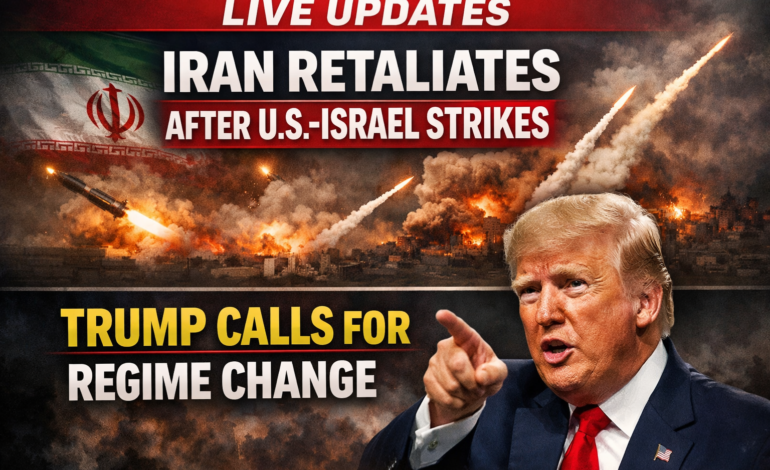
US and Israel Launch Strikes on Iran; Tehran Responds With Missile Attacks Across Region

The United States and Israel carried out coordinated strikes on Iran on Saturday, with powerful explosions reported in Tehran and several other cities. In response, Iran launched waves of missiles and drones targeting Israel and multiple US military bases across the Middle East.
Iran had previously warned that any attack on its territory would trigger retaliation against American military facilities in the region. The country’s Islamic Revolutionary Guard Corps (IRGC) said the operation would continue “until the enemy is decisively defeated,” adding that all US assets in the region are considered legitimate targets.
Strikes Reported Across Tehran and Major Cities
Around 9:27am local time (06:27 GMT), explosions were first reported in Tehran. Witnesses described hearing multiple blasts, and videos circulating online showed smoke rising from different parts of the capital.
Missiles reportedly struck areas near key government institutions and military facilities. Iranian media said sites linked to the Ministry of Intelligence, Ministry of Defence, the Atomic Energy Organization of Iran, and the Parchin military complex were targeted.
Other parts of the capital, including University Street and the Jomhouri district, were also hit. According to local reports, at least two students were killed when a school east of Tehran was struck.
Iran’s National Security Council has advised residents to leave Tehran amid concerns of further escalation.
In the southern city of Minab, an airstrike reportedly hit a girls’ elementary school, killing at least 51 people, according to state media.
Other cities affected by strikes include Isfahan, Kermanshah, Qom, Tabriz, Ilam, Karaj, Lorestan province, Zanjan, Urmia, Bushehr, Damavand, and Shiraz.
Isfahan is considered particularly significant, as it is believed to be a central hub for Iran’s ballistic missile development, with military and nuclear-related facilities in the area.
Iran Retaliates Against Israel and US Bases
Iran responded quickly, launching missiles and drones toward Israel and US military installations in the Gulf region. Many of these projectiles were intercepted by air defense systems.
Israel
At their closest points, Israel and Iran are less than 1,000 kilometers apart. The distance between Tel Aviv and Tehran is roughly 1,600 kilometers.
Israel declared a “special state of emergency” as sirens sounded across northern and central regions, including Tel Aviv and Haifa. The Israeli military confirmed it was intercepting incoming Iranian missiles, urging residents to seek shelter.
In northern Israel, a nine-storey building was damaged after missile interceptions, leaving one man with minor injuries from shrapnel.
Qatar
In Qatar, smoke was seen rising from a residential area near the capital after debris from an intercepted missile fell to the ground. The Ministry of Defense said several attacks were successfully thwarted.
UAE
In the United Arab Emirates, a Pakistani national was killed after being struck by falling missile debris. Authorities said a wave of missiles was intercepted. Explosions were also heard in Dubai, likely caused by air defense activity.
Bahrain
Bahrain reported that a missile attack targeted the headquarters of the US Navy’s Fifth Fleet, which is based in the country.
Kuwait
Kuwait’s Ministry of Defence confirmed that Ali al-Salem Air Base was targeted by ballistic missiles. All incoming threats were intercepted by Kuwaiti air defense systems.
Saudi Arabia
Loud explosions were heard in the capital, Riyadh. Saudi Arabia’s Foreign Ministry issued a statement expressing solidarity with regional partners including Qatar, Jordan, Bahrain, Kuwait, and the UAE.
Iraq and Jordan
In Iraq, air defenses intercepted a drone attack that reportedly targeted Erbil International Airport.
In Jordan, missiles were intercepted over Amman, and burning debris fell near residential areas. No injuries were reported.
US Military Presence in the Middle East
The United States has maintained military bases in the Middle East for decades. According to the Council on Foreign Relations, the US operates military facilities — both permanent and temporary — across at least 19 locations in the region.
Eight of these are permanent bases located in Bahrain, Egypt, Iraq, Jordan, Kuwait, Qatar, Saudi Arabia, and the UAE.
As of mid-2025, an estimated 40,000 to 50,000 US troops are stationed across the region. These bases serve as key hubs for air and naval operations, intelligence gathering, logistics, and rapid military deployment.