

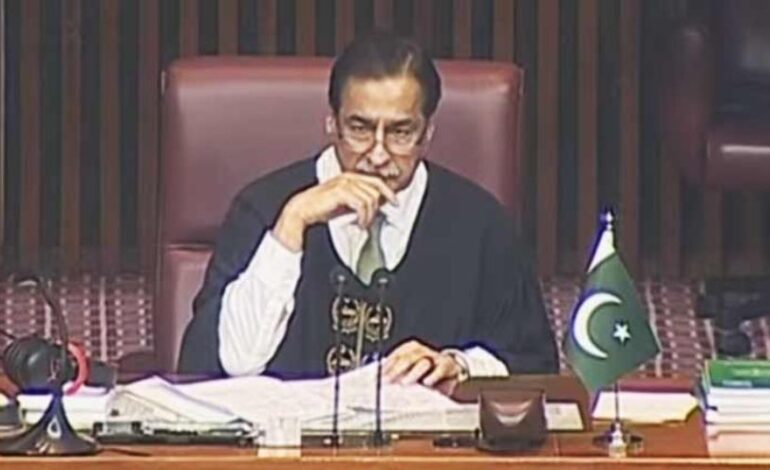
ISLAMABAD (Agencies) The National Assembly on Tuesday approved all 59 clauses of the 27th Constitutional Amendment during a session chaired by Speaker Ayaz Sadiq.
The voting process, conducted clause by clause, marked the completion of the amendment’s passage in the lower house with an overwhelming majority.
Law Minister Azam Nazeer Tarar presented the amendment motion, highlighting that its framework had already been discussed in the Senate. He described constitutional evolution as a continuous process, noting that Justice Yahya Afridi will serve as the Chief Justice of Pakistan under the new provisions.
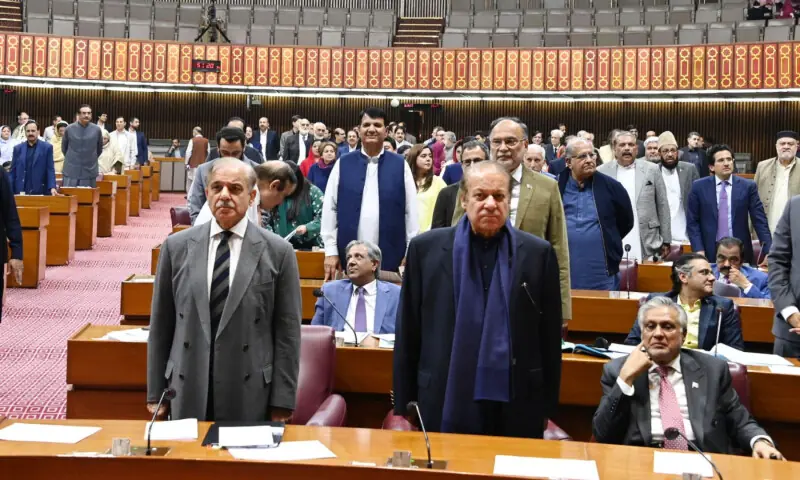
During the clause-by-clause voting, all 59 clauses were approved with 233 votes in favour and only four against. The Jamiat Ulema-e-Islam (JUI) opposed the amendment. A total of 233 government members were present in the House, surpassing the 224 votes required for constitutional approval, ensuring a comfortable passage for the government.
Bilawal condemns spate of terrorist attacks
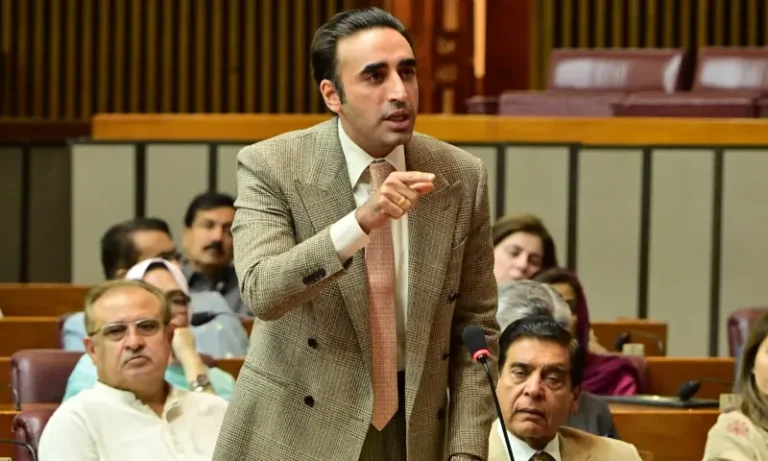
Bilawal addressed the assembly after getting up from his seat to meet PM Shehbaz and Nawaz.
However, the Bhutto scion’s speech was marred by opposition benches and PTI’s sloganeering in favour of party founder Imran Khan. They also carried the incarcerated ex-premier’s photos to the assembly. PTI stalwarts repeatedly disrupted Bilawal’s speech and tore up copies of the bill to express their disapproval.
Unaffected by the commotion, the PPP chief began his address by condemning yesterday’s terrorist attacks in the country.
“I want to remind the elected representatives in this house, whether in opposition or treasury benches, that we can have political and ideological differences, but as far as this country’s security and enemies, and combating these terrorists [is concerned], not only this house but the entire country should unite in facing them.”
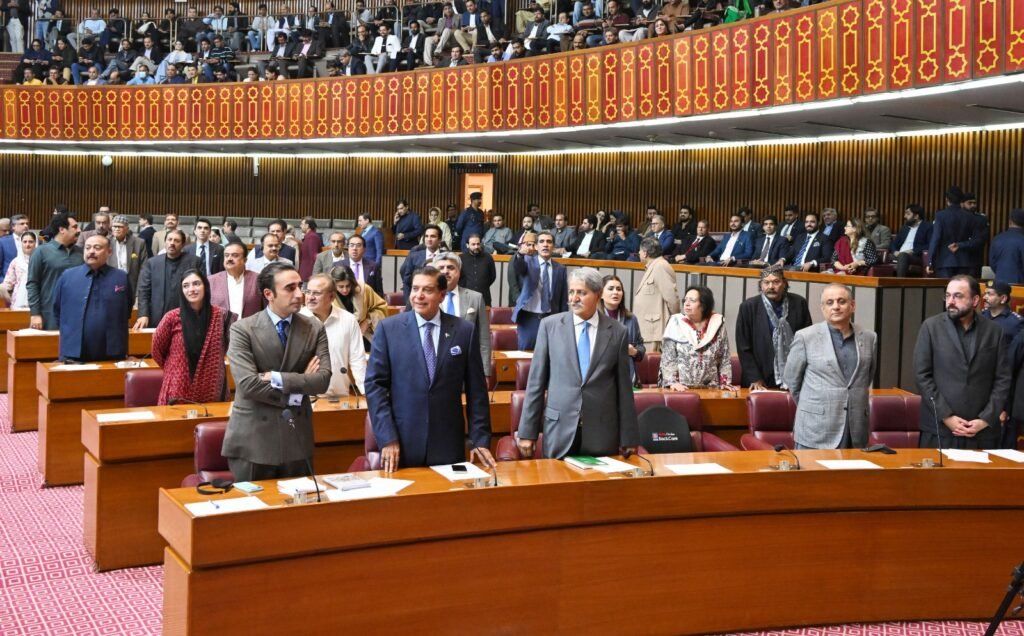
He said terrorism was once again on the rise in the country, but added that Pakistan had managed to defeat the menace before and would do so again.
Coming to the 26th Amendment, he said the PPP had strove to ensure that legislative activity took place with consensus, adding that the party had done the same at the time of the 18th Amendment and the 1973 Constitution.
He pointed out that both the PTI and the Jamiat Ulema-i-Islam Fazl were on board with the decision to form the Supreme Court’s Constitutional Bench, adding that the PTI’s other protestations were also catered to.
“In the 27th Amendment, we are about to fulfil the unfulfilled promises of the Charter of Democracy. We are about to establish constitutional courts and in Article 243 — after defeating India, the prime minister decided to make the army chief the field marshal — not only are we providing constitutional protection to that rank of field marshal, but also bringing some changes to the defence institutions.”
He said that in his opinion, any legislature’s real strength was not in the majority by which it could pass an amendment, but in the consensus that was present, pointing to the consensus that was present at the time of the 1973 Constitution.
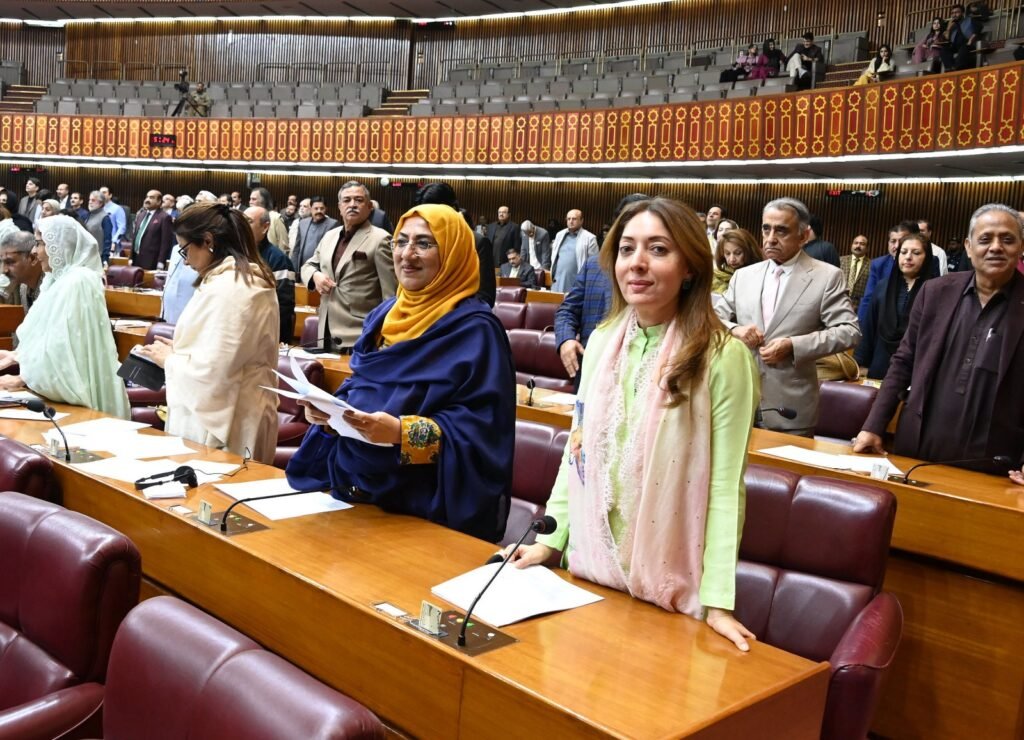
Bilawal further said that no one could roll back the provincial rights enshrined in the 18th Amendment since it too had been achieved after consensus from all major political parties.
“The constitutional amendment we are bringing today, we have the majority, but we could not form that consensus.”
He added that when a government brought a constitutional amendment, it meant that it had consulted with the defence institutions, considered the legal aspects with the courts, judges and lawyers and then brought the changes into the judicial structure.
The PPP chairman recalled that in the party’s central executive committee, it had decided to stand with the government and “fulfil the incomplete mission of the Charter of Democracy”.
He said the party had decided to give constitutional cover to the field marshal after the way he and the military received praise after the May conflict against India.
He added that when a government brought a constitutional amendment, it meant that it had consulted with the defence institutions, considered the legal aspects with the courts, judges and lawyers and then brought the changes into the judicial structure.
The PPP chairman recalled that in the party’s central executive committee, it had decided to stand with the government and “fulfil the incomplete mission of the Charter of Democracy”.
He said the party had decided to give constitutional cover to the field marshal after the way he and the military received praise for their performance after the May conflict against India.
The law minister said that consultation with the legal fraternity showed that there was confusion about the continuity of the chief justice of Pakistan’s position. “To remove this confusion, I will introduce an appropriate amendment in which it will be clarified that the current CJP … will remain the CJP,” he added.
He also mentioned Article 6 of the Constitution, saying that, as per the 18th Amendment, neither the Supreme Court nor any high court could ratify the abrogation of the Constitution.
Now, the law minister said, the constitutional court was also added to the list to remove any confusion.