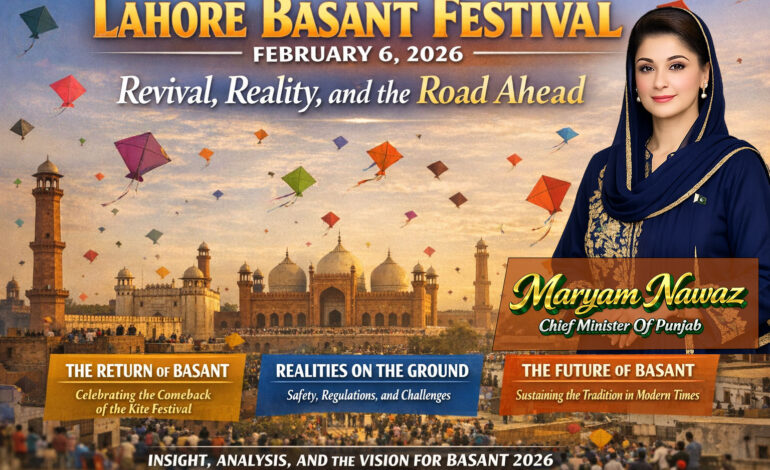
The discussion around the Lahore Basant Festival has once again taken center stage in Pakistan, placing culture, governance, and public safety at the heart of a national debate. With reports and announcements suggesting that Punjab Chief Minister Maryam Nawaz is considering or supporting a limited revival of Basant starting February 6, 2026, the debate has reignited across media, social platforms, and public circles.
- Why was Basant banned in Pakistan?
- What happened to kite makers and why did many move into slums?
- Why is Basant being reopened for only three days?
- Will a limited Basant festival be successful in Lahore?
Lahore Basant Festival 2026: What Is Being Proposed?
According to emerging discussions, the Punjab government is exploring a controlled, time-bound Basant festival in Lahore, potentially limited to three days. The goal is not a full-scale return to the past, but a regulated cultural revival with strict safety measures.
The proposed framework reportedly focuses on:
- Limited festival duration
- Heavy security and monitoring
- Zero tolerance for chemical or glass-coated kite strings
- Defined kite-flying zones
Chief Minister Maryam Nawaz’s cultural agenda emphasizes heritage revival with governance and safety, rather than unregulated celebration. Basant, once Lahore’s cultural identity, fits directly into this vision—if managed responsibly.
Why Was Basant Banned in Pakistan?
Basant was banned primarily due to public safety failures, not because of cultural opposition.
Over time, competitive kite flying turned dangerous. The use of chemical-coated and glass-lined strings caused:
- Fatal injuries to pedestrians and motorcyclists
- Serious accidents involving children
- Widespread power outages due to cut electricity lines
Instead of enforcing strict regulations, authorities opted for a complete ban, considering it the fastest way to control rising casualties. Unfortunately, this decision addressed the symptoms but not the system, resulting in the loss of an entire cultural festival.
From Rooftops to Slums: What Happened to Kite Makers?
One of the most overlooked consequences of the Basant ban was its economic and social impact.
Thousands of families in Lahore and surrounding areas depended on Basant-related industries:
- Kite manufacturing
- String (dor) production
- Dyeing and paper work
- Small-scale vendors and seasonal labor
When Basant ended, these workers lost their only source of income. With no alternative skills, social protection, or government rehabilitation programs, many were forced to migrate to urban slums, surviving through informal labor or daily wages.
For them, Basant was not entertainment—it was survival.
Why Only Three Days?
The proposal to allow Basant for just three days is a strategic decision.
Authorities aim to:
- Test law enforcement readiness
- Monitor public behavior
- Measure safety compliance
- Control scale and risk
A limited duration allows the government to evaluate whether Basant can exist without repeating past mistakes. If successful, future editions could be expanded under stricter frameworks.
Will the 3-Day Basant Festival Be Successful in Lahore?
The success of a limited Basant festival depends on three major factors:
1. Enforcement
Rules must be applied equally. Any compromise on illegal strings or unsafe practices could immediately undermine the experiment.
2. Public Responsibility
Cultural revival requires social maturity. Without public cooperation, even the strongest policies will fail.
3. Economic Inclusion
If the revival benefits only large event organizers while excluding traditional kite makers, it will lose cultural authenticity. Sustainable success requires rehabilitating affected workers.
If these conditions are met, a three-day Basant could prove that culture and safety can coexist in Lahore.
Opportunity or Risk?
Basant’s limited return is both an opportunity and a test.
It offers:
- Cultural revival
- Tourism growth
- Economic activity
- Positive global image
But it also carries risks if mismanaged.
The real question is not whether Basant should return—but whether Pakistan is ready to manage its traditions responsibly.
Conclusion: A Cultural Test for Lahore
- Widespread power outages due to cut electricity lines
Instead of enforcing strict regulations, authorities opted for a complete ban, considering it the fastest way to control rising casualties. Unfortunately, this decision addressed the symptoms but not the system, resulting in the loss of an entire cultural festival.
From Rooftops to Slums: What Happened to Kite Makers?
One of the most overlooked consequences of the Basant ban was its economic and social impact.
Thousands of families in Lahore and surrounding areas depended on Basant-related industries:
- Kite manufacturing
- String (dor) production
- Dyeing and paper work
- Small-scale vendors and seasonal labor
When Basant ended, these workers lost their only source of income. With no alternative skills, social protection, or government rehabilitation programs, many were forced to migrate to urban slums, surviving through informal labor or daily wages.
For them, Basant was not entertainment—it was survival.
A Cultural Test for Lahore
The proposed Lahore Basant Festival in February 2026 represents more than a celebration. It is a policy experiment, a cultural test, and a social responsibility.
If handled with regulation, inclusion, and discipline, Basant can once again become a symbol of Lahore’s vibrant spirit—without costing lives.
Culture should never be buried. It should be reformed, protected, and passed on—safely.