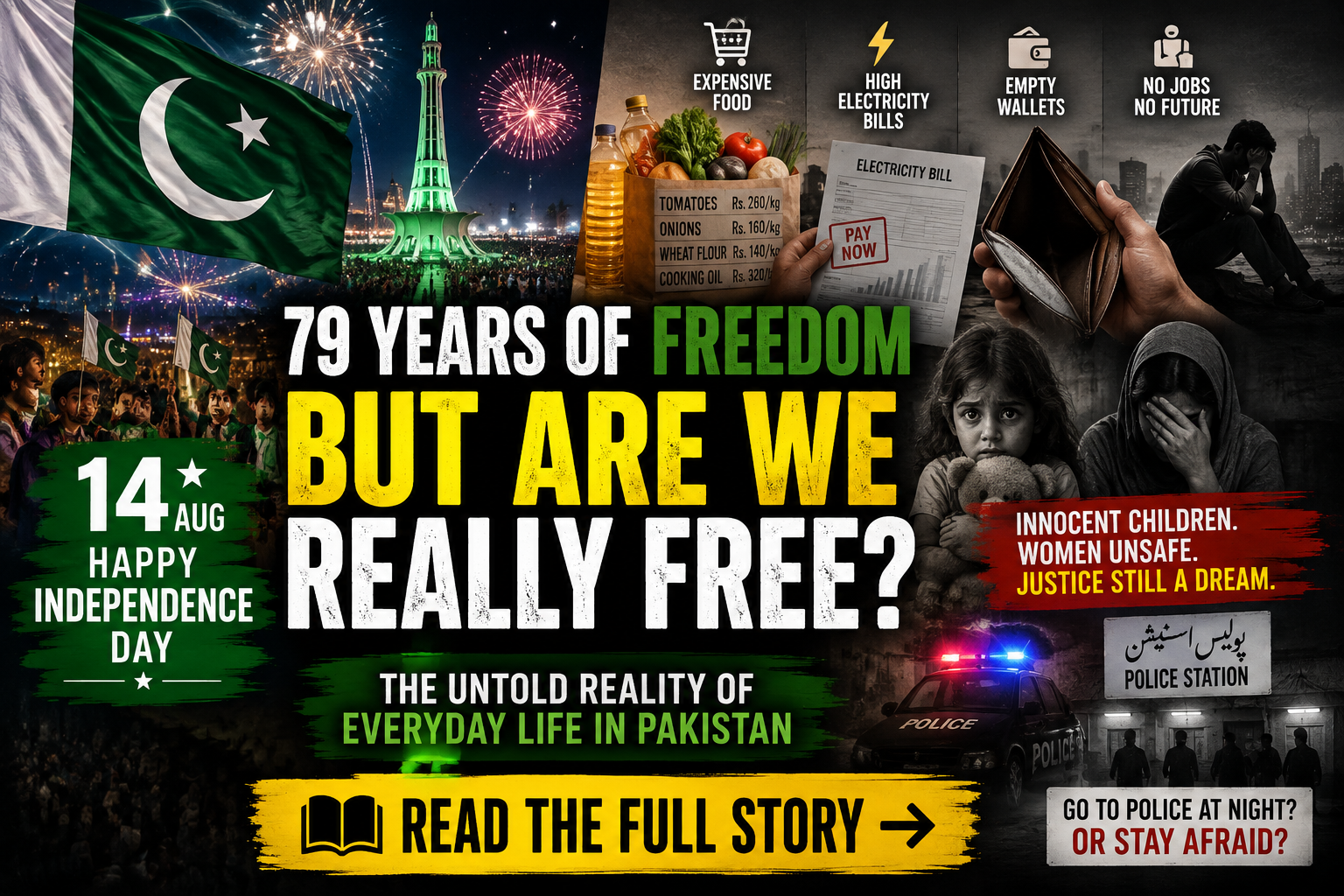
Every year, when August 14 arrives, Pakistan changes its appearance.
Green and white flags appear on buildings, roads and rooftops. Children wear national colours, motorcycles are decorated with flags, television channels broadcast special Independence Day programmes, and social media fills with messages celebrating the country. For one day, the streets seem to carry a shared sense of pride and belonging.
And there is every reason to celebrate Pakistan.
The creation of Pakistan in 1947 was accompanied by enormous sacrifice. Millions of people left their homes, families were separated, lives were lost and an entire generation went through one of the most difficult migrations in modern history. The country that emerged from that struggle became home to generations of Pakistanis who have continued to build, work, sacrifice and dream here.
But 79 years later, Independence Day also gives us an opportunity to ask what independence means in the everyday lives of ordinary citizens.
Because there are two very different pictures of Pakistan today.
There is the Pakistan we see on August 14: colourful, patriotic, hopeful and proud.
And then there is the Pakistan people experience on August 15, when the flags remain on the rooftops but the electricity bill arrives, petrol has to be purchased, groceries have to be bought, school fees have to be paid and people return to worrying about jobs, security and the future.
The second Pakistan deserves to be discussed too.
Not because the country should not be celebrated, but because loving Pakistan should not require pretending that everything is fine.
The Meaning of Freedom Has Changed for Ordinary Pakistanis
When we talk about independence, we usually talk about sovereignty, borders, national identity and the freedom to govern ourselves. These are fundamental parts of independence.
But for an ordinary Pakistani family, freedom is also much more personal.
It means being able to earn enough to support the family. It means being able to afford food without constantly calculating what can be removed from the shopping list. It means being able to pay an electricity bill without borrowing money. It means knowing that your children can travel to school or college safely. It means having confidence that if something goes wrong, the police and courts will protect you.
That is where the conversation becomes uncomfortable.
Pakistan is politically independent, but many people feel financially trapped. They have a home, but they are struggling to maintain it. They have qualifications, but they cannot find the opportunities they expected. They have legal rights, but they sometimes feel powerless when dealing with institutions.
For many people, independence is no longer simply about the country having its own government. It is about whether an individual can live with dignity inside that country.
And this is perhaps one of the biggest questions Pakistan faces at 79.
The Grocery Bill Has Become a Measure of How People Feel About the Economy
One of the easiest ways to understand the economic pressure on Pakistanis is to stand in a grocery shop.
The conversation is rarely about economic growth or fiscal reforms. It is much simpler.
How much is flour today?
What is the price of cooking oil?
Can we buy chicken?
How much are vegetables?
What happened to the price of tomatoes?
Should we buy branded milk or a cheaper alternative?
For a family living on a fixed income, these questions are not minor details. They determine what the family eats.
Pakistan’s latest inflation data show why this concern remains so strong. Consumer inflation was 9.2 percent year-on-year in July 2026, while food and non-alcoholic beverages were still recording 10.6 percent annual inflation. Some food prices had increased dramatically compared with the previous year, including wheat, wheat flour, onions and tomatoes.
It is important to understand what this means.
When inflation falls from a higher level to a lower level, it does not mean prices go back to what they were before. It simply means prices are increasing more slowly.
That distinction may be clear in an economic report, but it is not always clear to a family.
If a product that became unaffordable last year becomes slightly more expensive this year instead of dramatically more expensive, the family is still dealing with the higher price.
This is why many Pakistanis continue to feel that the economy is difficult even when official inflation indicators improve.
The problem is not simply the rate at which prices are increasing.
The problem is the level those prices have already reached.
Petrol Is Not Just About the Price at the Pump
Petrol is another example of how one price can affect almost everything else.
When fuel becomes expensive, the impact does not stop at the petrol station.
Transport becomes more expensive. Delivery costs increase. Goods travelling from farms and factories to markets cost more to move. Businesses have higher operating expenses. Workers who commute every day spend more on transportation.
Eventually, the consumer feels the effect in the price of everyday products.
This is why a Pakistani family may never purchase a barrel of oil or import fuel directly, yet still feel the international energy market in the price of bread, vegetables, transport and almost everything else.
For a motorcycle rider travelling to work every day, petrol is a daily expense.
For a small shopkeeper, it can affect deliveries.
For a farmer, fuel affects machinery and transportation.
For a business, it can affect logistics.
And for a family already struggling with food and electricity costs, another increase creates another difficult decision.
This is how inflation becomes more than an economic statistic. It becomes part of everyday life.
Electricity Has Become a Monthly Test of Household Survival
Then there is the electricity bill.
Few things create as much anxiety in a Pakistani household as receiving a bill that is significantly higher than expected.
The problem is particularly difficult during the summer months, when temperatures make air conditioning, fans, refrigerators and water pumps difficult to avoid. Families cannot simply stop using electricity when temperatures become unbearable, but using more electricity can also mean a much larger bill.
For wealthy households, a high electricity bill is an inconvenience.
For a lower-income or middle-class family, it can completely disrupt the monthly budget.
A person may have planned their salary around rent, food, education and transportation. Then the electricity bill arrives and suddenly something has to be sacrificed.
Perhaps the school fee is delayed.
Perhaps the grocery budget is reduced.
Perhaps a loan is taken.
Perhaps the family borrows from relatives.
This is why economic policy cannot be judged only from government announcements.
People ultimately experience the economy inside their homes.
A government may talk about tariff adjustments, reforms and relief packages. The citizen sees one number at the bottom of the bill.
Amount payable.
And that number can determine whether the month ends peacefully or with another financial crisis.
Why Are So Many Pakistanis Thinking About Leaving the Country?
One of the strongest signs of economic and social pressure is the desire among Pakistanis to look for opportunities abroad.
For decades, Pakistanis have travelled overseas for employment. Migration itself is not new. People have always gone abroad to work, study or build businesses.
What has changed is the scale and the emotional meaning attached to that decision.
For many young people today, going abroad is no longer simply an adventure.
It is viewed as an escape from uncertainty.
The latest official figures are revealing. Pakistan’s Economic Survey says the Bureau of Emigration and Overseas Employment registered 762,499 workers for overseas employment during 2025. More than 530,000 went to Saudi Arabia alone. The government says more than 15 million Pakistanis have proceeded abroad for employment through official channels since the programme began in the 1970s.
And the trend has continued.
During the first five months of 2026, 278,563 Pakistani workers registered for overseas employment, with labourers and drivers making up a large majority of registrations.
These numbers should make us pause.
Why does a country with so many educated, talented and hardworking people continue to send such a large number of workers abroad?
There is no single answer.
Some people leave because salaries abroad are higher.
Some want better professional opportunities.
Some want international experience.
Some want to send money back to their families.
But for others, the motivation is much more basic.
They simply want a more predictable future.
A young engineer may believe that his qualification is worth more somewhere else.
A doctor may look abroad because of better professional opportunities.
A skilled technician may see a Gulf job as a way to earn in a few years what might take much longer to earn at home.
A labourer may leave because his family depends on the income he can earn abroad.
This is not necessarily a rejection of Pakistan.
In many cases, it is a reflection of the economic choices available to people.
The Hidden Cost of Migration
There is another side to migration that is rarely discussed.
When a father leaves Pakistan for Saudi Arabia, Qatar, the UAE or another country, his family may gain financially, but it also loses his daily presence.
When a son leaves his elderly parents behind, the parents may receive money but lose companionship.
When an entire family moves abroad, grandparents may remain in Pakistan.
When educated young people leave, the country loses part of its skilled workforce.
Migration can therefore be both a solution for the individual and a challenge for the country.
Pakistan benefits enormously from overseas workers and remittances. The government reported around $40 billion in remittances during 2025.
But there is an uncomfortable question hidden inside that success.
What if the people who are helping Pakistan financially are leaving because they do not see enough opportunity to build their lives here?
Remittances are valuable.
Overseas Pakistanis are valuable.
But a healthy economy should also be capable of giving its citizens reasons to stay.
What About the Older Generation?
The economic crisis is particularly painful for older Pakistanis.
A young person can at least consider changing jobs, learning a new skill, starting a business or moving abroad.
An elderly person does not always have those options.
For someone who has spent decades working, retirement is supposed to be a period of stability.
Instead, many older people face rising medical expenses, household costs, electricity bills and dependence on family members.
The government’s own economic survey records old-age pension payments through EOBI, but the existence of a pension system does not automatically mean every elderly Pakistani has adequate financial protection.
An elderly parent who spent 30 or 40 years contributing to a family or society may eventually find himself depending on his children.
And what happens when those children are themselves struggling?
This creates a difficult cycle.
The son is trying to support his own children.
The daughter is managing her own household.
The elderly parents need medicines.
The electricity bill has arrived.
The grocery prices have increased.
Everyone loves their parents.
But love does not pay medical bills.
This is where social protection becomes more than a government programme. It becomes a question of dignity.
A country should not make its elderly citizens feel that growing old is a financial burden.
The Fear That Has Nothing to Do With Money
Even if Pakistan solved its inflation problem tomorrow, another major concern would remain: safety.
Parents worry about their children.
Women worry about harassment and sexual violence.
Families worry about kidnapping and murder.
Citizens worry about whether justice will actually be delivered when something goes wrong.
The numbers concerning children are particularly disturbing.
According to Sahil’s 2025 report, 3,630 child-abuse cases were reported across Pakistan, an 8 percent increase over the previous year. The cases included 522 reported rapes, 1,107 abductions, 596 cases of sodomy and 365 missing-child cases. The report also recorded 58 cases in which children were murdered after sexual abuse.
These numbers should not simply become another annual report.
They should force a national conversation about prevention.
What happens inside schools?
What happens inside homes?
How are children taught to recognise dangerous behaviour?
How quickly are complaints investigated?
How effectively are perpetrators prosecuted?
And how are victims protected after they report abuse?
A society cannot consider itself truly secure if parents are constantly afraid of what might happen to their children.
The Eshal Fatima Case Shows Why People Demand Answers
The case of 17-year-old Eshal Fatima in Jhang became a major source of public anger and discussion in 2026.
According to reports, Eshal, an 11th-grade student, was found in critical condition after disappearing and later died at DHQ Hospital in Jhang. Police pursued the case and arrested suspects, while public pressure for answers grew.
But the case also demonstrates another problem in Pakistan: the speed with which social-media claims can become accepted as fact.
Initial reports and social-media discussion included allegations of sexual assault and severe torture. However, the preliminary post-mortem reported no evidence of sexual assault or physical violence, and samples were sent for further forensic analysis to establish the cause of death.
That does not mean the case should be forgotten.
Quite the opposite.
It means the investigation should be allowed to reach the truth.
If someone committed a crime, that person should face justice.
If there was negligence, those responsible should be held accountable.
But the public deserves evidence rather than rumours.
A family that loses a 17-year-old daughter deserves something more permanent than a hashtag.
They deserve answers.
When the Police Station Itself Becomes a Question
Perhaps one of the most troubling issues facing public confidence is what happens when allegations of abuse involve the institutions that are supposed to protect citizens.
In August 2026, authorities suspended all 78 officers and staff members of Lahore’s Ghaziabad police station after an assistant sub-inspector was accused of raping a 20-year-old woman with learning disabilities inside the station. The accused officer was arrested and an investigation was launched.
The case is an allegation that must be decided through investigation and the courts.
But the wider issue is undeniable.
A police station should be one of the safest places a victim can approach.
If someone has been assaulted, threatened or harmed, the police station is supposed to be where protection begins.
That is why allegations of abuse inside a police station create such a powerful sense of betrayal.
It makes citizens ask whether the institution they are supposed to trust can always be trusted.
And this is where the conversation about reporting crimes at night also needs to be handled honestly.
There is no blanket legal rule saying that an FIR simply cannot be registered after sunset. Punjab Police itself provides mechanisms for complaints relating to non-registration of FIRs and police negligence.
But if victims believe they will be discouraged, delayed or told to return later, the practical problem remains.
A woman who has just been assaulted does not experience the justice system as a legal textbook.
She experiences it as a frightened human being standing in front of an institution.
Does she feel safe enough to ask for help?
That is the question.
Mir Raza Ali and the Fear of Going Out and Not Coming Back
The murder of 25-year-old Karachi businessman Mir Raza Ali is another example of how quickly an ordinary night can become a family’s worst nightmare.
According to the FIR and reporting on the case, Raza returned home after visiting his business and later left again, telling his family he would return within minutes. His body was subsequently found in Gulistan-e-Johar. Police continued investigating the circumstances of his abduction and murder.
For most people, saying “I will be back in ten minutes” is completely ordinary.
Nobody expects it to become the last sentence their family hears.
That is why crime changes the way societies live.
People begin checking their children’s locations.
Parents call repeatedly if a son is late.
Families become nervous about travelling at night.
Businesses close earlier.
People avoid certain roads.
The country may continue functioning, but fear quietly changes people’s behaviour.
And fear is one of the most difficult costs for a society to measure.
Social Media Gives Us Outrage, But Does It Give Us Justice?
Pakistan has become extremely active on social media.
Whenever a rape, murder, child-abuse case or police scandal emerges, the reaction can be immediate.
People post.
Journalists report.
Influencers speak.
Hashtags trend.
Thousands of users demand punishment.
Sometimes this pressure is important. Social media has helped bring attention to cases that might otherwise have received little public attention.
But the problem begins when the social-media cycle ends.
A tragedy trends for two days.
Then another tragedy takes its place.
The previous victim disappears from public discussion.
This creates a pattern in which society becomes very good at reacting, but not necessarily as good at following up.
Where is the final investigation?
Where is the prosecution?
Where is the verdict?
Where is the institutional reform?
Where is the report six months later?
This is why public anger needs to become sustained civic pressure.
Otherwise, the cycle simply repeats.
The Government Cannot Be Responsible for Everything—But It Is Responsible for Systems
It would be unfair to blame the government for every crime committed by an individual.
No government can prevent every criminal act.
But governments are responsible for institutions.
They are responsible for policing systems.
They are responsible for justice infrastructure.
They are responsible for economic policy.
They are responsible for social protection.
They are responsible for creating conditions in which businesses can grow and people can find work.
And they are responsible for making sure that citizens have somewhere to turn when things go wrong.
This is why Independence Day should also be a day when citizens ask their governments difficult but legitimate questions.
Is economic growth reaching households?
Are electricity costs becoming manageable?
Are young people finding meaningful employment?
Are children safer?
Are women safer?
Are police investigations improving?
Are cases being prosecuted successfully?
Are elderly citizens receiving enough support?
These questions are not an attack on Pakistan.
They are questions about how Pakistan can improve.
Why Are People Losing Hope?
Perhaps the biggest problem is not any single issue.
It is the accumulation of problems.
A person can tolerate one difficult year.
They can tolerate one expensive bill.
They can tolerate a temporary job problem.
They can tolerate a bad political period.
But when problems accumulate year after year, something changes psychologically.
People stop expecting improvement.
They begin thinking about leaving.
They start looking for opportunities abroad.
They stop believing that their children will necessarily have a better life than they did.
That is when an economic problem becomes a national problem.
A country does not lose people only when they physically leave.
It can also lose them emotionally when they stop believing that their future belongs there.
The fact that hundreds of thousands of Pakistanis continue registering for overseas employment shows the scale of this outward movement. In 2025 alone, 762,499 workers were registered for overseas employment, while the first five months of 2026 added another 278,563 registrations.
These people are not all leaving for the same reason.
But their decisions should make policymakers think.
Pakistan Does Not Need a Perfect Image. It Needs a Better Reality.
There is nothing wrong with showing the world a positive image of Pakistan.
Pakistan has extraordinary talent.
Its people are resilient.
Its entrepreneurs are building companies.
Its doctors and engineers work around the world.
Its students continue to compete internationally.
Its workers support families at home through overseas employment.
Its citizens repeatedly come together during floods, earthquakes, accidents and other disasters.
The country has enormous potential.
But potential is not the same thing as progress.
And patriotism should not require us to hide the distance between the two.
We should be able to say that Pakistan is worth loving while also saying that Pakistan needs better governance.
We should be able to celebrate our soldiers while demanding police reform.
We should be able to celebrate economic improvements while acknowledging that many households still struggle.
We should be able to celebrate Independence Day while asking why so many young people are planning their future somewhere else.
That is not negativity.
That is maturity.
At 79, What Should Pakistan Look Like?
The Pakistan of the future should not simply be a richer Pakistan.
It should be a safer Pakistan.
A country where a child can walk to school without fear.
Where a woman can report a crime without feeling that she will be judged or ignored.
Where a police station represents protection.
Where the law does not become weaker when the accused is powerful.
Where an elderly person can retire without worrying about becoming financially dependent on their children.
Where a family can buy food without constantly calculating what it can remove from the basket.
Where electricity is affordable enough that using a fan or refrigerator does not become a financial decision.
Where a young graduate can find a career without immediately concluding that the only successful future lies overseas.
And where the government measures success not only through economic reports but through the everyday experience of its citizens.
Independence Day Should Be About the Future Too
On August 14, we remember the Pakistan that was created in 1947.
But perhaps we should also think about the Pakistan that will exist in 2047, when the country reaches its centenary.
What will our children say about us then?
Will they say that we inherited a country with problems and simply complained about them?
Or will they say that we recognised the problems and started fixing them?
Will they inherit a country where people feel forced to leave?
Or one where leaving is a choice rather than an economic necessity?
Will they inherit institutions that citizens fear?
Or institutions that citizens trust?
Will they inherit an economy where families survive from month to month?
Or an economy where hard work can genuinely provide a decent life?
Those decisions are being made now.
Pakistan at 79: The Celebration and the Reality
There is no contradiction in celebrating Pakistan while discussing its failures.
There is no contradiction in loving the national flag while questioning government policy.
There is no contradiction in being proud of independence while demanding better economic and social conditions.
In fact, perhaps this is exactly what independence should allow us to do.
We should be free enough to speak.
Free enough to question.
Free enough to demand accountability.
Free enough to expect justice.
Free enough to imagine something better.
Pakistan at 79 is therefore not a story of complete success or complete failure.
It is an unfinished story.
The country has survived wars, political instability, economic crises, terrorism, natural disasters and enormous social challenges. Yet it continues to move forward because its people continue to work, sacrifice and hope.
But hope needs support.
A family cannot pay its electricity bill with hope.
A graduate cannot build a career with slogans.
A victim cannot obtain justice through a hashtag alone.
An elderly person cannot afford medicine simply because the country is celebrating Independence Day.
And a child cannot be protected by speeches.
These things require functioning institutions, economic opportunities, accountability and political will.
That is the real challenge before Pakistan.
So this August 14, celebrate the flag. Remember the sacrifices of those who created the country. Teach the next generation why Pakistan matters.
But when the celebrations are over, do not forget the questions.
Remember the family at the grocery store.
Remember the person calculating petrol expenses.
Remember the parent worried about an electricity bill.
Remember the young person preparing documents for a job abroad.
Remember the elderly parent depending on children who are themselves struggling.
Remember the child who needs protection.
Remember the woman who needs justice.
Remember the citizen who wants to believe that the police are there to protect rather than intimidate.
And remember that the real measure of independence is not how loudly we celebrate one day a year.
It is how safely, freely and with how much dignity people can live on the other 364 days.
Pakistan is 79 years old.
The question is not whether Pakistan is worth celebrating.
It is.
The bigger question is whether we are brave enough to build the Pakistan that its people deserve.
Because the Pakistan we celebrate today is the Pakistan we inherited.
The Pakistan of tomorrow will be the Pakistan we choose to build.