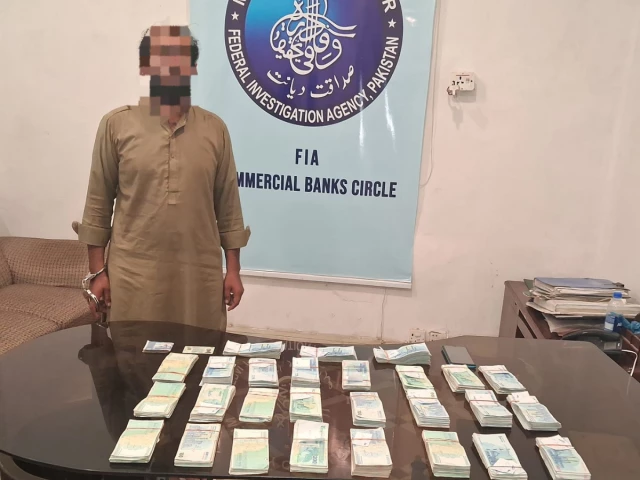
In a major enforcement action targeting illicit financial activities, Pakistan’s Federal Investigation Agency (FIA) has seized foreign currency worth approximately Rs2.89 billion during a raid on illegal hawala and hundi operations in Karachi.
The operation marks a significant escalation in the country’s nationwide crackdown on informal money transfer systems, which authorities say are fueling money laundering and undermining the formal economy.
Massive Currency Seizure in Targeted Raid
Suspect Arrested, Evidence Recovered
According to officials, the FIA’s Commercial Banking Circle carried out the raid under directives from senior authorities in the Karachi Zone. During the operation, a suspect identified as Abdul Rehman was taken into custody from the Mochko area.
Authorities recovered foreign currency—reportedly including Iranian denominations—valued at nearly Rs2.89 billion. In addition to the cash, a mobile phone containing records of suspected illegal transactions was also seized.
Preliminary analysis of the device revealed evidence pointing toward organized buying and selling of foreign currency, as well as involvement in hawala and hundi networks.
The suspect and recovered materials have been transferred to the FIA’s Commercial Banking Circle for further investigation.
Nationwide Crackdown on Hawala and Money Laundering
Government Tightens Enforcement
This operation is part of a broader nationwide campaign approved earlier this week to dismantle illegal financial networks. Authorities have reiterated a zero-tolerance policy toward hawala and hundi practices, emphasizing their commitment to curbing money laundering.
As part of this initiative, a joint working group has been established between the State Bank of Pakistan and the FIA. The group is tasked with monitoring progress and strengthening coordination in tackling illicit financial flows.
Officials say this collaborative approach aims to close regulatory gaps and improve enforcement efficiency.
What Are Hawala and Hundi Systems?
Informal Networks with Global Reach
Hawala and hundi are informal money transfer systems that operate outside regulated banking channels. While they are often used for legitimate purposes in regions with limited banking access, they are also frequently exploited for illegal activities such as:
- Money laundering
- Tax evasion
- Terror financing
- Capital flight
These systems rely on trust-based networks rather than physical cash movement, making them difficult to trace and regulate.
Global Context: Financial Transparency Under Pressure
International Scrutiny on Informal Transfers
Pakistan’s crackdown comes amid increasing global pressure to strengthen financial transparency and combat illicit flows. International bodies, including the Financial Action Task Force (FATF), have long urged countries to tighten controls on unregulated financial systems.
Efforts to dismantle hawala networks are seen as crucial for improving compliance with international standards and maintaining economic credibility.
Countries across South Asia and the Middle East have also intensified similar crackdowns in recent years, reflecting a broader global push to formalize financial systems.
Economic Impact: Why This Crackdown Matters
Protecting the Formal Economy
Illegal currency markets can significantly distort exchange rates and undermine the stability of a country’s financial system. By operating outside official channels, hawala networks reduce transparency and limit the government’s ability to monitor capital flows.
Experts note that large-scale seizures like this one send a strong signal to illicit operators while boosting confidence in regulatory institutions.
Strengthening Investor Confidence
Cracking down on money laundering is also critical for attracting foreign investment. Transparent financial systems are a key requirement for international investors, and enforcement actions demonstrate a country’s commitment to accountability.
Analysis: A Turning Point in Enforcement?
Coordinated Strategy Gains Momentum
The formation of a joint working group between the State Bank and FIA suggests a more coordinated and sustained approach to tackling financial crime. This could mark a shift from reactive enforcement to proactive monitoring.
If effectively implemented, such collaboration could significantly reduce the scale of illegal financial activities in Pakistan.
Challenges Ahead
Despite these efforts, dismantling hawala networks remains a complex task. Their decentralized nature and deep-rooted presence in certain communities make them resilient to enforcement actions.
Authorities will need to combine strict regulation with public awareness and improved access to formal banking services to achieve long-term success.
Conclusion
The seizure of Rs2.89 billion in foreign currency during the Karachi operation highlights Pakistan’s intensified efforts to combat illegal financial networks. With arrests made and investigations ongoing, the crackdown signals a firm stance against hawala and hundi practices.
As the government strengthens coordination between regulatory and enforcement bodies, the success of these اقدامات will play a crucial role in shaping Pakistan’s financial integrity and global economic standing.