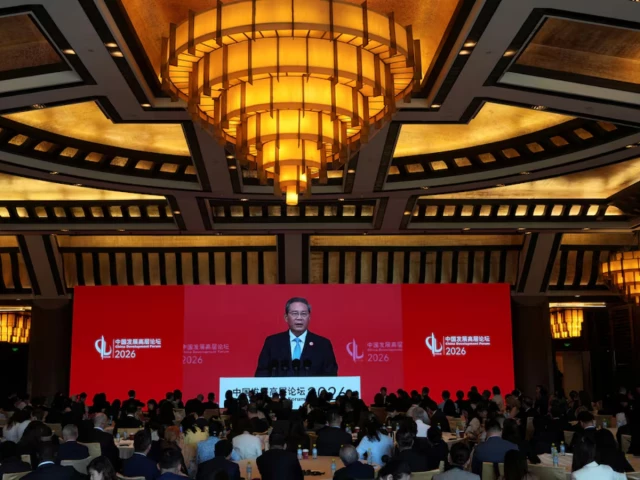
In a significant move aimed at restoring investor confidence, Chinese Premier Li Qiang has pledged to further open China’s economy and ensure equal treatment for foreign companies, positioning the country as a stabilizing force in an increasingly fragmented global trade landscape.
Speaking at the high-profile China Development Forum in Beijing, Li emphasized that China remains committed to deepening economic reforms and fostering a business-friendly environment despite mounting geopolitical and economic pressures.
China Seeks to Reassure Global Investors
“Cornerstone of Stability” in Uncertain Times
Li Qiang described China as a “cornerstone of certainty” and a “harbour of stability” for the global economy—remarks clearly aimed at calming concerns among multinational corporations navigating rising trade tensions.
He reaffirmed that Beijing would fully implement “national treatment” for foreign enterprises, a principle ensuring that overseas companies receive the same regulatory and legal treatment as domestic firms.
“Companies coming to China can develop with confidence and achieve success,” Li said, signaling Beijing’s intent to attract continued foreign investment.
Trade Pressures and Economic Challenges
Record Surplus Fuels Global Friction
China’s renewed outreach comes at a time when the world’s second-largest economy faces growing scrutiny over its trade practices. A record trade surplus of approximately $1.2 trillion last year has intensified tensions with key trading partners.
Countries including the United States and members of the European Union have raised concerns about market access, subsidies, and trade imbalances.
The situation has been further complicated by geopolitical developments, including the ongoing Middle East conflict, which has disrupted global supply chains and delayed diplomatic engagements.
Global Corporate Giants Attend Beijing Forum
Strong Presence from Multinationals
The China Development Forum brought together top executives from leading global corporations, underscoring continued international interest in the Chinese market.
Major companies represented at the forum included:
- Apple
- Samsung Electronics
- Volkswagen
- Broadcom Inc
- Siemens
- BASF
- Novartis
Their presence highlights the continued importance of China as a manufacturing hub, consumer market, and innovation center.
However, the absence of Japanese executives has drawn attention, potentially reflecting shifting regional dynamics and corporate caution.
Policy Direction: Openness and Innovation
Expanding Trade and Imports
Li Qiang announced that China would increase imports of high-quality goods and work with global partners to promote more balanced trade growth. This move is seen as an attempt to address criticism over trade imbalances and demonstrate a willingness to share economic opportunities.
He also emphasized the importance of technological advancement and market innovation in driving future growth, suggesting that China aims to transition from an export-led model to a more diversified economic structure.
Global Context: Trade Fragmentation and Competition
Rising Economic Nationalism
China’s latest assurances come against the backdrop of growing economic nationalism worldwide. Governments are increasingly prioritizing domestic industries, leading to tighter regulations and reduced openness in some markets.
At the same time, multinational corporations are reassessing supply chains, diversifying production bases, and seeking greater resilience in the face of geopolitical risks.
China’s message of openness is therefore both an economic strategy and a diplomatic signal aimed at maintaining its central role in global trade.
Analysis: Can China Rebuild Trust?
Investor Confidence at a Crossroads
While Li Qiang’s statements are likely to be welcomed by global investors, analysts caution that implementation will be key. Concerns over regulatory transparency, data security, and political risk remain significant factors influencing foreign investment decisions.
The promise of “national treatment” could mark a turning point if backed by concrete policy actions, including reduced barriers to market entry and stronger legal protections.
Strategic Timing
The announcement also comes ahead of a potential visit by Donald Trump, which could further shape the trajectory of U.S.-China relations. With trade tensions already high, Beijing appears eager to present itself as a cooperative and stable partner.
What It Means for the Global Economy
Opportunities and Risks
If successfully implemented, China’s renewed openness could create significant opportunities for foreign businesses, particularly in sectors such as technology, healthcare, and green energy.
However, persistent geopolitical tensions and policy uncertainties could limit the extent to which companies fully capitalize on these opportunities.
China’s pledge to expand market access and ensure equal treatment for foreign firms signals a strategic effort to stabilize its economic relationships at a time of global uncertainty. As trade tensions rise and supply chains evolve, Beijing is positioning itself as both a reliable partner and a driver of global growth.
The real test, however, will lie in how these promises translate into action—something investors and governments around the world will be watching closely.