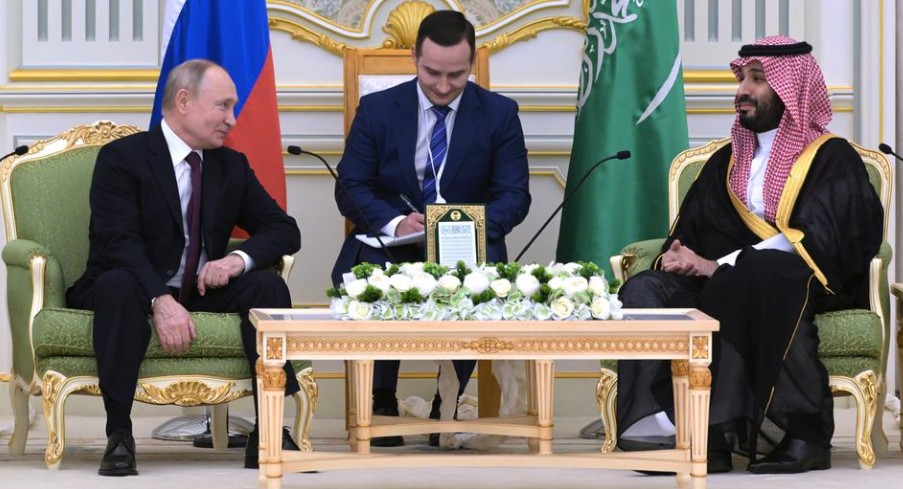
Russian President Vladimir Putin and Saudi Crown Prince Mohammed bin Salman held a telephone conversation on Thursday to discuss the rapidly escalating crisis in the Middle East, along with cooperation under the OPEC+ framework.
According to a statement issued by the Kremlin, both leaders expressed deep concern over the worsening military and political situation in the region.
Concerns Over Civilian Casualties and Infrastructure Damage
The two leaders highlighted the growing number of civilian casualties and the destruction of critical strategic infrastructure as key concerns amid the ongoing conflict.
The Kremlin noted that both sides stressed the urgent need for an immediate ceasefire and intensified diplomatic efforts to resolve the crisis.
Background of the Conflict
The current escalation traces back to February 28, when Israel and the United States launched strikes on Iran, triggering a broader regional confrontation.
Since then, tensions have continued to rise, raising fears of a wider conflict that could destabilize the entire Middle East.
Energy Security Risks Highlighted
Both Vladimir Putin and Mohammed bin Salman emphasized that disruptions to energy production and supply chains caused by the crisis pose serious risks to global energy security.
They warned that instability in the region could impact oil markets and lead to increased volatility in global prices.
OPEC+ Cooperation Seen as Crucial
In this context, the leaders underscored the importance of continued cooperation between Russia and Saudi Arabia under the OPEC+ framework.
They agreed that coordinated efforts are essential to maintaining stability in the global oil market during a period of heightened uncertainty.
The high-level discussion between Russia and Saudi Arabia reflects growing international concern over the Middle East crisis and its global implications. With both nations playing key roles in energy markets, their cooperation under OPEC+ could be critical in managing economic fallout while diplomatic efforts continue to seek a resolution to the conflict.