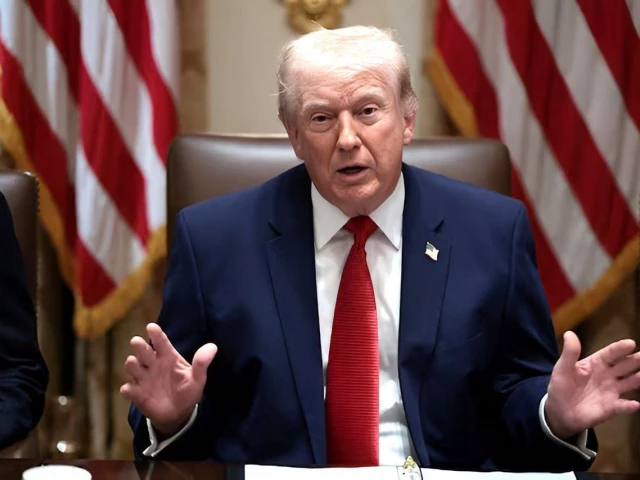
WASHINGTON – United States President Donald Trump said on Tuesday that Iran talks could resume in Pakistan over the next two days, according to an interview with the New York Post. “You should stay there, really, because something could be happening over the next two days, and we’re more inclined to go there,” he said.
“It’s more likely, you know why? Because the field marshal is doing a great job,” he said, referring to Chief of Defence Forces and Chief of the Army Staff Field Marshal Asim Munir. Continuing his praise for the military chief, Trump said: “He’s fantastic, and therefore it’s more likely that we go back there. Why should we go to some country that has nothing to do with it?”
Talks Could Resume This Week
Negotiating teams from the US and Iran could return to Islamabad this week to resume talks to end the war, sources earlier told Reuters on Tuesday, after the collapse of weekend negotiations prompted Washington to impose a blockade on Iranian ports. While the US blockade drew angry rhetoric from Tehran, signs that diplomatic engagement might continue helped calm oil markets, pushing benchmark prices below $100 on Tuesday.
The highest-level talks between the two adversaries since the 1979 Islamic Revolution ended in Islamabad without a breakthrough at the weekend, raising doubts over the survival of a two-week ceasefire that still has a week to run.
Proposal for Delegations to Return
But a source involved in the talks said on Tuesday both countries could return as early as the end of this week, and that a proposal had been shared with Washington and Tehran to resend their delegations. “No firm date has been set, with the delegations keeping Friday through Sunday open,” a senior Iranian source said.
A US official said there was continued engagement and forward motion on trying to get to an agreement. Prime Minister Shehbaz Sharif also said efforts were still underway to resolve the conflict.
Trump’s Conditions for a Deal
President Trump said Iran had been in touch on Monday and wanted to make a deal, adding that he would not sanction any agreement that allowed Tehran to possess a nuclear weapon. Vice President JD Vance, who led Washington’s delegation opposite Iran’s speaker of parliament, Mohammad Baqer Qalibaf, told Fox News on Monday the US had “made a lot of progress” by communicating to Tehran where Washington “could make some accommodation” and where it would remain inflexible.
He said Trump was adamant that any enriched nuclear material must be removed from Iran and a mechanism must be established to verify that Iran is not developing nuclear weapons. Tehran “moved in our direction, which is why I think we would say that we had some good signs, but they didn’t move far enough,” Vance said, without disclosing further details.
US Blockade and Iranian Response
Since the United States and Israel began the war on February 28, Iran effectively shut the Strait of Hormuz to all vessels except its own, saying passage would be permitted only under Iranian control and subject to a fee. In a countermeasure, the US military began blocking shipping traffic in and out of Iran’s ports on Monday. Tehran has threatened to hit naval ships going through the strait and to retaliate against its Gulf neighbours’ ports.
Shipping data on LSEG showed Chinese-owned oil-and-chemicals tanker Rich Starry passed through the strait on Tuesday — the first since the US blockade began. The vessel, which departed Sharjah anchorage off the coast of Dubai on Monday heading for China, had earlier turned back minutes after approaching the strait.
Oil Prices Slip
Oil prices fell on Tuesday in Asian trade, as concerns about supply risks stemming from the US blockade of the Strait of Hormuz were allayed by signs of possible talks to end the US-Iran war. Brent futures declined 76 cents or 0.8% to $98.57, while US West Texas Intermediate (WTI) crude fell $1.63 or 1.65% to $97.45.
The US military said on Monday its blockade of the Strait of Hormuz would extend east to the Gulf of Oman and Arabian Sea, while ship-tracking data showed two ships turned around in the strait as the blockade started.
Ceasefire Still Holding
With the war unpopular at home and rising energy prices causing political blowback, Trump paused the US-Israeli bombing campaign last week after threatening to destroy Iran’s “whole civilisation” unless it reopened the strait. The ceasefire, which halted US-Israeli strikes and fire from Iran across the Gulf in response, has largely held over its first week despite sharp rhetoric from both sides.
An Iranian military spokesperson called any US restrictions on international shipping “piracy,” warning that if Iranian ports were threatened, no port in the Gulf or Gulf of Oman would be secure. Any military vessels approaching the strait would violate the ceasefire, Iran’s Revolutionary Guards said.
Lebanon Attacks Continue
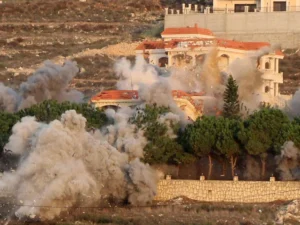
Israel has continued to bombard Lebanon and on Monday, troops launched an attack it said was intended to seize a key south Lebanon town from Iran-backed Hezbollah. The Israeli military said on Tuesday that an Israeli soldier was killed and three reservists were wounded during combat in southern Lebanon. Israel and the US have said the campaign against Hezbollah was not part of the ceasefire, while Iran has insisted it is.
Analysis: A Diplomatic Lifeline
President Trump’s suggestion that Iran talks could resume in Pakistan over the next two days is a diplomatic lifeline after the collapse of weekend negotiations. The fact that both sides are willing to return to the table — despite the US having imposed a blockade on Iranian ports — suggests that neither Washington nor Tehran wants the ceasefire to collapse.
Trump’s praise for Field Marshal Asim Munir is significant. The US president explicitly linked the possibility of resumed talks to Pakistan’s military leadership, saying “the field marshal is doing a great job.” This public acknowledgment of Pakistan’s role in facilitating dialogue underscores the importance Islamabad has played in the diplomatic process.
The ceasefire has largely held over its first week, despite sharp rhetoric and continued Israeli strikes on Lebanon. If the parties can return to Islamabad and bridge their remaining differences — particularly over Iran’s nuclear programme and the status of the Strait of Hormuz — a permanent end to the war may still be possible.
For now, the world watches Islamabad. As Trump noted, “something could be happening over the next two days.”