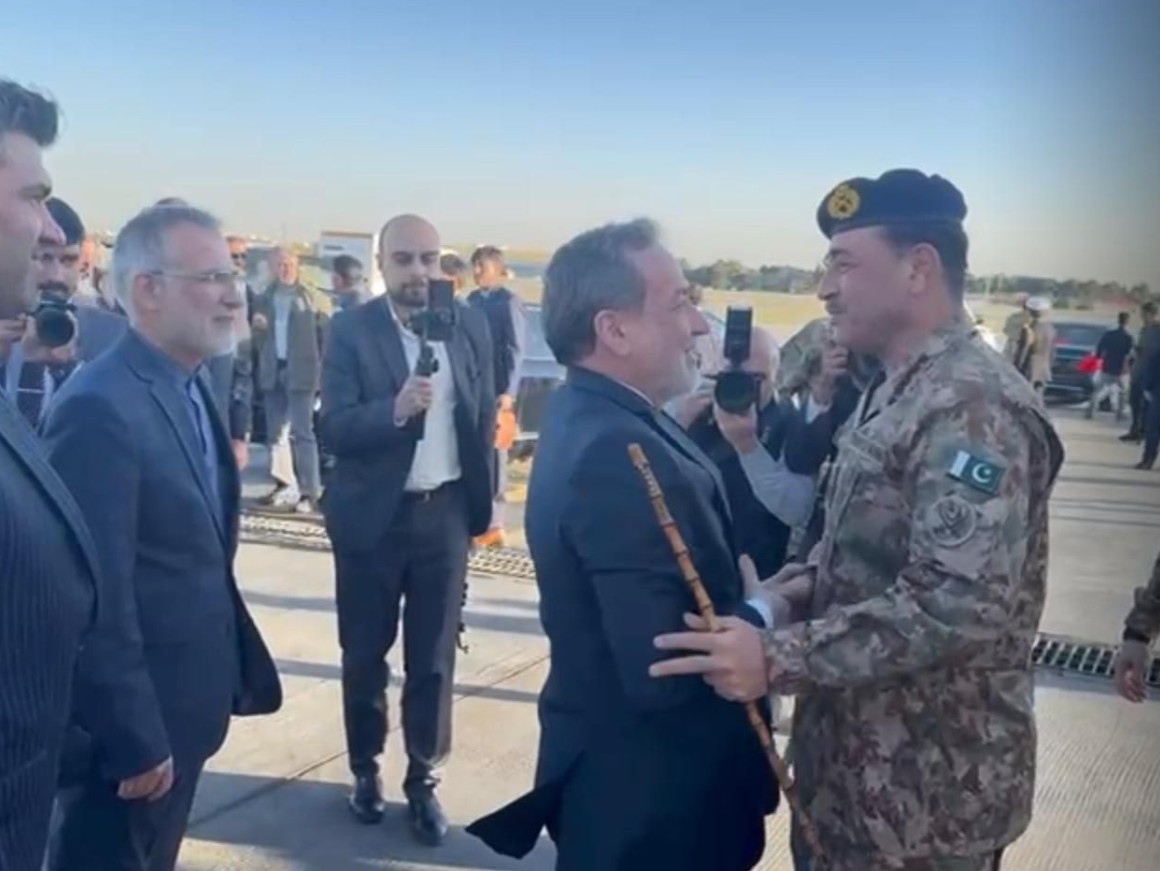
TEHRAN – Chief of Defence Forces and Chief of the Army Staff Field Marshal Asim Munir landed in Tehran on Wednesday as part of the ongoing Middle East peace negotiation efforts. The Inter Services Public Relations said in a statement that he was part of a delegation that also included Interior Minister Mohsin Naqvi. Iranian Foreign Minister Abbas Araghchi received the delegation.
The high-level visit underscores Pakistan’s continued commitment to mediating between the United States and Iran, even after the first round of direct talks in Islamabad ended without a breakthrough. The presence of both the military chief and the interior minister signals the importance Pakistan attaches to the diplomatic process.
Message Exchanges Continue
Iran earlier said it continued to exchange messages with Washington through Pakistani mediators. “Message exchanges continue” regarding negotiations with the United States, Foreign Ministry spokesperson Esmaeil Baghaei said in a news briefing cited by the state news agency IRNA.
“Since Sunday, when the Iranian delegation returned to Tehran, multiple messages have been exchanged through the Pakistani intermediary,” he added. “Our positions have been conveyed and heard,” he said.
Nuclear Enrichment Discussions
On the nuclear file, the spokesperson said discussions over uranium enrichment are not new. “There is room for discussion on the type and level of enrichment,” he said. “The Islamic Republic of Iran must be able to continue enrichment based on its national needs,” he added.
Background of Talks
The US and Iran held rare direct talks in Pakistan this weekend aimed at ending their conflict, but the talks ended early Sunday without any agreement. The two-week ceasefire brokered by Pakistan remains intact, however, and both sides have indicated a willingness to continue dialogue.
Pakistan’s Mediation Role
The visit to Tehran follows President Trump’s statement that Iran talks could resume in Pakistan over the next two days. Trump had praised Field Marshal Munir, saying “the field marshal is doing a great job” and that he was “fantastic.”
The delegation’s presence in Tehran suggests that Pakistan is actively shuttling between the two capitals, carrying messages and exploring potential compromises.
Analysis: Shuttle Diplomacy in Action
The arrival of Pakistan’s top military officer and interior minister in Tehran represents a significant escalation of Pakistan’s mediation efforts. Field Marshal Munir, who has been directly involved in the negotiations from the Pakistani side, is now personally carrying messages between Washington and Tehran.
The fact that Iran has confirmed that “multiple messages have been exchanged through the Pakistani intermediary” since the Iranian delegation returned from Islamabad suggests that the diplomatic channel remains active, even if direct talks have not yet resumed.
The discussion of uranium enrichment — “there is room for discussion on the type and level of enrichment” — is significant. The US has demanded that Iran cease enrichment entirely; Iran insists it must be able to continue enrichment based on its national needs. The fact that the Iranian spokesperson is publicly acknowledging “room for discussion” suggests that Tehran may be open to compromise.
As the ceasefire enters its second week, the shuttle diplomacy between Islamabad, Tehran, and Washington continues. The visit of Field Marshal Munir and Interior Minister Naqvi to Tehran is a clear signal that Pakistan remains committed to bridging the gap between the two sides.