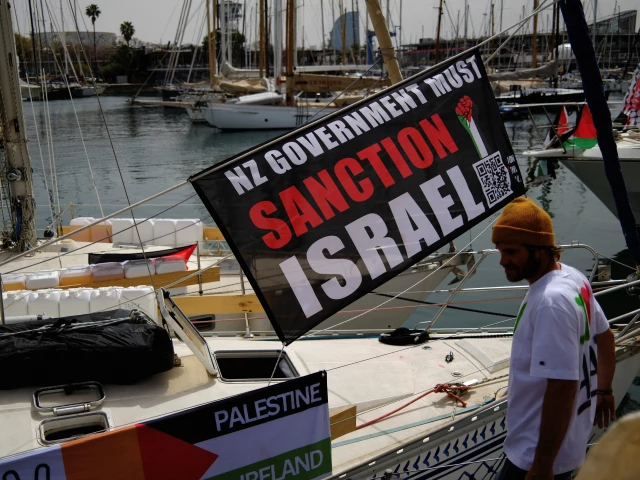
ISTANBUL/ATHENS – Israel has intercepted aid ships bound for Gaza in international waters near Greece, flotilla organisers said on Thursday, decrying the move as an “escalation of Israel’s impunity”. A second flotilla carrying humanitarian aid to Palestinians in Gaza sailed from the Spanish port of Barcelona on April 12, aiming to try to break the Israeli blockade.
The vessels were seized by Israel hundreds of miles from Gaza, said the organisers, Global Sumud Flotilla. “This is piracy,” the group said in a statement. “This is the unlawful seizure of human beings on the open sea near Crete, an assertion that Israel can operate with total impunity, far beyond its own borders, with no consequences.”
No state had the right to claim, police, or occupy international waters, but Israel had done that, extending its control outward to occupy the Mediterranean Sea off the coast of Europe, it added.
Türkiye Condemns ‘Act of Piracy’
Türkiye on Thursday called Israel’s illegal intervention against a Gaza-bound aid flotilla “an act of piracy,” saying it is taking “all necessary steps” regarding its citizens and other passengers on board, Anadolu Agency reports.
“By attacking the Global Sumud Flotilla, which sought to draw attention to the humanitarian catastrophe faced by the oppressed people of Gaza, Israel has targeted humanitarian values and international law,” the Turkish Foreign Ministry said in a statement.
It said Israel’s actions also violated the principle of freedom of navigation in international waters, adding: “We call on the international community to take a united stance against this lawless act by Israel.”
“All necessary steps are being taken in coordination with relevant countries regarding the situation of our citizens and other passengers on the board the fleet,” it added.
Israel’s Response
Israel’s UN envoy Danny Danon said the flotilla “was stopped before reaching our area.” In a posting on X, he added, “Our brave IDF soldiers are acting with professionalism and determination, dealing with a group of delusional attention-seeking agitators,” referring to the Israeli military.
Previous Interception
Israel’s military halted a previous flotilla assembled by the same organisation last October in an attempt to reach blockaded Gaza, arresting Swedish activist Greta Thunberg and more than 450 participants.
Gaza Blockade
Israel, which controls all access to the Gaza Strip, denies withholding supplies for its residents, numbering more than 2 million. Yet Palestinians and international aid bodies say supplies reaching the territory are still insufficient, despite a ceasefire reached in October that included guarantees of increased aid.
Analysis: Piracy or Enforcement?
The interception of aid ships in international waters raises complex legal questions. Under international law, the principle of freedom of navigation is fundamental. Intercepting vessels on the high seas is generally impermissible unless authorised by international law (e.g., piracy, slavery, or unauthorised broadcasting).
Israel’s justification — that the ships were attempting to break its blockade of Gaza — is contested. The blockade itself is of disputed legality. The International Committee of the Red Cross has stated that blockades are permissible under international humanitarian law if they are not aimed at starving the civilian population. But critics argue that the blockade of Gaza amounts to collective punishment.
The organisers’ characterisation of the interception as “piracy” is strong language. Whether it meets the legal definition of piracy (illegal acts of violence or detention committed for private ends) is questionable. Israel’s actions were certainly unauthorised, but they were carried out for a political purpose — enforcing a blockade — not for private ends.
Türkiye’s condemnation — “an act of piracy” — reflects the strong opposition to Israel’s actions in the Muslim world. The call for the international community to take a “united stance” suggests that Turkey may seek diplomatic or legal action.
The involvement of Swedish activist Greta Thunberg in the previous flotilla added star power to the cause. Her arrest garnered international attention.
As the humanitarian crisis in Gaza continues, with over 800 Palestinians killed since the October ceasefire according to a recent UN statement, the flotillas represent an attempt by civil society to bypass a blockade they consider illegal. Israel’s interception of these ships, hundreds of miles from Gaza, underscores its determination to maintain the blockade — and its willingness to enforce it far from its shores.