LOS ANGELES – The growing footprint of Pakistani cinema on the global festival circuit received a fresh boost at the 24th edition of the Indian Film Festival of Los Angeles (IFFLA), where local filmmakers earned critical recognition alongside a diverse South Asian lineup that reflected the region’s evolving storytelling voice.
While Tribeny Rai’s debut feature ‘Shape of Momo’ secured the Grand Jury Prize for best feature, it was the strong showing by Pakistani films that quietly underscored the country’s rising cinematic credibility on an increasingly competitive international stage.
‘Lali’ Earns Honourable Mention
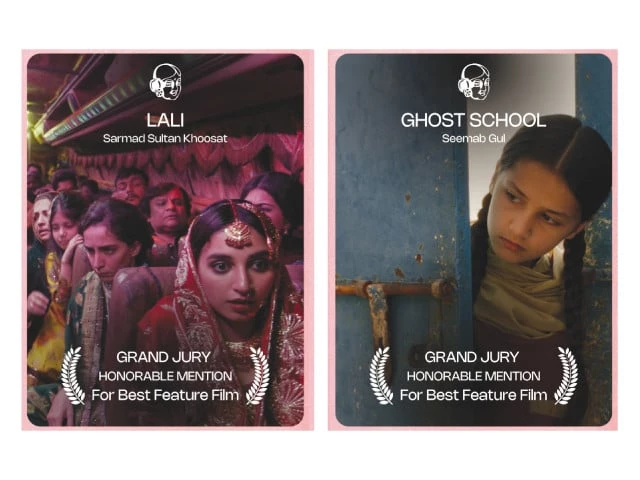
Filmmaker Sarmad Sultan Khoosat’s ‘Lali’ received an honourable mention from the feature jury, which praised its genre fluidity and visual richness, describing it as a work that “envelopes the audience in a vibrant symphony of music and colour.”
‘Ghost School’ Recognised
Similarly, Seemab Gul’s ‘Ghost School’ earned an honourable mention for its restrained storytelling and thematic depth, with jurors highlighting its ability to function as both a political allegory and a piece of grounded social realism.
A Growing Presence
These recognitions come at a time when Pakistani independent cinema is steadily carving out space in global conversations, often relying on nuanced narratives and limited resources rather than spectacle — a contrast that continues to define its artistic identity.
Festival Platform
According to Variety, the festival itself, held in Los Angeles, remains one of North America’s most prominent platforms dedicated to South Asian cinema, bringing together filmmakers from Pakistan, India, Bangladesh, Nepal and beyond, while facilitating industry connections through its parallel ‘Industry Days’ programme.
Thematic Range
Beyond the Pakistani entries, the festival showcased a wide thematic range, from migration and identity to class, gender and urban anxieties, with films such as ‘Gas Station Attendant’ and ‘Sand City’ reflecting the complexities of life across the region and its diaspora.
Shorts Category
In the shorts category, emerging voices also found space, with works like ‘Room at the Farm’ winning the Grand Jury Prize, while other films explored questions of religion, cultural identity and interpersonal tension through experimental and narrative-driven approaches.
Audience Engagement
Audience engagement remained a key feature of the event, with ‘Breaking the Code’ winning the Audience Choice Award for best feature, signalling a continued appetite for stories rooted in personal history and transnational experience.
Industry Initiatives
Industry initiatives further highlighted the festival’s role as more than just a screening platform, as projects like ‘Blind Tiger’ secured development support, pointing to a growing ecosystem aimed at nurturing South Asian storytelling for global audiences.
A Clear Takeaway
For Pakistan, however, the takeaway was clear: even without taking home the top prize, films like ‘Lali’ and ‘Ghost School’ demonstrated that the country’s storytellers are not only participating in international forums but shaping conversations through bold, socially aware and visually distinctive cinema.
Analysis: A Quiet Revolution
The recognition of Pakistani films at IFFLA is part of a quiet revolution in the country’s cinema. For decades, Pakistani cinema was defined by commercial productions — often formulaic, low-budget, and regionally focused. But a new generation of filmmakers, many of them independent, is changing that.
Sarmad Sultan Khoosat, whose ‘Lali’ was praised for its genre fluidity and visual richness, is part of this wave. His earlier work, including ‘Mula Jatt’ and ‘Kamli’, has already garnered international attention. Seemab Gul, whose ‘Ghost School’ was recognised for its political allegory and social realism, represents an emerging voice.
The contrast between Pakistani independent cinema and commercial cinema is stark. Independent films rely on nuanced narratives, limited resources, and artistic risk-taking. They are not made for mass audiences but for festivals and discerning viewers.
The fact that these films are being recognised at a prominent South Asian film festival in Los Angeles — within the heart of the global entertainment industry — is significant. It suggests that Pakistani cinema is being taken seriously.
The IFFLA platform, with its ‘Industry Days’ programme, also offers networking opportunities. For Pakistani filmmakers, connections made at such festivals can lead to co-productions, distribution deals, and international funding.
As Pakistani indie cinema continues to grow, the challenge will be sustaining momentum. The country’s film industry is still small, and funding is limited. But the talent is there. The world is starting to notice.