RAWALPINDI – Pakistan’s armed forces reaffirmed their commitment to defending the country, warning that any hostile design would be met with greater strength, precision, and resolve, as the nation marked the first anniversary of Marka-e-Haq. The term “Marka-e-Haq” refers to the 2025 conflict with India, which began with the April 22 Pahalgam attack and concluded with a ceasefire on May 10 following Operation Bunyanum Marsoos.
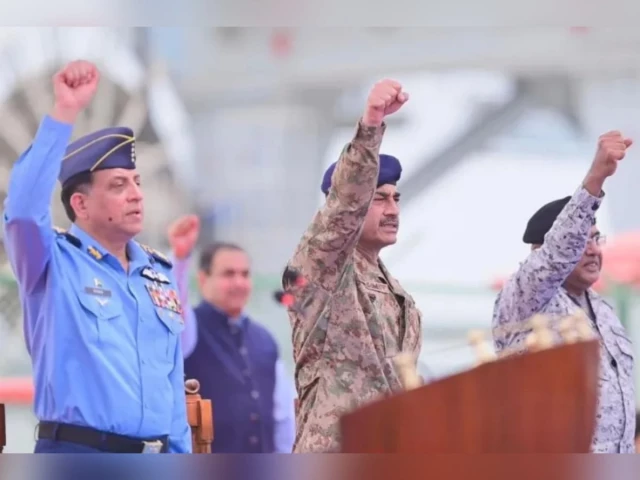
In a statement, the Inter-Services Public Relations (ISPR) said that on the night of May 6-7, the armed forces, particularly the Pakistan Air Force (PAF), commemorated a defining chapter in the country’s military history.
“Pakistan Armed Forces, particularly Pakistan Air Force, proudly commemorate a defining chapter in the nation’s military history; one that strengthened national confidence, reaffirmed institutional resolve and validated PAF’s relentless pursuit of modernisation and focused capability enhancement,” the statement said.
A Future-Ready Air Power
The ISPR said the milestone reflected the PAF’s journey towards becoming a future-ready air power through the induction of cutting-edge systems and operationalisation of niche technologies.
“By mastering the skillful employment of Multi-domain Operations, Pakistan Air Force continues to consolidate itself into a future-focused and capable air power, fully prepared to uphold the sovereignty and territorial integrity of Pakistan in the face of the evolving nature and parameters of modern air warfare,” it added.
Unprecedented Operations
Describing the operations as unprecedented in scope, the statement said they underscored the PAF’s professional excellence and renewed national pride.
“The successful execution of these operations, unprecedented in scope and novel in the history of aerial warfare, not only underscored the professional excellence of Pakistan Air Force but also renewed the pride, confidence and spirit of the resilient Pakistani nation,” it said.
A Peace-Loving Nation
The ISPR emphasised that Pakistan remained a peace-loving country, with its armed forces committed to stability and security.
“Pakistan is a peace-loving country, and its Armed Forces embody a mature and responsible strategic culture,” the statement said, adding that all efforts were aimed at preserving peace, promoting stability and ensuring security in the region.
The statement noted that the armed forces were cognisant of the evolving geopolitical and regional security environment, as well as the capabilities of adversarial forces, and continued to invest in advanced technologies and professional excellence to meet future challenges.
A Warning to Adversaries
The statement reaffirmed the armed forces’ unwavering commitment to defend the country. “Any hostile design against Pakistan will be countered with even greater strength, precision and resolve far stronger than what was witnessed by the adversary during Marka-e-Haq, Insha’Allah,” the statement added.
Tribute to the Air Force
Paying tribute to the Pakistan Air Force, the ISPR said the nation acknowledged the force’s professionalism and sacrifices.
“Tonight the nation pays tribute to every member of Pakistan Air Force for their professionalism, sacrifice, untiring efforts and exceptional operational focus,” it said, adding that these contributions were pivotal to the defence of the country’s airspace.
The statement concluded that Pakistan Air Force is and will remain second to none, and a symbol of pride, strength and confidence for the nation.
The Pahalgam Attack and Marka-e-Haq
On April 22, 2025, escalation between Pakistan and India began when an attack in Pahalgam killed 26 people. India immediately blamed Pakistan for the incident. However, Pakistan categorically rejected the Indian blame.
In response, India undertook a series of hostile actions the next day, on April 23, 2025, including suspending the 65-year-old Indus Waters Treaty (IWT), cancelling visas for Pakistani citizens, closing the Wagah-Attari border crossing, ordering the shutdown of the Pakistan High Commission in New Delhi, and reducing diplomatic staff at each other’s embassies.
The May 7 Strikes and Pakistan’s Response
Tensions further escalated in the early hours of May 7, 2025, when missile strikes hit six cities in Punjab and Azad Jammu and Kashmir (AJK), destroying a mosque and killing dozens of civilians, including women, children, and the elderly.
In a swift military response, Pakistan’s armed forces shot down Indian warplanes, including three Rafale jets. The confrontation intensified again in the early hours of May 10, 2025, when India targeted several Pakistani airbases with missile strikes. In retaliation, Pakistan launched Operation Bunyanum Marsoos, damaging Indian military installations, including missile storage sites, airbases, and other strategic targets.
On May 10, 2025, US President Donald Trump announced that a ceasefire had been reached following intense overnight diplomatic efforts. Minutes later, the agreement was confirmed separately by Pakistan’s Foreign Minister Ishaq Dar and the Indian foreign secretary.
Analysis: A Legacy of Resolve
The first anniversary of Marka-e-Haq is not merely a commemoration; it is a reaffirmation of Pakistan’s defensive capabilities. The ISPR’s statement makes clear that the armed forces have learned from the 2025 conflict and are prepared for any future confrontation.
The emphasis on the PAF’s modernisation and the induction of cutting-edge systems suggests that Pakistan is not resting on its laurels. The successful execution of unprecedented aerial operations has validated the strategic direction.
The warning of a “stronger response” is not a threat of aggression; it is a promise of defence. Pakistan’s armed forces have proven their capability. The message to adversaries is unambiguous: any hostile design will be met with overwhelming force.
As the nation marks this anniversary, the families of those who fell in the conflict — civilians killed in Indian missile strikes and soldiers who died defending the country — are remembered. Their sacrifice is the foundation of Pakistan’s resolve.