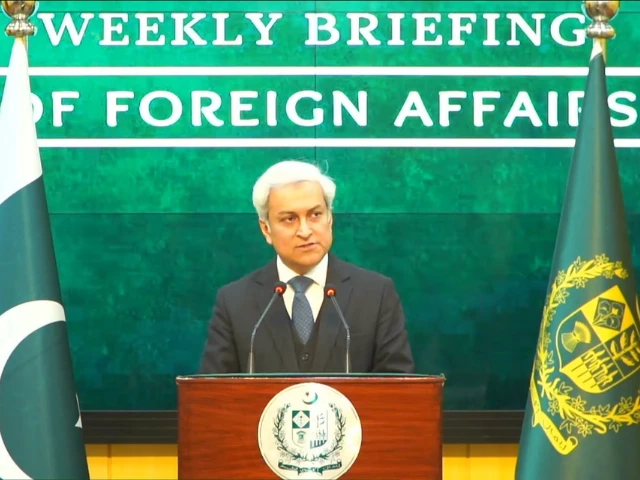
ISLAMABAD – Foreign Office Spokesperson Tahir Andrabi said on Thursday that Islamabad was optimistic about a peace agreement between the United States and Iran and expected a deal to be struck “soon” to bring peace to the region and the world, even though no timeline had been confirmed. “We remain optimistic, and… expect an agreement sooner rather than later. We hope the parties will reach a peaceful and sustainable solution that brings peace not just to our region but to the world at large,” said Andrabi during a weekly press briefing in Islamabad.
He told reporters that Pakistan would welcome a settlement between Iran and the US wherever it may be reached. “If an agreement is reached in Pakistan, it would be an honour for us,” he said.
Andrabi did not go into the specifics behind those expectations, declining to confirm reports about a potential memorandum of understanding that US and Iranian officials are reportedly inching towards. He did not confirm the document’s length either.
Project Freedom Pause Welcomed
The spokesperson reiterated that Prime Minister Shehbaz Sharif welcomed the “timely announcement” regarding the pause in “Project Freedom” on Wednesday in a post on X, noting that Pakistan remained committed to supporting all efforts that promote restraint and the peaceful resolution of conflict between the US and Iran through dialogue and diplomacy.
Andrabi added that “working with the same spirit of optimism and positive engagement”, Deputy Prime Minister and Foreign Minister Ishaq Dar worked with his counterparts throughout the last week in the pursuit of peace, diplomacy and a settlement between Washington and Tehran.
Confidence-Building Measure
He said that, as a confidence-building measure by the US, 22 crew members held from the seized Iranian container ship MV Touska were evacuated to Pakistan and later sent to Iran, which was coordinated with the support of both the Iranian and US sides.
Marka-e-Haq Anniversary
On the first anniversary of Marka-e-Haq, reiterating Pakistan’s desire for dialogue and diplomacy, Andrabi made it clear that Pakistan would respond with full strength and all available means if aggression was imposed on it, as it was exactly one year ago.
“Pakistan’s position on every issue is firmly anchored in international law, the UN Charter, and relevant UN Security Council resolutions. We do not talk of war or clashes; we talk of dialogue and diplomacy. However, if aggression is imposed on us as it was exactly one year ago, Pakistan will respond with full strength and all means available,” Andrabi said.
He called Operation Bunyanum-Marsoos a “defining moment” in the national journey, which was not just about remembering the past but about shaping the future. “Because the spirit of Marka-e-Haq lives not just in our history, but in each of us,” he remarked.
Dialogue with India
Andrabi said that Pakistan had always understood the importance of diplomacy, dialogue, and the peaceful settlement of all bilateral issues with India. “Pakistan has never shied away from dialogue with India on any issue. The fact that dialogue has not taken place cannot be blamed on Pakistan. We have repeatedly expressed our readiness for dialogue. However, it takes two to dialogue, and for it to be meaningful, it must be a dialogue and not a monologue. It is for everyone to judge who is responsible for the absence of dialogue.”
He said that Pakistan’s response under Operation Bunyanum Marsoos was measured, lawful, and in line with the UN Charter.
Kashmir and Indus Waters
He said that Foreign Minister Ishaq Dar also briefed the Diplomatic Corps on the first anniversary of Marka-e-Haq, wherein he highlighted that the Jammu and Kashmir dispute remained central to regional stability and called for its resolution under UN auspices through an impartially held plebiscite, besides cautioning against any unilateral action on the Indus Waters Treaty.
On the IWT, the spokesperson said that Pakistan would explore all legal and political mechanisms enshrined in the Treaty and under international law to secure its rights over the waters of the Indus Basin. “All options remain on the table. Some are already underway through the Indus Waters Commissioners. We are closely monitoring the implementation of the Treaty and documenting all variations in river flows. All efforts are being made to ensure that not a single drop of water that is Pakistan’s right is taken away.”
Indian Arms Build-Up
Commenting on the Indian arms build-up and force modernisation, the spokesperson said that Pakistan was mindful of the impact of India’s force modernisation on strategic stability in South Asia. “Our military preparedness and our own acquisitions of technologies would be sufficient to maintain our robust defence, robust military preparations and maintain our credible minimum deterrence vis-a-vis India.”
Pakistan-Afghanistan Relations
On Pak-Afghan relations, he welcomed the agreements among tribal elders in Bajaur and Chitral but reiterated that the single issue of terrorism emanating from Afghan soil was holding back bilateral relations. He said if the Taliban administration provides credible assurances that Afghan soil would not be used against Pakistan, all other issues between the two nations could be resolved easily.
Pakistani Nationals Detained Abroad
Andrabi also told the media that 49 of 54 Pakistanis detained in Cambodia, following a raid on a scamming compound, had returned, and the remaining three would return soon. Moreover, about 85 Pakistani nationals detained in Kampala on April 27 for engaging in unauthorised employment while on visit visas, he said that Pakistan’s embassy there engaged with the relevant authorities and ensured their expeditious repatriation by Wednesday.
To another question about the MV Abdullah vessel hijacked by Somali pirates, also carrying 10 Pakistanis on board, he said the individuals had not yet been released as direct contact was made on Wednesday with the Somali authorities, who assured us that they were negotiating with the pirates for the release of all individuals.
Analysis: Cautious Optimism
The Foreign Office’s expression of optimism about a US-Iran deal reflects Pakistan’s continued engagement as a mediator. The reference to “sooner rather than later” suggests that progress has been made, even if details remain confidential.
The pause in “Project Freedom” — at Pakistan’s request — is a significant confidence-building measure. The evacuation of Iranian crew members to Pakistan is another.
The Marka-e-Haq anniversary provides a domestic context. While Pakistan pursues peace in the Middle East, it remains prepared to defend itself against India.
The spokesperson’s comments on the Indus Waters Treaty and Indian arms build-up indicate that Pakistan is not lowering its guard. The “credible minimum deterrence” remains intact.
As the world waits for a US-Iran deal, Pakistan continues to play the role of honest broker. The optimism is cautious — but it is real.