MUZAFFARABAD: The Supreme Court of Azad Jammu and Kashmir (AJK) has ruled that the 12 seats reserved for Kashmiri refugees in the Legislative Assembly are constitutionally protected and cannot be changed through executive decisions, political agreements, or public pressure.
The ruling came in a detailed advisory opinion issued on a presidential reference, providing legal clarity on one of the most contentious political issues in the region ahead of the upcoming AJK elections.
Refugee Seats Protected Under Constitution
The 53-member AJK Legislative Assembly includes 12 seats reserved for refugees who migrated from Indian Illegally Occupied Jammu and Kashmir (IIOJK) during the conflicts of 1947 and 1965 and are now settled across Pakistan.
Six seats represent refugees from the Jammu division, while six seats are allocated to refugees from the Kashmir Valley.
The court held that these seats are explicitly protected under Article 22 of the AJK Constitution and are rooted in decades of constitutional and legislative history.
According to the opinion, refugee representation reflects the political and historical realities arising from the displacement of Kashmiris following the partition of the subcontinent and subsequent conflicts.
Changes Only Through Constitutional Amendment
The court emphasized that any modification to the Assembly’s composition can only be made through the constitutional amendment process outlined in Article 33.
“The provisions of the Constitution may be amended in accordance with Article 33,” the court stated.
The judges described the amendment mechanism as “exhaustive and exclusive,” ruling that no executive authority, political arrangement, or public movement can lawfully alter constitutional provisions outside the legislative process.
The court stressed that constitutional reforms must occur through democratic procedures, parliamentary debate, and public mandate.
Court Addresses Protests and Political Pressure
A significant portion of the opinion focused on the use of protests and public demonstrations to demand constitutional changes.
While reaffirming that peaceful assembly remains a fundamental right, the court clarified that such rights are not unlimited and must be exercised without infringing upon the rights of others.
The opinion specifically warned against road blockades, forced business closures, and disruptions to public services.
“The Constitution protects peaceful dissent; it does not protect conduct that undermines public order,” the court observed.
The judges further ruled that constitutional change cannot be achieved through coercive methods and that such efforts are legally unenforceable.
Timely Elections Must Be Held
The Supreme Court also reaffirmed the constitutional obligation to conduct elections within the prescribed timeframe under Article 22(4).
Describing the requirement as mandatory and non-negotiable, the court stated that constitutional deadlines cannot be suspended because of political disputes, public agitation, or uncertainty.
The Election Commission and relevant authorities were directed to ensure free, fair, transparent, and timely elections while maintaining public order and security.
Historical Significance of Refugee Representation
Tracing the evolution of refugee representation, the court noted that reserved refugee seats have existed in various forms since 1960 and have been retained through successive constitutional frameworks.
The opinion described refugee representation as a “continuously affirmed constitutional principle” and a reflection of the unresolved Kashmir dispute.
According to the court, the uninterrupted continuation of these seats demonstrates a long-standing constitutional commitment rather than a temporary administrative arrangement.
Political Context and JAAC Controversy
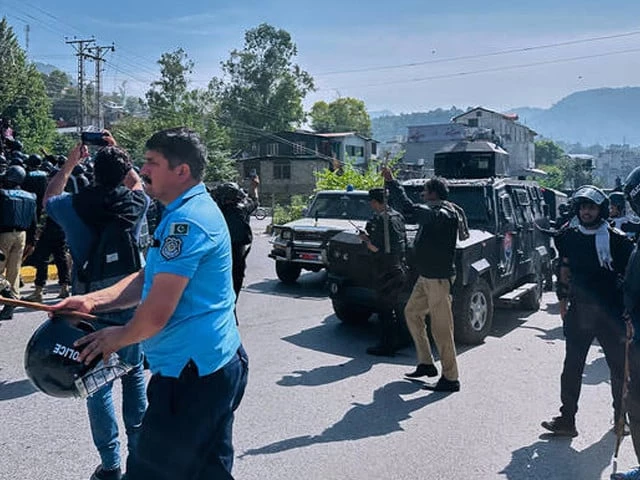
The issue of refugee seats has been a central demand of the now-banned Joint Awami Action Committee (JAAC), which organized large-scale protests across AJK in 2025.
The demonstrations turned violent, resulting in multiple deaths, including police personnel.
JAAC had demanded the abolition of the 12 refugee seats, arguing that they distorted political representation within the territory.
The group’s broader reform agenda also included changes to governance structures and the quota system.
The court’s ruling comes shortly after the AJK government declared JAAC a proscribed organization, citing allegations of terrorism, incitement, and public disorder.
PTI Criticises Government Action
Meanwhile, Pakistan Tehreek-e-Insaf (PTI) criticised the government’s decision to ban JAAC.
The party questioned why authorities had previously negotiated with the organization and implemented several of its demands if it was considered unlawful.
The debate over refugee representation remains politically sensitive as AJK prepares for Legislative Assembly elections scheduled for July 27.
Impact on Upcoming Elections
Political analysts believe the Supreme Court’s opinion significantly strengthens the legal status of refugee representation and narrows the scope for future challenges outside the constitutional framework.
With election preparations underway, the ruling is expected to play a major role in shaping political discourse and campaign narratives across Azad Jammu and Kashmir.
The court reiterated that its opinion is advisory in nature and intended to guide constitutional authorities, but its interpretation provides a clear constitutional roadmap regarding refugee representation and future electoral reforms.