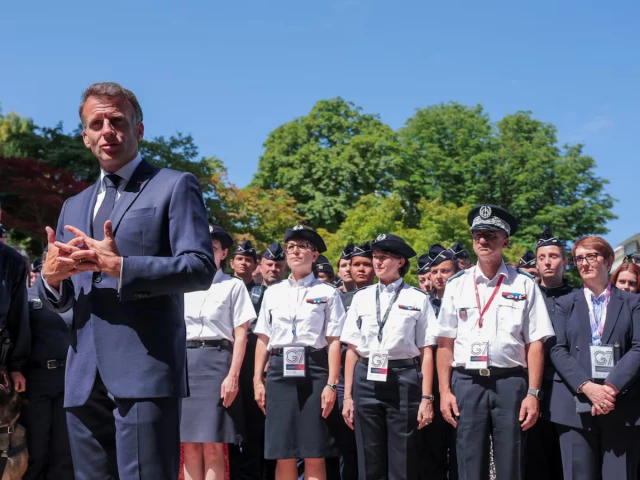
EVIAN-LES-BAINS, FRANCE: Leaders of the Group of Seven (G7) industrialized nations arrived in France on Monday for a high-stakes summit dominated by concerns over global trade tensions, regional conflicts, and the future of international cooperation, as US President Donald Trump renewed threats of steep tariffs against key allies.
The three-day summit, taking place in the picturesque lakeside resort town of Evian-les-Bains, brings together leaders from the United States, France, Germany, Britain, Canada, Italy, and Japan at a time of significant geopolitical uncertainty.
Trade Disputes Loom Over Summit
One of the most immediate sources of tension emerged even before the summit officially began.
In an interview with the New York Post, President Donald Trump warned that the United States could impose 100% tariffs on French wine unless France withdraws its digital services tax targeting major American technology companies.
The threat has reignited concerns among European leaders about Washington’s increasingly protectionist trade policies and the possibility of another transatlantic trade dispute.
French officials sought to downplay the issue before the summit, insisting that digital taxation policies are already governed by European regulations and are not expected to be formally discussed during G7 meetings.
Nevertheless, Trump’s comments have added fresh uncertainty to an already complex diplomatic agenda.
Iran Deal and Middle East Stability
A major focus of discussions is expected to be the evolving situation between the United States and Iran.
Recent diplomatic breakthroughs have raised hopes of ending months of military confrontation that disrupted regional stability and global energy markets.
G7 leaders are expected to seek greater clarity regarding a preliminary agreement reportedly reached between Washington and Tehran.
According to diplomatic sources, a formal memorandum of understanding is expected to be signed later this week in Switzerland, although details of the agreement remain largely undisclosed.
The potential reopening of the Strait of Hormuz, one of the world’s most critical energy shipping routes, is also expected to be a key topic of discussion.
The strategic waterway carries a significant share of global oil and liquefied natural gas supplies and has experienced major disruptions during the recent conflict.
Ukraine Remains on the Agenda
The ongoing war in Ukraine continues to be another central issue at the summit.
Ukrainian President Volodymyr Zelensky is scheduled to participate in discussions with G7 leaders and hold meetings aimed at securing continued military and economic support for Kyiv.
Although Russian military advances have slowed in recent months, Ukraine continues to face significant security challenges and remains dependent on Western assistance.
French President Emmanuel Macron reiterated support for Ukraine ahead of the summit, emphasizing the need to pursue diplomatic solutions while maintaining pressure on Moscow.
The summit comes shortly after renewed Russian attacks on Ukrainian infrastructure, reinforcing concerns among European leaders about regional security.
Questions Over America’s Global Leadership
Beyond specific policy issues, the summit reflects broader concerns regarding the future role of the United States within the international system.
Many G7 members have been unsettled by Washington’s recent foreign policy decisions, including trade disputes, military actions in the Middle East, and shifting diplomatic priorities.
Analysts suggest that allies are increasingly seeking reassurance regarding America’s commitment to the international institutions and alliances that have shaped global politics since World War II.
President Trump’s participation in the summit is viewed as particularly significant given his increasingly nationalist approach to foreign policy and economic relations.
Macron Seeks Diplomatic Legacy
For French President Emmanuel Macron, the summit represents one of the final major international gatherings of his presidency and an opportunity to reinforce France’s role as a leading diplomatic actor on the global stage.
Macron has positioned France as a bridge-builder on issues ranging from Ukraine and Middle East diplomacy to global economic reform and climate cooperation.
The French leader is also expected to host a special state dinner at the Palace of Versailles commemorating 250 years of American independence and highlighting the historic alliance between France and the United States.
Economic Challenges and China Concerns
Global economic imbalances are expected to feature prominently in summit discussions.
France has advocated for coordinated efforts to address concerns surrounding international trade patterns, supply chains, and investment flows.
Particular attention is being paid to reducing dependence on China for critical minerals and strategic resources used in advanced technologies and clean energy industries.
G7 leaders are expected to discuss strategies to diversify supply chains while strengthening economic resilience among member states.
French officials have framed the issue as a shared global challenge, arguing that China continues to overproduce, the United States overconsumes, and Europe underinvests in critical sectors.
Outlook for the Summit
Despite disagreements on trade, security, and economic policy, leaders are expected to seek common ground on key international challenges.
The progress of US-Iran diplomacy, continued support for Ukraine, global economic stability, and energy security are likely to dominate discussions throughout the summit.
Observers believe the gathering will serve as an important test of whether major Western powers can maintain unity amid rising geopolitical tensions and shifting global alliances.
As the summit unfolds, attention will remain focused on President Trump’s interactions with allies and whether G7 nations can present a united front on the world’s most pressing issues.