In a stark warning to the global community, UNICEF has revealed that more than one billion children worldwide are exposed to at least three overlapping climate hazards, with Pakistan among the hardest-hit nations, hosting 34 million children in this high-risk category.
The UN agency’s latest report, which cross-referenced data on the geographic distribution of the world’s 2.4 billion children with eight major climate impacts, paints a dire picture of the escalating climate crisis and its disproportionate toll on the youngest and most vulnerable populations .
The Most Common and Deadly Combination
The report identifies the most prevalent combination of climate hazards as drought, extreme heat (above 35 degrees Celsius), and heat waves—a trio affecting some 296 million children globally. Nigeria leads with 74 million children exposed to this deadly combination, followed by Pakistan with 34 million and India with 32 million .
This “three-or-more” category has seen a sharp increase over the past 20 years, underscoring the accelerating pace of climate change and its expanding impact on children’s lives .
A Global Crisis with Regional Hotspots
The findings reveal a deeply unequal distribution of climate risk. Almost all children—some 2.3 billion—are exposed to at least one climate hazard, while two billion face at least two. Alarmingly, 364 million children are exposed to at least four hazards, and 123,000 children—46,000 of whom live in Myanmar—face seven or more .
“There isn’t a super short answer” to the worst place for a child, said report author Tom Slaymaker. “But they’re not all equal. We do see some hot spots… it’s really concentrated in Sub-Saharan Africa and parts of South Asia” .
Pakistan’s Dire Situation
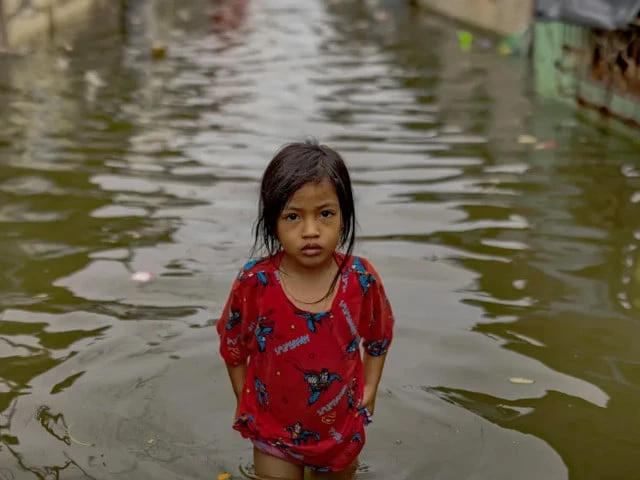
Pakistan’s inclusion among the top countries for child climate exposure comes as no surprise to observers. The nation has experienced devastating floods, unprecedented heatwaves, and glacial melt in recent years, events that have repeatedly displaced millions and destroyed critical infrastructure.
In percentage terms, Sub-Saharan African nations—particularly the Sahel region—have the highest proportion of children affected, often exacerbated by governments’ limited capacity to cope with climate hazards. Chad, for instance, faces a humanitarian crisis with restricted access to water, electricity, and food, where more than 95 percent of children are exposed to at least three hazards .
Island States Face Existential Threat
The report also highlights the vulnerability of 39 island states, which face unique challenges including limited freshwater resources, import dependence, and the inability to easily shelter elsewhere after a disaster such as a hurricane .
Analysis: A Call to Action Ignored?
“Children are at the forefront of the impact of climate change,” said UNICEF chief Catherine Russell, a sentiment that has been echoed by scientists and activists for years.
The UNICEF report is more than a compilation of alarming statistics; it is an urgent call for global leaders to prioritize child-centered climate policies. As the impacts of climate change accelerate, the window for meaningful action is closing. The fact that the number of children exposed to multiple hazards has increased sharply over the past two decades suggests that current mitigation and adaptation efforts are insufficient.
Without immediate and aggressive intervention to reduce emissions and build climate resilience, especially in vulnerable regions like South Asia and Sub-Saharan Africa, the future for hundreds of millions of children will be defined by preventable suffering, displacement, and lost potential. The report implicitly asks the world a crucial question: How many more warnings will it take before we act decisively for the sake of our children?