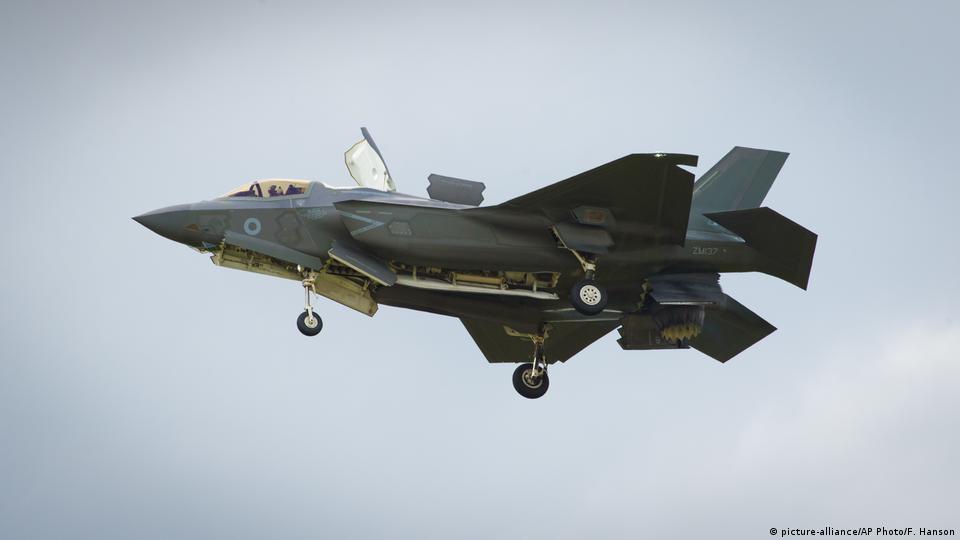
COPENHAGEN, March 10, 2026 — Denmark’s Supreme Court on Tuesday began hearing arguments in a pivotal lawsuit filed by four humanitarian organizations that accuse the Danish state of violating international law by permitting the export of F-35 fighter jet components to Israel .
The case, brought against the Ministry of Foreign Affairs and the National Police, does not yet rule on the legality of the arms sales themselves. Instead, the Supreme Court is tasked with determining a preliminary but crucial question: whether the non-governmental organizations have the legal standing—or “right of action”—to challenge Danish arms export policies in court .
The plaintiffs include the Palestinian human rights association Al-Haq, ActionAid Denmark, and the Danish branches of Amnesty International and Oxfam .
The Core Allegation: Complicity in Violations
The organizations argue that by allowing Danish companies, particularly the defense firm Terma, to supply parts for the US-led F-35 program—aircraft subsequently used by Israel in the Gaza Strip—Denmark is breaching its commitments under the UN Arms Trade Treaty and the EU Common Position on arms exports .
These international agreements require states to deny export licenses if there is a “clear, overriding risk” that the equipment could be used to commit serious violations of international humanitarian law .
“Amnesty International’s documentation shows that Israel is committing war crimes and genocide against the Palestinians in Gaza,” Dina Hashem, an official with Amnesty Denmark, told AFP. “That risk is clearly present in Gaza” . While Israel adamantly rejects accusations of genocide, the NGOs maintain that the scale of civilian casualties and the blocking of humanitarian aid necessitate a halt to weapons transfers .
The Procedural Hurdle: Legal Standing
In April 2025, the Eastern High Court (Østre Landsret) dismissed the lawsuit, ruling that the organizations could not “be considered to be affected in such a direct, individual and concrete manner that they meet the general conditions of Danish law regarding their right to bring proceedings” .
The NGOs immediately appealed to the Supreme Court. In a packed courtroom on Tuesday, Emil Kiørboe, the lawyer representing three of the four organizations, argued that the NGOs act as essential “watchdogs.” He contended that if civil society is denied access to the courts on matters of export control, “There will be areas that escape legal control” .
Vibe Klarup, Secretary General of Amnesty International Denmark, emphasized the broader democratic implications. “In a time when Denmark is arming itself and the international rules of the game that are supposed to protect civilians are under pressure, it is extremely important that we, as relevant organizations, can go to the courts to ensure that Denmark complies with international law,” she said in a press release .
Haifaa Awad, chairwoman of Mellemfolkeligt Samvirke (ActionAid Denmark), added, “It is absolutely crucial in a vibrant democracy and in a state governed by the rule of law that the decisions of our politicians can be reviewed to see if they are in conflict with our international obligations” .
The Government’s Position
The Danish foreign ministry has consistently maintained that its export controls, particularly regarding the F-35 program, are “in accordance with applicable EU and international law obligations” . The Ministry of Foreign Affairs and the National Police have asked the Supreme Court to uphold the Eastern High Court’s ruling, thereby dismissing the NGOs’ bid for standing .
Broader Context: A Parallel Case in the Netherlands
The Danish lawsuit, initially filed in March 2024, followed a similar legal challenge in the Netherlands by a coalition of pro-Palestinian groups. However, a Dutch court ruled in December 2024 that the Dutch government was respecting the rules governing its arms trade and rejected demands for a total ban on exports to Israel .
What Happens Next?
The Danish Supreme Court’s hearings are scheduled to conclude on Wednesday. A ruling on the question of the NGOs’ legal standing is expected within approximately one week .
If the Supreme Court rules in favor of the organizations, the case will proceed to a substantive review—likely at the High Court—where the legality of Denmark’s export permits for F-35 parts will be examined on their merits. If the court rules against them, the lawsuit will be terminated .
The proceedings come amid a fragile and repeatedly violated ceasefire in Gaza. Since the truce took effect on October 10, 2025, at least 618 Palestinians and five Israeli soldiers have been killed, according to the Gaza health ministry and the Israeli army, respectively .