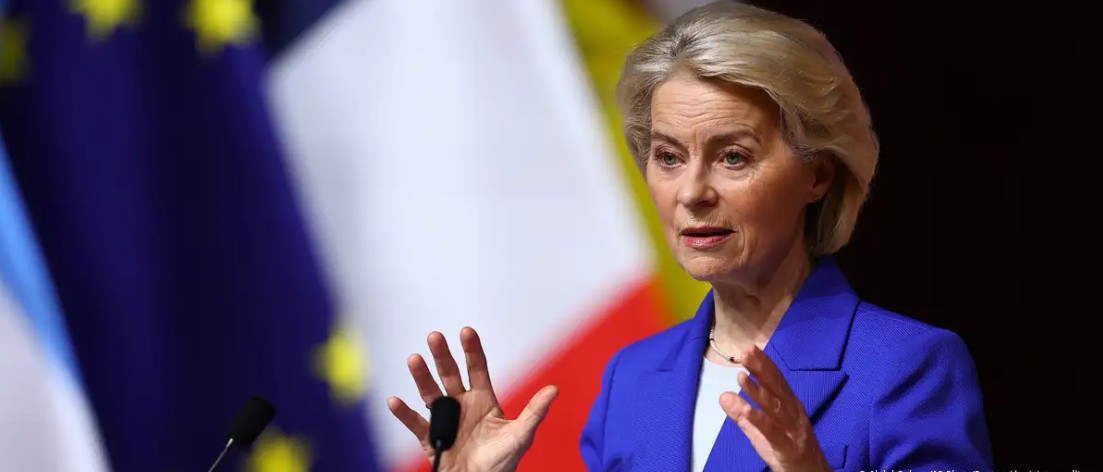
PARIS — European Commission President Ursula von der Leyen declared on Tuesday that Europe’s decades-long retreat from civilian nuclear power was a “strategic mistake,” a stark admission made against the backdrop of a widening war in the Middle East that has exposed the continent’s deep dependence on imported fossil fuels .
Speaking at the International Atomic Energy Agency (IAEA) Nuclear Energy Summit just outside Paris, von der Leyen lamented that while nuclear power supplied one-third of Europe’s electricity in 1990, that share has now dwindled to just 15% . “This reduction in the share of nuclear was a choice. I believe that it was a strategic mistake for Europe to turn its back on a reliable, affordable source of low-emission power,” she told world leaders and industry executives .
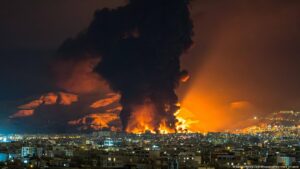
The mea culpa comes as the US-Israeli conflict with Iran enters its second week, triggering the closure of the Strait of Hormuz—a chokepoint for 20% of global oil supplies—and sending energy prices soaring . Von der Leyen warned that Europe, which is “neither an oil nor a gas producer,” remains “completely dependent on expensive and volatile imports” . “The current Middle East crisis gives a stark reminder of the vulnerability it creates,” she added .
A €200 Million Bet on Small Modular Reactors
To reverse course, von der Leyen announced a €200 million ($230 million) guarantee to support private investment in innovative nuclear technologies, specifically Small Modular Reactors (SMRs) . The funding will be sourced from the EU Emissions Trading System and aims to de-risk investment in what she called “the most efficient energy system”—a mix of nuclear and renewables supported by modernized grids and storage .
The European Commission also unveiled a dedicated SMR strategy, with the goal of having the first units operational by the early 2030s . Unlike traditional reactors generating around 1,000 megawatts, SMRs produce roughly 300 megawatts but are cheaper and faster to build due to standardized factory production . Von der Leyen emphasized the need to harmonize regulations across member states: “The logic is very clear. When it is safe to deploy, it has to be simple to deploy all across Europe” .
Macron Champions ‘Energy Sovereignty’
French President Emmanuel Macron, hosting the summit at a time when France itself imported 39% of its enriched uranium from Russia in 2025, strongly endorsed the nuclear pivot . “Nuclear power is key to reconciling both independence—and thus energy sovereignty—with decarbonization, and thus carbon neutrality,” Macron stated .
He warned that excessive reliance on hydrocarbons turns them into “a tool of pressure, or even of destabilisation” . Macron also proposed standardizing reactor designs across Europe, a move that could benefit France’s state-owned EDF, which has recently lost key contracts to South Korean competitors .
Germany’s Lingering Divide
The policy shift highlights a deepening rift within the EU. Germany, where von der Leyen served as a minister in Angela Merkel’s government when it decided to phase out nuclear power after the 2011 Fukushima disaster, remains staunchly opposed . German Environment Minister Carsten Schneider criticized von der Leyen’s “backward-looking strategy,” insisting that “cleaner, safer electricity from wind and sun is cheaper, has long been driving the energy transition, and produces no radioactive waste” .
However, some previously anti-nuclear nations like Denmark and the Netherlands are softening their stance as they seek stable, low-carbon power for heavy industry . Austria and Luxembourg remain opposed .
Protests and Geopolitical Ironies
The summit was not without disruption. Two Greenpeace activists stormed the stage at the event’s opening, holding banners reading “Nuclear Power = Energy Insecurity” and “Nuclear power fuels Russia’s war,” a pointed reference to the EU’s continued, albeit reduced, imports of Russian uranium . According to Euratom, Russia still supplied around 15% of the bloc’s natural uranium in 2024 .
Despite these contradictions, von der Leyen framed the nuclear revival as an industrial imperative. “We have now the ambition to progress rapidly and on a large scale so that Europe becomes a global hub for next-generation nuclear energy,” she said . The question remains whether the EU can bridge its internal divisions and secure the massive investment needed—far beyond the initial €200 million—to make that ambition a reality .