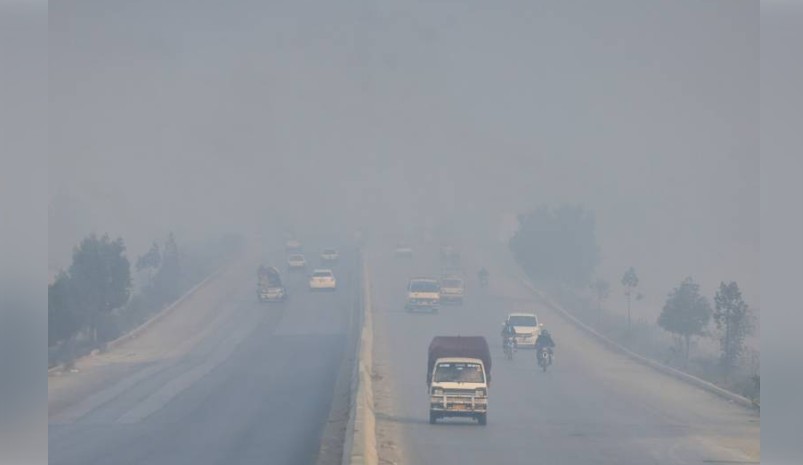
LAHORE/ISLAMABAD – The Swiss air quality monitoring firm IQAir released its annual World Air Quality Report on Tuesday, delivering a sobering assessment of Pakistan’s environmental crisis. Concentrations of fine particulate matter—PM2.5, the microscopic pollutants most dangerous to human health—were found to be up to 13 times higher than the WHO’s safety threshold across the country.
The report found that the world’s 25 most polluted cities in 2025 were all located in India, Pakistan, and China. Within Pakistan, major urban centers including Karachi, Hyderabad, and Lahore recorded persistently high pollution levels. In Karachi, the Air Quality Index (AQI) exceeded 100 on September 29, 2025, placing it in the “unhealthy for sensitive groups” category—a designation that became increasingly common throughout the year.
The findings place Pakistan ahead of Bangladesh and Tajikistan, which ranked second and third respectively, while Chad—the most polluted country in 2024—fell to fourth place. The report noted that only 13 countries and territories managed to maintain annual PM2.5 levels within the WHO guideline of less than 5 micrograms per cubic meter in 2025, an increase from seven in 2024, but overall global air quality deteriorated.
A Public Health Emergency
The health implications of Pakistan’s air quality crisis are profound. PM2.5 particles—produced by vehicle emissions, industrial activity, construction dust, and agricultural burning—are small enough to penetrate deep into the lungs and enter the bloodstream. Long-term exposure has been linked to respiratory and cardiovascular diseases, lung cancer, and premature death.
For Pakistan’s urban populations, the toll is already visible. Hospitals in Lahore and Karachi report spikes in respiratory emergencies during winter months when temperature inversions trap pollutants close to the ground. Children, the elderly, and those with pre-existing conditions are particularly vulnerable. The WHO estimates that air pollution causes approximately 7 million premature deaths globally each year, with South Asia bearing a disproportionate share of the burden.
The timing of the IQAir report is particularly significant. As Pakistan’s government prepares to finalize a proposal for a weekly one-day nationwide lockdown to conserve fuel amid surging oil prices, environmental advocates are warning that energy conservation measures must not come at the expense of air quality improvements.
The Energy Crisis and Environmental Intersection
Pakistan’s ranking as the world’s most polluted country comes at a moment of acute energy vulnerability. The closure of the Strait of Hormuz and the resulting surge in global oil prices have forced the government to consider drastic demand-side measures, including restricting commercial activity hours and implementing a weekly shutdown.
These measures, while aimed at conserving fuel, could have complex environmental implications. Reduced vehicular traffic and industrial activity during a weekly lockdown would likely result in temporary improvements in air quality—a phenomenon observed during COVID-19 pandemic restrictions when pollution levels dropped dramatically in cities worldwide.
However, any improvements would be short-term and contingent on the nature of the restrictions. Moreover, the underlying drivers of Pakistan’s air pollution—inefficient vehicle fleets, reliance on dirty fuels for industrial and domestic heating, agricultural burning practices, and inadequate emissions controls—would remain unaddressed.
Environmental experts argue that the current crisis presents an opportunity to rethink Pakistan’s energy and environmental policies. Rather than relying solely on demand reduction, the government could accelerate investments in renewable energy, promote cleaner transportation, and enforce existing emissions standards. The fuel conservation measures under consideration, if designed thoughtfully, could incorporate environmental co-benefits.
Global Air Quality Trends
The IQAir report painted a mixed picture of global air quality in 2025. While 75 countries recorded a decline in PM2.5 levels compared to the previous year, 54 experienced worsening pollution—underscoring the persistent global challenge of air quality management.
Widespread wildfires in Canada contributed to elevated PM2.5 levels across the United States and parts of Europe, demonstrating how air pollution increasingly crosses borders. In contrast, countries such as Australia, Iceland, Estonia, and Panama met the WHO air quality standards, highlighting the significant disparities in environmental governance and public health outcomes worldwide.
The report also highlighted data limitations that affected the global rankings. The shutdown of a United States-run air quality monitoring program in March 2025 led to gaps in pollution data, particularly in developing countries. As a result, nations including Burundi, Turkmenistan, and Togo were excluded from the latest assessment—a reminder that environmental monitoring remains unevenly distributed across the globe.
Overall, 130 out of 143 monitored countries failed to meet WHO air quality guidelines in 2025, a statistic that underscores the scale of the global challenge.
Pakistan’s Regional Pollution Burden
The report’s finding that the world’s 25 most polluted cities are concentrated in India, Pakistan, and China reflects the severe environmental challenges facing South Asia. Within this regional context, Pakistan’s ranking as the most polluted country signals that its urban centers are bearing a particularly heavy burden.
Lahore, Pakistan’s cultural capital and second-largest city, has long been a hotspot for winter smog. The combination of vehicle emissions, industrial activity, and agricultural burning in surrounding Punjab province creates a toxic cocktail that regularly pushes AQI readings into the hazardous range. Karachi, the country’s commercial hub and largest city, faces similar challenges compounded by rapid urbanization and inadequate infrastructure.
Hyderabad, the third major city highlighted in the report, reflects the spread of pollution beyond the largest metropolitan centers. As Pakistan’s urban population continues to grow, the health impacts of air pollution are likely to intensify unless significant policy interventions are implemented.
Analysis: A Crisis of Governance and Opportunity
Pakistan’s designation as the world’s most polluted country is both a condemnation of past environmental governance failures and a warning about future public health costs.
The drivers of Pakistan’s air pollution are well understood. Decades of underinvestment in public transportation, reliance on imported fossil fuels, weak enforcement of industrial emissions standards, and agricultural practices that rely on crop burning have created a perfect storm. Climate change has exacerbated the problem, with shifting weather patterns affecting the dispersion of pollutants.
Yet the current moment also presents opportunities. The fuel conservation measures being considered in response to the Middle East crisis could serve as a catalyst for longer-term energy reforms. If the government uses the crisis to accelerate the transition to renewable energy, promote electric vehicles, and strengthen emissions standards, the environmental benefits could extend far beyond any short-term improvements from lockdowns.
The international community has a role to play as well. Development partners and climate finance mechanisms can support Pakistan’s efforts to improve air quality monitoring, invest in cleaner technologies, and build institutional capacity for environmental regulation. The IQAir report’s data limitations—exacerbated by the shutdown of US-run monitoring programs—underscore the need for sustained international investment in environmental data infrastructure.
For Pakistan’s citizens, the report serves as a reminder of the daily health costs of air pollution. As the government finalizes its response to the energy crisis, environmental considerations must be part of the calculus. The weekly lockdown under consideration could provide temporary relief, but only sustained policy action can address the underlying drivers of Pakistan’s air quality crisis.
As the country navigates the intersecting challenges of energy security, diplomatic engagement, and environmental degradation, the decisions made in the coming weeks will shape not only Pakistan’s economic trajectory but also the health of its 240 million citizens for years to come.