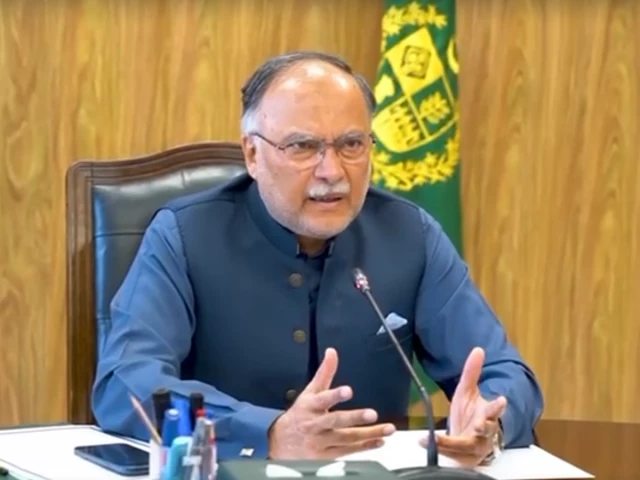
As Pakistan confronts a deepening fuel crisis, rising pollution levels, and the economic fallout of the Middle East conflict, Federal Minister Ahsan Iqbal has issued a rallying call for national unity and economic revival. Speaking at a Pakistan Day ceremony, the minister urged the nation to overcome pessimism, reduce dependence on foreign loans, and win what he described as the “battle of development”—a struggle he framed as the natural successor to the independence movement led by Quaid-e-Azam Muhammad Ali Jinnah.
ISLAMABAD – On the 86th anniversary of the Lahore Resolution, which laid the foundation for Pakistan’s creation, Federal Minister for Planning, Development, and Special Initiatives Ahsan Iqbal delivered a passionate address calling for a renewed national focus on economic self-reliance and development. Speaking at a ceremony commemorating Pakistan Day, the minister invoked the legacy of the nation’s founders to frame the current economic challenges as a continuation of the struggle for independence.
“The vision of Pakistan was conceived on March 23, 1940, under the leadership of Quaid-e-Azam Muhammad Ali Jinnah and materialized within just seven years of struggle,” Iqbal told the gathering, reminding his audience that the nation’s founders overcame seemingly insurmountable odds to achieve independence. He noted that despite severe illness, the Quaid continued to lead the Pakistan Movement, concealing his condition and intensifying efforts until the nation achieved independence.
“We cannot fully repay the sacrifices of Quaid-e-Azam, but it is our responsibility to follow in his footsteps and put the country on the path of progress,” the minister said.
The ‘Battle of Development’ vs. Current Crises
Iqbal’s address comes at a moment when Pakistan is navigating a convergence of domestic and international challenges that threaten to derail economic stability. The country is ranked as the world’s most polluted nation according to a report released Tuesday, with PM2.5 levels 13 times higher than World Health Organization safety limits. Sindh is on high alert for heavy rains forecast from Wednesday, with authorities mobilizing to prevent urban flooding. The federal government is considering a nationwide one-day weekly lockdown to conserve fuel amid surging oil prices driven by the closure of the Strait of Hormuz.
Against this backdrop, Iqbal’s call for economic revival takes on particular urgency. The minister emphasized that Pakistan must reduce its dependence on foreign loans, increase exports to earn dollars, and make collective efforts to win the “battle of development”—a phrase that encapsulates the administration’s framing of economic growth as a national security imperative.
“Pakistan today possesses strong defence capabilities, which have gained global recognition in recent years,” Iqbal noted, adding that vigilance and strength are essential in a changing regional environment. He credited former leaders Zulfikar Ali Bhutto, General Zia-ul-Haq, Ghulam Ishaq Khan, and Nawaz Sharif for their key roles in making Pakistan a nuclear power, rendering its defence invincible.
The minister’s emphasis on self-reliance reflects a broader policy orientation that has gained traction in recent months. With foreign exchange reserves under pressure and the current account deficit widening due to higher oil import costs, the government has been exploring measures to boost domestic production, reduce imports, and attract foreign investment.
The Economic Landscape: Fuel, Inflation, and Uncertainty
Iqbal’s call for economic revival comes at a time of significant economic uncertainty. The closure of the Strait of Hormuz has driven global oil prices above $100 a barrel, forcing Pakistan to consider drastic fuel conservation measures. The federal government is finalizing a proposal for a nationwide one-day weekly lockdown, while Sindh has already implemented a 60 percent reduction in official vehicle fuel consumption and is considering smart lockdowns.
Inflation remains a persistent challenge, with higher energy costs feeding into prices across the economy. The government has been forced to pass on some of the increase in global oil prices to consumers, adding to the burden on households already struggling with the cost of living.
The minister’s emphasis on reducing dependence on foreign loans and increasing exports reflects a recognition that Pakistan’s economic vulnerabilities are exacerbated by its reliance on external financing. The “battle of development,” as framed by Iqbal, involves structural reforms aimed at boosting competitiveness, attracting investment, and building export capacity.
Pakistan Day: A Moment for National Reflection
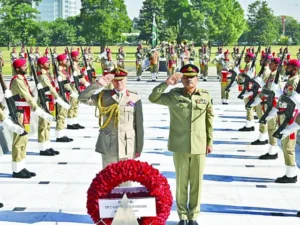
Pakistan Day, observed annually on March 23, commemorates the Lahore Resolution of 1940, in which the All-India Muslim League formally called for the creation of independent Muslim states in the subcontinent’s northwestern and eastern zones. The day is traditionally marked by military parades, flag-raising ceremonies, and patriotic speeches.
This year’s commemorations, however, unfolded against an unusually complex backdrop. In addition to the economic and environmental challenges, Pakistan is playing a central role in diplomatic efforts to de-escalate the Middle East conflict, with backchannel communications between Tehran and Washington being facilitated through Islamabad. Army Chief Field Marshal Asim Munir has engaged directly with President Trump and Iranian leadership, positioning Pakistan as a key mediator in a crisis that threatens global energy supplies.
The military dimension of Pakistan Day took on added significance this year, with President Asif Ali Zardari approving military awards for 1,253 armed forces personnel on Tuesday—a day before the official commemorations. The honors included gallantry awards for soldiers who made the ultimate sacrifice, underscoring the ongoing operational commitments of Pakistan’s armed forces.
Overcoming Pessimism: A Call for National Unity
Throughout his address, Iqbal struck a tone of determined optimism, urging the nation to move beyond “inferiority and negative thinking.” He stressed that Pakistan is “a great blessing of Allah” that must be strengthened through hard work and determination, in line with the legacy of its forefathers.
The minister’s emphasis on overcoming pessimism reflects a recognition that national morale plays a critical role in navigating crises. With the public facing rising fuel prices, potential lockdowns, and the daily health impacts of severe air pollution, maintaining a sense of national purpose is a significant challenge for the administration.
Iqbal’s framing of current economic struggles as a “battle” echoes the language used by Pakistan’s founders, who spoke of the struggle for independence in terms of sacrifice, determination, and unwavering commitment. By invoking this historical parallel, the minister sought to galvanize public support for the difficult economic adjustments that lie ahead.
Analysis: A Battle on Multiple Fronts
Ahsan Iqbal’s Pakistan Day address captures the duality of Pakistan’s current moment: a nation with formidable defensive capabilities and a proud historical legacy, yet one grappling with economic vulnerabilities that threaten to undermine its stability.
The “battle of development” that Iqbal invoked is not a single struggle but a convergence of multiple challenges. The fuel crisis, driven by external factors beyond Pakistan’s control, requires both short-term conservation measures and long-term energy security planning. The pollution crisis, which has earned Pakistan the dubious distinction of being the world’s most polluted country, demands environmental reforms that will take years to implement. The threat of urban flooding in Sindh requires immediate disaster preparedness.
Yet there are also sources of resilience. Pakistan’s armed forces continue to receive recognition for their professionalism and sacrifice, as reflected in the recent military awards. The country’s diplomatic corps has positioned Islamabad as a key mediator in the Middle East conflict, demonstrating that Pakistan can play a constructive role in regional stability. The leadership’s focus on exports and self-reliance suggests a recognition that economic sovereignty is as important as military sovereignty.
For ordinary Pakistanis, the coming weeks will test the limits of national resilience. The potential implementation of a weekly lockdown, combined with rising fuel prices and the health impacts of air pollution, will impose significant costs. Whether the public can maintain the “hard work and determination” that Iqbal called for will depend in part on whether the government can demonstrate that the sacrifices are leading toward tangible progress.
As Pakistan navigates the intersection of diplomatic ambition, domestic crisis management, and long-term development goals, the “battle of development” remains a work in progress. The nation’s founders achieved independence against seemingly impossible odds; whether their successors can achieve economic stability in equally challenging circumstances remains to be seen.