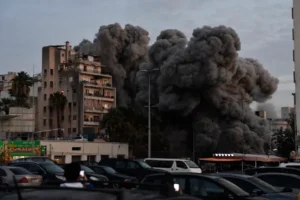
The United States and Israel have targeted Iran’s Khuzestan and Mobarakeh steel companies—among the country’s largest and most strategic industrial assets—in a new wave of strikes amid the ongoing escalation, Iranian media reported Friday. One person was killed and 15 others were injured in the attack in Isfahan province, as the conflict that has engulfed the region enters its fifth week with no end in sight.
TEHRAN – The US-Israeli military campaign against Iran has expanded to target the country’s industrial base, with strikes hitting the Khuzestan and Mobarakeh steel companies—two of Iran’s largest and most strategically significant steel producers. Emergency units arrived at the scene, Iran’s semi-official Fars News Agency reported, stating that more details would be revealed regarding the development.
The strikes in Isfahan province resulted in one fatality and 15 injuries, according to Mehdi Jamalinejad, the provincial governor, speaking to Iran’s IRIB News Agency. The attack represents a significant expansion of the targeting criteria used by US and Israeli forces, which have previously focused on military installations, nuclear facilities, and energy infrastructure.
Strategic Significance of the Targets
The Khuzestan and Mobarakeh steel companies are cornerstones of Iran’s industrial sector. Mobarakeh Steel Company, located near Isfahan, is Iran’s largest steel producer and one of the largest industrial complexes in the Middle East. It plays a critical role in Iran’s economy, supplying steel for construction, infrastructure, and military applications. Khuzestan Steel Company is another major producer, vital to the country’s industrial output.
Targeting these facilities represents a shift in the US-Israeli strategy, moving beyond purely military targets to strike at the economic foundations of the Iranian state. The steel industry is not only a major source of employment and foreign exchange but also a critical component of Iran’s industrial self-sufficiency—a key element of the country’s resilience in the face of sanctions.
The strikes also carry symbolic weight. The Mobarakeh Steel Company is located in Isfahan, a city of profound historical and cultural significance to Iran. The choice to strike in this region sends a message about the US and Israel’s willingness to target assets across the country, regardless of their location.
The Human Toll
The reported death and injuries from the Isfahan strikes add to the mounting human cost of the conflict. According to figures cited by Anadolu, more than 1,340 people have been killed in Iran since the US-Israeli offensive began on February 28, including former Supreme Leader Ayatollah Ali Khamenei. The toll includes civilians, military personnel, and industrial workers caught in the expanding strikes.
The Iranian Red Crescent has reported that more than 82,000 civilian structures have been damaged or destroyed in the strikes, including over 62,000 homes, 281 medical facilities, and 498 schools. The targeting of industrial sites adds another dimension to the humanitarian crisis, potentially affecting employment and economic stability in already hard-hit regions.
Iran’s Retaliatory Capabilities
Tehran has retaliated for the US-Israeli strikes with waves of drone and missile attacks targeting Israel, Jordan, Iraq, and Gulf countries hosting US military assets. These attacks have inflicted casualties and infrastructure damage while disrupting global markets and aviation.
According to a Wall Street Journal report published Friday, US military losses in the conflict are estimated at $1.4 billion to $2.9 billion in the first three weeks alone. Damages include three F-15E fighter jets mistakenly shot down by a Kuwaiti aircraft, an F-35 stealth jet damaged, a midair collision between two KC-135 refueling planes that killed six crew members, and more than a dozen MQ-9 Reaper drones lost. The aircraft carrier USS Gerald R. Ford also sustained damage and is undergoing repairs.
The strikes on the steel companies are likely to provoke further Iranian retaliation, potentially targeting US or allied assets in the region. The cycle of escalation shows no signs of abating as diplomatic efforts to broker a ceasefire continue.
The Strait of Hormuz and Global Energy Markets
The targeting of Iran’s industrial infrastructure comes amid continued disruption to the Strait of Hormuz, through which approximately 20 percent of the world’s oil normally passes. Iran’s military has declared that the situation in the strait “will not return to the past,” asserting Tehran’s authority over transit through the strategic waterway.
The closure has driven up global energy prices and prompted fuel conservation measures in countries as far away as Pakistan, which is considering weekly lockdowns to reduce consumption. Iraq’s oil production has also been severely impacted, with output at Basra Oil Company slashed from 3.3 million barrels per day to just 900,000 barrels.
The strikes on Iran’s steel industry, which relies heavily on energy for its operations, will likely further strain the country’s industrial capacity at a time when it is already under immense pressure.
The Expanding War
The conflict has now expanded beyond Iran’s borders, with Israel conducting extensive strikes against Hezbollah in Lebanon. The UN has reported that an average of 19,000 children have been displaced daily in Lebanon over the past three weeks, with more than 370,000 children forced from their homes. At least 121 children have been killed and 395 injured in Lebanon alone.
Iraq’s oil sector has been severely disrupted, and the country has become a battleground for Iranian retaliation against US forces. The US has also reported drone incursions over domestic military installations, including Barksdale Air Force Base in Louisiana, which hosts B-52 bombers critical to the war effort.
Diplomatic Efforts Amid Escalation
Despite the escalating violence, diplomatic efforts to end the conflict continue. Pakistan has positioned itself as a key mediator, with Prime Minister Shehbaz Sharif formally offering to host US-Iran talks in Islamabad. The White House has said that talks remain “productive” even as it warned that President Trump is prepared to “unleash hell” on Iran if Tehran fails to accept the “reality of the current moment.”
France and the G7 have expressed support for Pakistan’s mediation role, with French Foreign Minister Jean-Noel Barrot calling for an immediate halt to attacks on civilian populations and infrastructure. The G7 also reaffirmed “the absolute necessity” of restoring free and safe navigation in the Strait of Hormuz.
However, Iran has hardened its position. The country’s parliament speaker, Mohammad Bagher Qalibaf, accused the US and Israel on Wednesday of planning to occupy one of Iran’s islands with support from an unnamed regional country, threatening “relentless attacks” on that country’s vital infrastructure if any move is made.
Analysis: A Dangerous Expansion of the Conflict
The US-Israeli strikes on Iran’s largest steel companies represent a significant escalation of the conflict, moving beyond military targets to strike at the heart of the country’s industrial economy.
For Tehran, the targeting of the Khuzestan and Mobarakeh steel companies is a direct attack on the economic infrastructure that underpins both civilian life and military capability. The steel industry is not only a major employer and source of export revenue but also a critical component of Iran’s ability to sustain itself under sanctions. Damaging these facilities strikes at Iran’s long-term resilience.
For Washington and Jerusalem, the strikes signal a determination to impose costs on Iran that extend beyond the military realm. By targeting industrial assets, the US and Israel are sending a message that no part of Iran’s economy is safe from attack—a message that may be intended to pressure Tehran into concessions.
Yet the strategy carries significant risks. The strikes will likely provoke further Iranian retaliation, potentially targeting US and allied assets in the region. The loss of life—at least one killed and 15 injured—adds to the toll that may make it more difficult for Iranian leadership to engage in negotiations.
As the conflict enters its fifth week, with no ceasefire in sight, the strikes on Iran’s steel industry represent another dangerous step toward a wider war. Whether diplomatic efforts can halt this trajectory before it becomes irreversible remains the central question of the coming days.