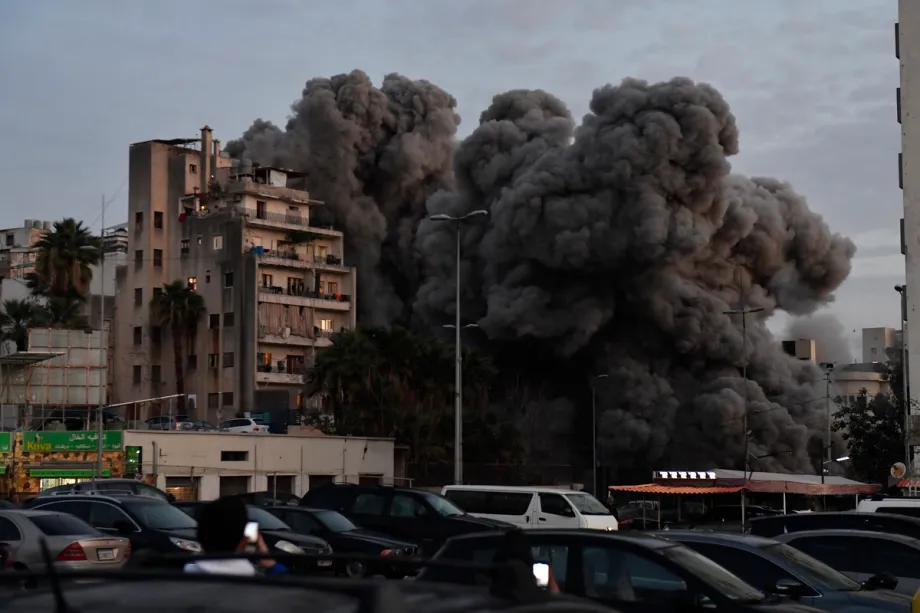
Israel has launched another military invasion of Lebanon, repeating a pattern of armed intervention that has failed to secure its northern border for more than four decades. With the Israeli Defense Forces (IDF) pushing toward the Litani River, issuing mass displacement orders, and threatening indefinite occupation of southern Lebanon, critics warn that the current operation—like its predecessors in 1978, 1982, 2006, and 2024—is destined to fail, sowing the seeds for the next iteration of Hezbollah or an even more formidable resistance movement to emerge.
BEIRUT/TEL AVIV – The familiar pattern is playing out once again. Israeli warplanes strike Hezbollah positions. Civilians in southern Lebanon flee their homes in anticipation of a ground offensive. Bridges across the Litani River are targeted. Displacement orders are issued. And the rhetoric from Israeli officials speaks of “security zones,” “sterile cordons,” and the creation of conditions that will finally guarantee the safety of Israel’s northern residents.
Yet for those who have watched Lebanon over the decades, the auguries are not good. Israel’s previous invasions—1978, 1982, 2006, and the 2024 incursion—have each failed to deliver lasting security. Each created conditions that fueled the very resistance movements Israel sought to destroy. And each ended with Israeli forces withdrawing, often under fire, leaving behind a landscape of destruction and a population more deeply resentful than before.
Now, as the IDF pushes toward the Litani with a declared intention of establishing a permanent buffer zone, the cycle threatens to repeat itself with devastating consequences.
The Current Invasion: By the Numbers
The scale of the current operation is already staggering. Since the front reopened in fury on March 2, following the collapse of a November 2024 ceasefire agreement, Lebanon’s Ministry of Public Health has documented 1,029 deaths, including 118 children and 40 medical workers. The UN reports that an average of 19,000 children have been displaced daily over the past three weeks, with more than 370,000 children forced from their homes.
On March 22, Israel’s Defense Minister Israel Katz announced that he and Prime Minister Benjamin Netanyahu had ordered the destruction of all bridges over the Litani River “to prevent passage of Hezbollah terrorists and weapons southward.” He also ordered the accelerated “destruction of Lebanese homes in the border villages” to eliminate threats to Israeli settlements—language that echoes the destruction wrought in Beit Hanoun and Rafah in Gaza.
Katz’s declaration on March 16 that “hundreds of thousands of Shiite residents of southern Lebanon […] will not return to their homes south of the Litani until the safety of Israel’s northern residents is guaranteed” signaled the intention to create a depopulated buffer zone—a policy that international law experts warn constitutes collective punishment and may amount to a war crime.
A Pattern of Historical Repetition
The current invasion follows a grim template established over more than four decades. In 1978, Israel invaded Lebanon in Operation Litani, seeking to push Palestinian militant groups away from its border. The invasion failed to achieve lasting security, and Israeli forces withdrew only to return in 1982 with an even larger operation.
The 1982 invasion had seemingly clear goals: destroy the Palestine Liberation Organization (PLO), expel its leadership north of the Litani, and broker a peace treaty with Lebanon. The PLO was expelled, its leadership finding troubled sanctuary in Tunisia. But the Israeli occupation that followed—lasting until 2000—gave birth to a new resistance movement. Iranian-backed and inspired, Hezbollah emerged precisely because of the conditions created by Israeli occupation.
In the aftermath of the IDF’s 2000 withdrawal, Hezbollah grew in prominence, framing its 2006 war with Israel as an achievement of resistance. The constant theme of the conflict, promoted by its late leader Hassan Nasrallah, was defensive resistance to Israeli occupation.
Now, as Israeli officials speak of establishing a “security zone” up to the Litani and creating a “sterile security cordon,” the pattern threatens to repeat itself. As Jack Khoury, writing in Haaretz, observed: “History suggests that as long as an occupation exists, an organization will emerge to fill the vacuum and carry that banner.”
The Political Context: A Missed Opportunity
The current invasion comes at a moment when Lebanon’s political landscape offered a rare opening for diplomacy. The Lebanese government, led by President Joseph Aoun and Prime Minister Nawaf Salam, has shown willingness to conduct direct negotiations with Israel through the offices of Washington to reach a peace agreement.
The decision to launch a devastating military operation, rather than pursue this diplomatic opening, may prove strategically foolish. It weakens the very Lebanese leaders who could have delivered a negotiated settlement, empowering hardline factions on both sides and entrenching the conflict for another generation.
Israel’s far-right finance minister, Bezalel Smotrich, went further on March 23, telling his Religious Zionism faction that the Litani had to “be our new border with the state of Lebanon… just like the ‘Yellow Line’ in Gaza and like the buffer zone and peak of the Hermon in Syria.” He envisaged the creation of “a sterile security cordon that will separate the enemy from our citizens.”
Such language suggests a policy of de facto annexation and territorial theft—a move that would, as history has shown, enliven the narrative of resistance and ensure that the conflict continues indefinitely.
The Human Cost
The immediate human cost of the invasion is already devastating. The destruction of bridges across the Litani and Zahrani rivers has cut off entire districts, isolating more than 150,000 people and severely limiting humanitarian access. Over 435 schools have been repurposed as shelters, disrupting education for more than 115,000 students.
The targeting of medical workers—40 documented killed so far—has crippled an already strained healthcare system. The International Federation of Red Cross and Red Crescent Societies has reported that one volunteer has been killed and several others injured during ambulance missions.
UNICEF has warned of severe psychological consequences for children caught in repeated cycles of violence, with the mental and emotional exhaustion weighing on them described as “devastating.” The organization has called for an immediate ceasefire, stressing that “children are paying the highest price for this conflict.”
The Broader Regional Conflict
The invasion of Lebanon cannot be separated from the broader regional war that has engulfed the Middle East since the US-Israeli offensive on Iran began on February 28. The conflict has now expanded to multiple fronts, with Israeli strikes targeting Hezbollah in Lebanon, Iranian infrastructure, and Palestinian militant groups in Gaza and the West Bank.
The US has suffered significant losses, with the Wall Street Journal reporting $1.4 billion to $2.9 billion in damaged equipment, 13 service members killed, and nearly 300 wounded. Iran has retaliated with drone and missile strikes targeting Israel and Gulf countries hosting US military assets.
The closure of the Strait of Hormuz has disrupted global oil supplies, driving prices above $100 a barrel and prompting fuel conservation measures in countries as far away as Pakistan. Iraq’s oil production has been slashed from 3.3 million barrels per day to just 900,000 barrels.
Analysis: The Illusion of Military Solutions
Israel’s repeated invasions of Lebanon rest on a fundamental misreading of the conflict’s dynamics: the belief that military force can achieve what political engagement cannot.
Each previous invasion was justified by the same logic: destroy the militant infrastructure, push the enemy back, create a buffer zone, and secure the border. And each previous invasion ended with Israeli forces withdrawing—often under fire—leaving behind a population more deeply committed to resistance than before.
The reasons are not mysterious. Military force can destroy infrastructure and kill leaders, but it cannot eliminate the conditions that give rise to resistance movements. When a population has been displaced, when homes have been destroyed, when collective punishment is inflicted on entire communities, the result is not submission but enduring grievance.
As the late Hezbollah leader Hassan Nasrallah understood, the narrative of defensive resistance is powerful precisely because it is rooted in the experience of occupation. Each Israeli invasion, each displacement order, each destroyed home confirms that narrative and fuels the next generation of fighters.
The current invasion, with its explicit intention to depopulate southern Lebanon and create a “sterile security cordon,” is likely to have the same effect. If not a revivified Hezbollah, then some other power will assume the mantle of resistance. The conditions that produced Hezbollah in the 1980s—Israeli occupation, displacement, and the absence of a political solution—are being recreated before our eyes.
The political tragedy is compounded by the fact that a diplomatic opening existed. The Lebanese government’s willingness to conduct direct negotiations with Israel offered a path to a negotiated settlement that could have addressed Israel’s legitimate security concerns without inflicting devastating human costs. That path has been abandoned in favor of a military approach that has failed before and will fail again.
For the people of southern Lebanon, the auguries are grim. For the Israeli soldiers who will occupy a hostile population, the auguries are grim. For the hope of peace between Israel and Lebanon—a peace that seemed possible after the 2024 ceasefire—the auguries are grim. The hateful heart can hunger and prove insatiable. The lessons of history, once again, are being ignored. And the cycle of invasion, occupation, resistance, and withdrawal will continue—until, perhaps, another generation learns what this one refuses to accept.