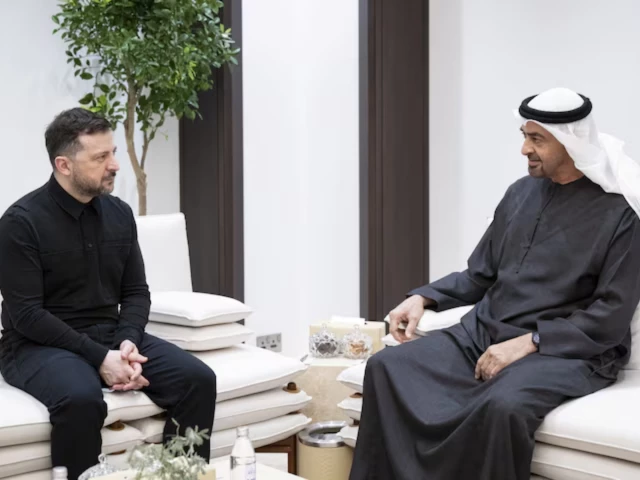
KYIV/ABU DHABI – Ukrainian President Volodymyr Zelensky said Saturday that he had met with UAE President Sheikh Mohammed bin Zayed Al Nahyan and that the two leaders had agreed to deepen cooperation on security and defence matters. The agreement represents a significant diplomatic achievement for Kyiv as it seeks to build partnerships beyond its traditional Western allies.
“Our teams will finalise the details,” Zelensky said on the Telegram app, without providing specifics on the scope or timeline of the proposed cooperation.
The Emirati state news agency WAM reported that the two leaders discussed opportunities to advance bilateral cooperation under the Comprehensive Economic Agreement between the two sides, though it did not elaborate on the defence components of the deal. They also addressed “the security developments and military escalation in the region and their impact on international navigation and the global economy,” WAM added—a reference to the ongoing US-Israeli war on Iran that has disrupted shipping through the Strait of Hormuz and driven up global energy prices.
A Diplomatic Blitz Across the Gulf
Zelensky’s Gulf tour has been swift and productive. After arriving in Saudi Arabia on Thursday, the Ukrainian leader witnessed the signing of a defence cooperation agreement between the Saudi and Ukrainian defence ministries. He then traveled to Qatar on Saturday for further talks, with Ukrainian Foreign Minister Dmytro Kuleba indicating that Kyiv was close to clinching several security agreements in the region.
The diplomatic push reflects Ukraine’s urgent need to counter Iranian military support for Russia. Since the beginning of Russia’s full-scale invasion in 2022, Iran has supplied Moscow with thousands of Shahed drones and other weaponry used to attack Ukrainian cities, energy infrastructure, and civilian targets. Iranian-made drones have become a persistent threat to Ukrainian air defenses, striking power grids and residential areas across the country.
Ukraine has sought to pressure Iran through diplomatic channels, including by pursuing security partnerships with Gulf states that have traditionally maintained ties with Tehran. The agreements with Saudi Arabia, the UAE, and potentially Qatar represent a strategic effort to isolate Iran diplomatically while building alternative security relationships in the region.
Regional Context: The Iran War’s Ripple Effects
The Ukrainian leader’s Gulf tour unfolds against the backdrop of the escalating US-Israeli war on Iran, which began on February 28 and has now entered its fifth week. The conflict has disrupted shipping through the Strait of Hormuz, through which approximately 20 percent of the world’s oil passes, and has driven global energy prices above $100 a barrel.
For Gulf states, the war presents a strategic dilemma. While several have expressed concern about Iranian retaliation against their infrastructure, they have also sought to maintain channels of communication with Tehran. Ukraine’s effort to build defence partnerships in the region represents a parallel diplomatic track—one that seeks to capitalize on Gulf states’ unease with Iranian aggression while offering an alternative security partnership.
Zelensky’s meetings with Gulf leaders have also addressed the broader security implications of the Iran conflict. The UAE and Saudi Arabia, both major energy exporters, have been directly affected by the closure of the Strait of Hormuz, which has disrupted their ability to ship oil through the critical waterway. Iran has also launched drone and missile strikes against US military assets in Gulf countries, raising regional security concerns.
Ukraine’s Counter-Iran Strategy
Ukraine’s push for Gulf partnerships is part of a broader strategy to counter Iranian military support for Russia. Ukrainian officials have long argued that Iran’s supply of drones and missiles to Moscow constitutes direct participation in the war against Ukraine and should be met with international consequences.
Ukrainian Foreign Minister Dmytro Kuleba said Friday that Kyiv was close to clinching several security agreements, including with the UAE and Qatar, to counter Iranian attacks. The agreements are expected to include intelligence sharing, technology cooperation, and potentially the acquisition of counter-drone systems—capabilities that Ukraine urgently needs to defend its cities and infrastructure.
The defence cooperation agreements with Saudi Arabia and the UAE also carry symbolic weight. Both countries have historically maintained balanced relationships with Iran and the United States, and their willingness to enter defence partnerships with Ukraine signals a recalibration of their regional alignments.
The UAE’s Evolving Role
For the United Arab Emirates, the defence agreement with Ukraine represents a continuation of its growing role as a regional diplomatic and security actor. In recent years, the UAE has positioned itself as a mediator in conflicts ranging from Ukraine to the Horn of Africa, and has invested heavily in building its own defence industrial base.
The agreement with Ukraine could involve the supply of Emirati-made defence systems, intelligence cooperation, or joint military exercises—though specifics have not been disclosed. Emirati officials have also expressed interest in Ukraine’s post-war reconstruction, and the defence agreement may be linked to broader economic cooperation under the Comprehensive Economic Agreement mentioned by WAM.
The UAE has also been active in mediation efforts related to the Iran conflict, with Emirati officials engaging with both Washington and Tehran through backchannels. The UAE’s dual role—building defence ties with Ukraine while maintaining channels to Iran—reflects a broader trend of Gulf states diversifying their security relationships.
Zelensky’s Diplomatic Offensive
President Zelensky’s Gulf tour is the latest in a series of diplomatic offensives he has conducted since Russia’s invasion began. The Ukrainian leader has traveled extensively to secure military, economic, and political support from allies around the world, building a coalition that includes NATO members, Asian powers, and increasingly, Gulf states.
The agreements with Saudi Arabia and the UAE represent a significant expansion of that coalition. While Gulf states have largely maintained neutrality in the Russia-Ukraine war, their willingness to enter defence partnerships with Ukraine suggests a shift in posture—one that may be driven in part by concerns about Iranian aggression and the destabilizing effects of the Iran conflict on the region.
Zelensky’s meetings have also provided an opportunity to discuss the broader security implications of the Iran war, which has disrupted global energy markets and threatened shipping through the Strait of Hormuz. For Ukraine, which has suffered from Iranian weapons supplied to Russia, the Iranian conflict is not a distant crisis but an immediate threat that compounds the challenges of defending against Russian aggression.
Analysis: A Strategic Realignment in the Gulf
Ukraine’s defence agreements with Saudi Arabia and the UAE represent a significant diplomatic achievement for Kyiv and a potential shift in Gulf security alignments.
For Ukraine, the partnerships offer more than symbolic support. The agreements could provide access to advanced defence technologies, intelligence sharing, and diplomatic backing in international forums. They also demonstrate that Ukraine’s coalition of supporters extends beyond Europe and North America to include major powers in the Middle East.
For the Gulf states, the agreements reflect a calculation that their security interests are increasingly aligned with Ukraine’s. Iran’s supply of drones and missiles to Russia has contributed to a conflict that has destabilized global energy markets and threatened shipping through the Strait of Hormuz. By building defence ties with Ukraine, Gulf states can signal their opposition to Iranian aggression while diversifying their security partnerships.
The timing of the agreements is significant. The US-Israeli war on Iran has created a volatile security environment in the Gulf, and Gulf states are reassessing their defence postures. Building partnerships with Ukraine—a country that has demonstrated resilience in the face of Iranian-supplied weapons—offers a way to strengthen their own defences while maintaining channels of communication with Tehran.
For the broader international order, the agreements represent another step in the reconfiguration of global alliances. The United States remains a critical security partner for Gulf states, but the Gulf’s willingness to build independent defence relationships reflects a trend toward multipolarity. Ukraine, once seen as a peripheral actor in Middle Eastern geopolitics, has emerged as a significant player in regional security dynamics.
As Zelensky continues his diplomatic tour, the agreements with Saudi Arabia and the UAE will likely be followed by further partnerships. Ukraine’s foreign minister has indicated that a deal with Qatar is imminent, suggesting that Kyiv’s Gulf offensive is just beginning.