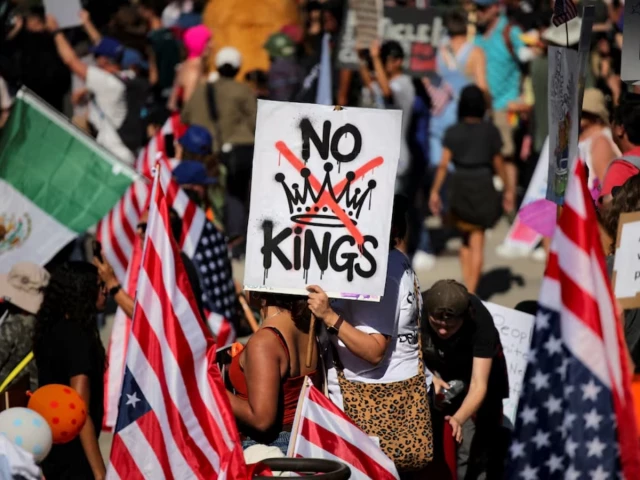
WASHINGTON, D.C. – On Saturday, Americans from every corner of the country will take to the streets in what organizers describe as a defining moment of civic resistance. The “No Kings” movement, which launched last year on Trump’s birthday and has since grown into one of the largest protest mobilizations in modern US history, is expected to draw millions of participants across more than 3,200 events spanning all 50 states.
The protests are fueled by a confluence of grievances: the administration’s prosecution of an unauthorized war against Iran, aggressive immigration enforcement actions, government shutdowns, and what demonstrators characterize as a systematic assault on democratic norms and constitutional checks and balances. The movement’s name—”No Kings”—invokes the founding principle that America was established as a republic governed by laws, not by the whims of any single ruler.
Flagship rallies will take place in New York, Los Angeles, Washington, DC, and Minnesota’s Twin Cities. But organizers say the most significant growth has occurred outside major metropolitan areas, with nearly 40% more events planned in smaller communities compared to the movement’s first mobilization last June. Two-thirds of participants are expected from outside major city centers.
“The defining story of this Saturday’s mobilization is not just how many people are protesting, but where they are protesting,” said Leah Greenberg, Co-Founder of Indivisible, the group that started the No Kings movement and led the planning of Saturday’s events.
A Movement Reaches Deep into Red America
Organizers report a surge in participation in deeply Republican states such as Idaho, Wyoming, Montana, and Utah—regions not typically associated with large-scale anti-administration protests. Competitive suburban areas that have helped decide national elections are seeing “huge” increases in interest, Greenberg said, citing Pennsylvania’s Bucks and Delaware counties, East Cobb and Forsyth in Georgia, and Scottsdale and Chandler in Arizona as examples.
“Voters who decide elections, the people who do the door knocking and the voter registration and all of the work of turning protests into power, they are taking to the streets right now, and they are furious,” she said.
The expansion into traditionally conservative areas suggests that opposition to Trump’s policies—particularly his conduct of the Iran war without congressional authorization—is cutting across partisan lines. Republican lawmakers, including Kentucky’s Thomas Massie and Ohio’s Warren Davidson, have publicly criticized the administration for bypassing Congress on war powers, reflecting a constitutional conservative critique of executive overreach.
The Iran War as a Flashpoint
Saturday’s protests come amid what organizers call a call to action against the bombardment of Iran by the US and Israel—a conflict now entering its fifth week. President Trump launched the military offensive on February 28 without a formal declaration of war or congressional authorization, a move that critics argue violated Article I of the Constitution, which grants Congress the sole power to declare war.
The war has exacted a devastating toll. According to Iranian officials, more than 1,900 people have been killed, over 22,800 injured, approximately 3.5 million displaced, and more than 81,000 civilian facilities damaged or destroyed since the strikes began. The closure of the Strait of Hormuz has driven global oil prices above $100 a barrel, with ripple effects felt across the US economy, where diesel in California hit a record average high of $7.17 a gallon.
The administration’s handling of the war has drawn criticism from across the political spectrum. Senator Chris Van Hollen called it “an illegal, regime-change war against Iran.” Senator Tim Kaine warned that the precedent of unchecked presidential war-making “is opening the door for presidents of either party into the future just to wage war willy-nilly.”
From Protests to Political Power
The No Kings movement has demonstrated an ability to translate street-level activism into tangible political results. Deirdre Schifeling, chief political and advocacy officer for the American Civil Liberties Union, said protests have led to administration reversals on several fronts.
“Whenever we stand up to President Trump’s abuses of power, like most bullies, he backs down,” Schifeling said, citing administration reversals following earlier demonstrations over National Guard deployments in Los Angeles and Immigration and Customs Enforcement (ICE) actions that led to the deaths of two American citizens in Minneapolis.
The movement’s previous mobilizations have drawn staggering numbers. The first No Kings Day of Action on June 14—Trump’s birthday—drew an estimated four to six million people spread across roughly 2,100 sites nationwide. The second mobilization in October involved an estimated seven million participants across more than 2,700 cities, according to a crowd-sourcing analysis published by prominent data journalist G. Elliott Morris.
That October event was largely fueled by a backlash against a government shutdown, an aggressive crackdown by federal immigration authorities, and the deployment of National Guard troops to major cities.
White House Response
In a statement, White House spokeswoman Abigail Jackson dismissed the rallies as “Trump Derangement Therapy Sessions” of interest only to journalists. The dismissive response echoes the administration’s previous characterizations of protest movements, which have consistently failed to dampen turnout.
The administration’s position on the protests reflects a broader tension: while Trump has claimed that the Iran war enjoys public support, the scale of the No Kings mobilization suggests significant opposition. With midterm elections scheduled for later this year, the movement’s ability to channel protest energy into electoral turnout could have substantial political implications.
Constitutional Foundations
The “No Kings” movement draws its name and inspiration from the founding premise of the American republic. The Declaration of Independence listed grievances against King George III, and the Constitution established a system of separated powers specifically designed to prevent the concentration of authority in any single branch or individual.
Protesters argue that Trump’s conduct of the Iran war without congressional authorization violates this foundational principle. The Constitution’s framers deliberately placed the power to declare war in the legislative branch, having lived under a monarch who could wage war at will. They did not intend to create another.
The movement’s constitutional framing has allowed it to attract support from across the political spectrum. Conservative critics of the administration, including former Republican lawmakers and military veterans, have joined liberals and progressives in calling for a restoration of congressional war powers.
A Defining Moment
As Saturday’s protests unfold, organizers are watching to see whether the movement can surpass its previous mobilizations. With more than 3,200 events planned—a significant increase from the 2,700 sites in October—and participation surging in smaller communities and traditionally Republican areas, the third No Kings Day of Action could indeed become the largest single-day nonviolent protest in US history.
But for organizers, the goal extends beyond turnout numbers. The movement has consistently framed its protests as part of a broader strategy to defend democratic institutions and restore constitutional checks and balances. With midterm elections approaching, the question is whether the energy of the streets can be channeled into sustained political engagement.
“The people who do the door knocking and the voter registration and all of the work of turning protests into power, they are taking to the streets right now, and they are furious,” Greenberg said. The coming months will test whether that fury translates into lasting political change.
Analysis: A Movement at a Crossroads
The No Kings protests represent the largest sustained mobilization against a presidential administration in modern American history. With three major mobilizations in less than a year, drawing millions of participants across thousands of events, the movement has demonstrated an ability to organize at scale and sustain momentum.
Yet the movement faces inherent challenges. The protests are decentralized, reflecting a coalition of groups with diverse priorities—from opposition to the Iran war to immigration reform to concerns about democratic norms. Sustaining unity across these constituencies while maintaining focus on the constitutional issues that have given the movement its broad appeal will be essential.
The midterm elections present both an opportunity and a test. The movement has shown an ability to mobilize voters in competitive suburban districts, but whether that translates into electoral outcomes depends on sustaining engagement through Election Day. Organizers are aware that the energy of the streets must be paired with the mechanics of political organizing.
For the administration, the protests present a political challenge. While White House dismissals of “Trump Derangement Syndrome” may satisfy the president’s base, they do little to address the substantive critiques raised by protesters—particularly the constitutional concerns about war-making authority. As the Iran conflict continues and economic pressures mount, the protests may grow rather than subside.
The “No Kings” movement has tapped into a deep vein of American political tradition: the belief that no individual is above the law and that the Constitution’s checks and balances must be defended. Whether that tradition can reassert itself in the face of sustained executive overreach remains to be seen. But on Saturday, millions of Americans will make their views known—and their voices will be heard across all 50 states.