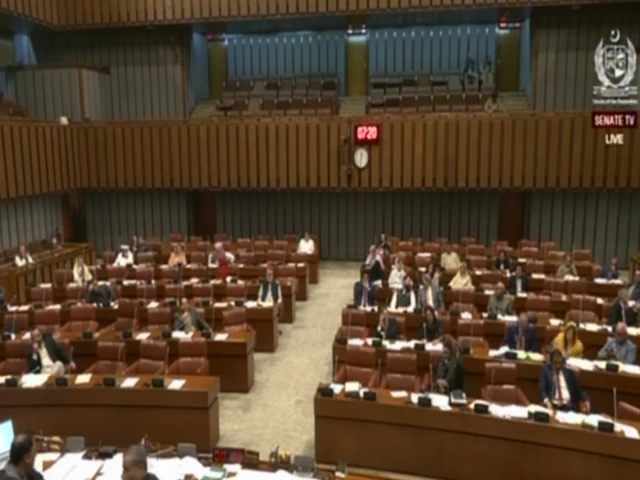
ISLAMABAD – The Senate committee expressed serious concern over the high prices of pharmaceutical products in the market, with Senator Rubina Khalid highlighting the burden on citizens. The CEO of the Drug Regulatory Authority of Pakistan (DRAP) briefed the committee on the pricing mechanism and committed to furnishing a detailed report within the next 14 days.
DRAP officials informed the committee that a survey covering 50 percent of pharmaceutical products available in the market would be conducted. Senator Chishti endorsed the concerns raised by members and directed that a comprehensive report be presented at the next meeting.
Medical Education Standards Under Scrutiny
The committee was also briefed on the entry test criteria for medical and dental colleges in various Asian countries. Senator Chishti directed that international criteria be followed in this regard, noting inconsistencies in current admission standards.
The federal minister for National Health Services, Regulations and Coordination (NHSR&C) observed that in some foreign countries, even students who have failed at the FA level manage to secure admission to medical institutions. He further noted that less than 1 percent of foreign-qualified graduates are able to pass the National Registration Examination (NRE) upon returning to Pakistan.
The minister emphasized the need to create awareness that not everyone can pursue a medical profession, suggesting that unrealistic expectations about medical careers are contributing to the flood of students seeking education abroad.
Foreign Exchange Drain
Highlighting the financial impact of the trend, the minister noted that the outward flow of students for medical education results in an annual foreign exchange loss of approximately $800 million. The committee chairman observed that a significant number of students continue to seek education in various Asian countries, stressing that they should instead be accommodated within Pakistan at Pakistan Medical and Dental Council (PMDC)-recognized institutions.
The chairman called for an increase in government seats and emphasized the need to strengthen both public and private colleges to deliver quality education locally, thereby conserving foreign exchange.
Vacant Seats and Admission Formula
The PMDC president informed the committee that last year, some seats were left vacant and were filled according to a certain formula. Senator Chishti recommended that the ministry fill the vacant MBBS and BDS seats this year, including those still unfilled as of today, using the same formula applied last year.
The committee also expressed concern over the increase in seats in certain institutions. The minister explained that seat enhancements in specific specialities are being considered to address the trend of students seeking medical education abroad. He further informed that a cap has been imposed on seat enhancement for three years, under which no college will be allowed to increase its intake.
Nursing Council Act Progress
The Minister for NHSR&C informed the committee that, after prolonged efforts, the Nursing Council Act has now been put in place, and elections for the president and vice president have been conducted. The committee chairman acknowledged and appreciated the minister’s efforts in this regard.
Pharmaceutical Pricing: Next Steps
The committee directed DRAP to present a comprehensive report on pharmaceutical pricing at the next meeting. The proposed survey covering 50 percent of pharmaceutical products in the market is expected to provide data for policy decisions aimed at controlling drug prices.
Analysis: A System Under Strain
The Senate committee’s concerns highlight two interconnected crises in Pakistan’s health sector: unaffordable drug prices driving household hardship, and a medical education system that fails to retain aspiring doctors within the country, resulting in massive foreign exchange losses.
The pharmaceutical pricing issue is not new. Despite regulatory mechanisms, drug prices in Pakistan remain high relative to regional averages, and the committee’s demand for stricter oversight reflects persistent public frustration. DRAP’s commitment to a comprehensive report and market survey suggests an acknowledgment that current pricing mechanisms may be inadequate.
The medical education crisis is equally pressing. With nearly $800 million flowing out annually to foreign medical schools—many of which have lower standards than Pakistani institutions—the country is losing both foreign exchange and potential healthcare professionals. The minister’s observation that less than 1 percent of foreign-qualified graduates pass the NRE upon return suggests that many students are pursuing degrees that do not qualify them to practice in Pakistan.
The committee’s recommendations—increasing government seats, strengthening local colleges, and standardizing admission criteria—address the supply side of the problem. But the demand for medical education abroad persists, driven by the perception that Pakistani medical colleges have limited capacity and that foreign degrees offer better opportunities.
As the committee prepares for its next meeting, the focus will be on translating concerns into concrete policy changes. For Pakistani patients struggling with drug prices, and for families spending thousands of dollars on foreign medical education, the stakes are high.