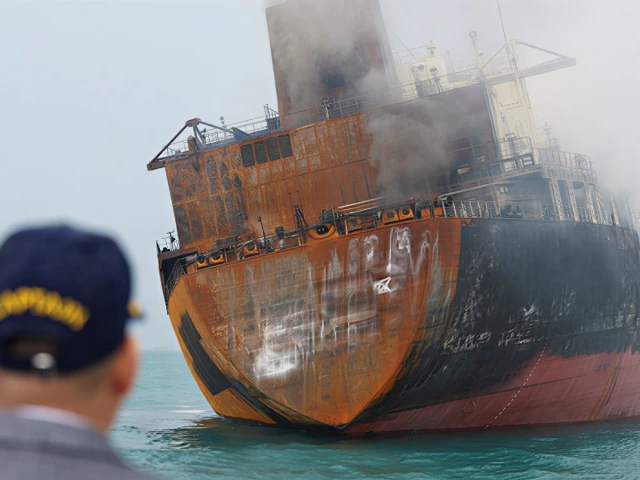
Iran attacked and set ablaze a fully loaded crude oil tanker off Dubai on Monday, as US President Donald Trump warned the US would obliterate Iran’s energy plants and oil wells if it did not open the Strait of Hormuz. The strike on the Kuwait-flagged Al-Salmi is the latest in a string of attacks on vessels in the Gulf and Strait of Hormuz since the US and Israel launched their offensive on Iran on February 28.
DUBAI – The month-long conflict escalated further on Monday when an Iranian strike hit a fully loaded crude oil tanker off the coast of Dubai. Kuwait Petroleum Corp, the ship’s owner, said the attack caused a fire and hull damage, but there were no reported injuries. Authorities in Dubai later said they had brought the fire under control following the drone attack.
The tanker, which can carry approximately 2 million barrels of oil worth more than $200 million at current prices, was attacked as crude oil prices briefly spiked anew. The vessel was Kuwait-flagged, and the strike occurred amid heightened tensions following Trump’s latest threats against Iran’s energy infrastructure.
Trump’s Ultimatum
In a social media post on Monday, Trump warned that if a deal is not reached and the Strait of Hormuz is not “immediately ‘Open for Business,’ we will conclude our lovely ‘stay’ in Iran by blowing up and completely obliterating all of their Electric Generating Plants, Oil Wells and Kharg Island.” He also threatened to attack Iranian desalination plants.
The Strait of Hormuz, through which approximately 20% of global oil passes, has been effectively closed since Iran asserted control over the waterway in early March. Tehran has attacked several tankers attempting to transit the strait, including the Al-Salmi.
US Shifts Strategy on Hormuz
According to the Wall Street Journal, citing US officials, Trump is “willing to end war without reopening Hormuz.” The president and his aides have assessed in recent days that attempting to pry open the chokepoint would push the war beyond the president’s four-to-six-week timeline.
White House press secretary Karoline Leavitt later said Trump wanted to reach a deal with Tehran before an April 6 deadline he set last week after extending an earlier deadline. Leavitt said talks with Iran were progressing, adding that what Tehran says publicly differs from what it tells US officials in private.
The Wall Street Journal reported that Trump has decided the US should achieve its main goals of crippling Iran’s Navy and its missile stocks before winding down the fighting. Washington would then proceed to diplomatically pressure Tehran to resume trade, pressing allies in Europe and the Gulf to take the lead.
Iranian Rejection of US Proposals
Iranian Foreign Ministry spokesperson Esmaeil Baghaei said earlier Monday that Tehran had received US peace proposals via intermediaries following Sunday’s talks in Islamabad between the foreign ministers of Pakistan, Egypt, Saudi Arabia, and Turkey. However, he dismissed the proposals as “unrealistic, illogical and excessive.”
“Our position is clear. We are under military aggression. Therefore, all our efforts and strength are focused on defending ourselves,” Baghaei told a press conference.
Despite Trump’s characterization of Iran’s new leaders as “very reasonable,” Tehran has publicly rejected direct negotiations with the US and has continued its military campaign against shipping in the Gulf.
Israeli Interceptor Depletion
Israeli news outlet Haaretz reported, citing official Israeli sources, that the success rate of Iranian missiles has reached 80% and that missiles are not being intercepted at previous rates.
According to the report, citing the Royal United Services Institute for Defense and Security (RUSIDS), Israel has fired approximately 80% of its Arrow 2 and Arrow 3 interceptors, 54% of its David’s Sling missiles, and 45% of the American-made THAAD interceptors it operates. Only 20% of Iron Dome interceptors have been used.
For the US, RUSIDS estimates that 60% of the THAAD missiles deployed to protect Gulf states from Iranian attacks have already been expended. The depletion of interceptor stocks raises concerns about the ability of US and Israeli air defenses to sustain the current pace of operations.
Economic Fallout
The jump in oil and fuel prices has started to weigh on US household finances and become a political headache for Trump and his Republican Party ahead of the November midterm elections. Trump had vowed to lower energy prices and ramp up US oil and gas production.
The US national average retail price of gasoline crossed $4 a gallon for the first time in more than three years on Monday, data from price-tracking service GasBuddy showed, as tightening global supplies push US crude prices above $101 a barrel.
Conflict Spreads Across Region
Attacks by both sides are showing no signs of easing, with fears of a wider conflict growing. Iran-aligned Houthis entered the war by firing missiles and drones at Israel in recent days, and Turkey reported a ballistic missile launched from Iran had entered Turkish airspace before being shot down by NATO air and missile defenses.
Israel carried out missile strikes on what it called military infrastructure in Tehran and infrastructure used by Iran-backed Hezbollah in Beirut, leaving black smoke hanging over the Lebanese capital. Three United Nations peacekeepers from Indonesia were killed in two separate incidents in southern Lebanon.
US Military Buildup Continues
Thousands of soldiers from the US Army’s elite 82nd Airborne Division have started arriving in the Middle East, two US officials told Reuters on Monday, part of a reinforcement that would expand Trump’s options to include the deployment of forces inside Iranian territory, even as he pursues talks with Tehran.
The White House said Trump was considering asking Arab nations to pay for the cost of the war. “It’s an idea that I know that he has and something that I think you’ll hear more from him on,” Leavitt said in response to a reporter’s question.
The administration has requested an additional $200 billion in funding for the war, a request facing stiff opposition in the US Congress, which must approve new spending.
Analysis: A Dangerous Crossroads
The attack on the Kuwait-flagged oil tanker off Dubai represents a significant escalation in Iran’s campaign against shipping in the Gulf. By striking a vessel so close to Dubai, a major commercial and tourism hub, Iran is demonstrating its ability to project power into the heart of the Gulf’s economic zone.
For Trump, the strike presents a direct challenge to his ultimatum. If Iran continues to attack shipping and refuses to open the Strait of Hormuz, Trump will face a choice: escalate further, potentially launching the strikes on Iranian energy infrastructure he has threatened, or accept a compromise that leaves the strait partially closed—a decision that would be seen as a concession to Tehran.
The depletion of interceptor stocks adds another dimension to the crisis. Both the US and Israel have expended significant portions of their air defense arsenals over the past month. Sustaining the current pace of operations will require resupply, while any expansion of the conflict—particularly if it involves ground operations—would strain these systems further.
As the war enters its second month, the convergence of military escalation, diplomatic efforts, and economic pressures creates a moment of maximum danger. The tanker attack off Dubai is a reminder that in this conflict, no vessel, no infrastructure, and no civilian is entirely safe. And with Trump’s deadline approaching, the decisions made in the coming days will determine whether the region moves toward a ceasefire or deeper into war.