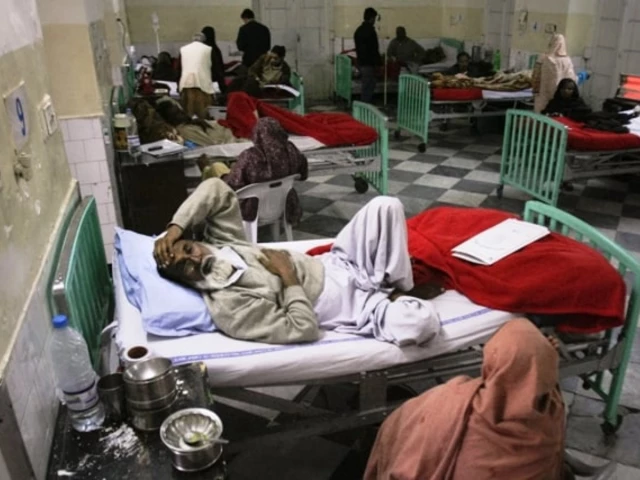
PESHAWAR – The Khyber-Pakhtunkhwa Health Department has initiated discussions to increase fines on private organisations managing outsourced government hospitals amid complaints of poor performance and administrative lapses, officials and sources told The Express Tribune.
Under the existing public-private partnership (PPP) model overseen by the Khyber-Pakhtunkhwa Health Foundation, partner organisations are currently liable to pay a penalty equivalent to 10 per cent of their total budget for failing to meet contractual obligations, particularly in staff attendance and delivery of essential medical services.
Scope of Outsourcing
The Health Foundation has outsourced 19 hospitals across the province to experienced private entities and non-governmental organisations. The government releases quarterly funds based on performance verified by monitoring committees that include representatives from the health department, district administration, and the Foundation. Regular monitoring is conducted to ensure compliance.
Complaints Received
Sources indicated that the department has received multiple complaints from district health officers regarding substandard services in several outsourced facilities. Issues include:
- Frequent staff shortages
- Unavailability of medicines and equipment
- Disruptions caused by protests and strikes by medical personnel
Patients have also expressed dissatisfaction with the quality of care, particularly in remote districts where these hospitals were outsourced to address longstanding performance deficits and improve service delivery.
Original Aim of Outsourcing
The original aim of the outsourcing initiative was to revitalise underperforming public hospitals in far-flung areas by leveraging private sector expertise in management, specialist recruitment, equipment installation, and maintenance. The model was designed to bring private sector efficiency to public healthcare delivery.
Proposed Penalty Increase
The Health Department is now considering increasing the penalty rate beyond the current 10 per cent threshold to create stronger deterrents against contractual violations. Officials believe that higher financial penalties would incentivise partner organisations to maintain consistent service quality and adhere to staffing requirements.
Challenges in Remote Areas
Remote districts face particular challenges, where attracting and retaining medical staff is difficult even for private operators. Some outsourced hospitals have reportedly struggled to maintain round-the-clock emergency services due to staffing shortages, while medicine stock-outs remain a recurring issue despite contractual requirements.
Monitoring Mechanism
The monitoring committees, which include representatives from multiple government bodies, conduct regular inspections and verify performance metrics before releasing quarterly funds. However, sources suggest that the monitoring system may need strengthening to ensure that performance data accurately reflects on-ground realities.
Analysis: Balancing Public-Private Partnership
The K-P government’s decision to review penalties for outsourced hospitals reflects the challenges of implementing public-private partnerships in healthcare. While the outsourcing model has brought private sector management to underperforming public hospitals, ensuring consistent service quality remains a challenge.
The current penalty of 10 per cent of the total budget may be insufficient to deter violations, particularly for larger organisations that may view the penalty as a cost of doing business. Increasing the penalty could create stronger incentives for compliance.
However, penalties alone may not address the underlying issues. Remote districts face structural challenges — including security concerns, difficult terrain, and limited infrastructure — that make healthcare delivery difficult regardless of the management model. The government may need to provide additional support to outsourced hospitals in these areas.
The monitoring mechanism also requires attention. If performance data is not accurately collected or verified, the government cannot effectively enforce contracts. Strengthening monitoring committees and ensuring they have the resources and authority to conduct thorough inspections is essential.
For patients in remote districts, the outsourcing initiative was meant to bring better healthcare. If the current model is failing to deliver, the government must take corrective action — whether through higher penalties, better monitoring, or a fundamental reassessment of the outsourcing approach.