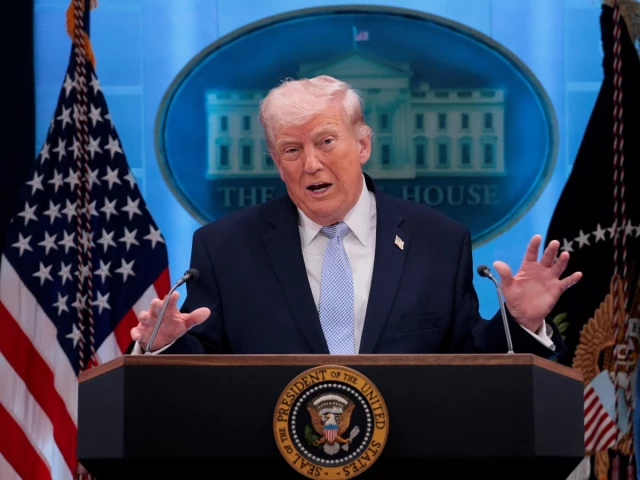
WASHINGTON – United States President Donald Trump said on Thursday that he asked Israeli Prime Minister Benjamin Netanyahu to reduce strikes on Lebanon and was assured that Israel would be “scaling back” operations. “I spoke with Bibi and he’s going to low-key it. I just think we have to be sort of a little more low-key,” Trump said during a brief telephone interview with NBC News.
The president announced a two-week ceasefire on Tuesday with Iran after more than one month of war that rapidly spread across the region. Delegations from the US and Iran are slated to convene Saturday for negotiations in Islamabad that seek to broker a definitive end to the conflict.
Trump Optimistic About Peace Deal
Trump said he is “very optimistic” that a peace deal will be struck. The president struck an upbeat note ahead of the meeting, saying Iran’s leaders “talk much differently when you’re at a meeting than they do to the press. They’re much more reasonable.”
“They’re agreeing to all the things that they have to agree to. Remember, they’ve been conquered. They have no military,” he told NBC. “If they don’t make a deal, it’s going to be very painful.”
Israel’s Strikes on Lebanon
The Israeli military escalated attacks across Lebanon despite the two-week Washington-Tehran ceasefire brokered by Pakistan. Israel carried out one of its largest strikes in Lebanon on Wednesday since launching a military offensive against Hezbollah early last month. The attacks have killed at least 254 people and wounded 1,165, according to Lebanon’s Civil Defence.
The escalation has raised concerns about a potential renewed Israeli occupation of southern Lebanon, possibly extending to the Litani River.
Netanyahu Calls for Peace Talks with Lebanon
Meanwhile, Netanyahu said that he has instructed to begin peace talks with Lebanon that would also include the disarmament of Hezbollah. “In light of Lebanon’s repeated requests to open direct negotiations with Israel, I instructed the cabinet yesterday to start direct negotiations with Lebanon as soon as possible,” Netanyahu said in a statement. “The negotiations will focus on disarming Hezbollah and establishing peaceful relations between Israel and Lebanon.”
There was no immediate response from the Lebanese government to Netanyahu’s remarks. An hour before Netanyahu’s statement, Lebanese President Joseph Aoun said: “The only solution to the situation in Lebanon is to achieve a ceasefire between Israel and Lebanon, followed by direct negotiations between them.”
PM Shehbaz Condemns Israeli Aggression
Meanwhile, Prime Minister Shehbaz Sharif strongly condemned Israel’s ongoing aggression against Lebanon that threatens the ceasefire between the United States and Iran. In a statement on his X account, the premier said he spoke with Lebanon’s PM Nawaf Salam.
“I strongly condemned Israel’s ongoing aggression against Lebanon and offered condolences over the loss of thousands of precious lives in Lebanon as a result of these hostilities. I reaffirmed Pakistan’s commitment to advance peace efforts, including facilitating dialogue through the upcoming Iran–US talks in Islamabad.”
He said he was grateful to PM Salam, who expressed his “appreciation for Pakistan’s peace efforts and underscored the need for our continued support” in securing an immediate end to the attacks targeting Lebanon and its people.
Iran’s Position
Earlier, Iran’s President Masoud Pezeshkian said that the Israeli strikes on Lebanon violated the ceasefire agreement and would render negotiations meaningless, adding Iran would not abandon the Lebanese people. In a post on X, he strongly condemned Israel’s renewed military actions in Lebanon, calling them a “blatant violation” of the original ceasefire agreement and a “dangerous sign” of bad faith in diplomatic efforts.
Iranian negotiators were expected to set off later on Thursday for Pakistan for the first peace talks of the war, where they are due to meet a delegation led by US Vice President JD Vance on Saturday. But there was no sign Iran had lifted its blockade of the Strait of Hormuz, which has caused the worst disruption to global energy supplies in history, and Tehran said there would be no deal as long as Israel was striking Lebanon.
Differing Interpretations of Ceasefire
Israel, which invaded Lebanon last month in parallel with the war on Iran to root out the armed group Hezbollah, Tehran’s ally, says its actions there are not covered by the ceasefire announced late on Tuesday by President Trump. Washington has also said Lebanon is not covered by the truce, but Iran and Pakistan, which acted as mediators, say it was explicitly part of the deal.
A host of countries, including prominent US allies Britain and France, said the truce should extend to Lebanon and condemned Israel’s attacks on the country. A Pakistani source with knowledge of the discussions said Pakistan was working on ceasefires for Lebanon and Yemen: “It will be discussed during the (upcoming) talks and we will settle it.”
Pakistan’s View
Pakistan’s former ambassador to the United Nations, Maleeha Lodhi, told Al Jazeera that Pakistan’s understanding of the US-Iran ceasefire is the same as Iran’s – Lebanon is meant to be included. “In the run-up to this ceasefire, Pakistani officials had specifically asked their American counterparts whether they would be able to rein in or restrain Israel, and we were given the assurance that the Americans would do that,” Lodhi said.
Israel’s latest deadly attacks in Lebanon have created even more concern in Islamabad about the ceasefire’s fate and how Iran will react, she added. “I think there is a lot of uncertainty created by Israel’s actions,” Lodhi said.
Joint Statement from World Leaders
In a joint statement on Thursday, the leaders of Canada, Japan, and many European nations welcomed the “two-week ceasefire concluded between the United States and Iran today.” The release stated that they “thank Pakistan and all partners involved for facilitating this important agreement.” They also extended the ceasefire to Lebanon, saying that they “call upon all sides to implement the ceasefire, including in Lebanon.”
Spain Reopens Embassy in Tehran
Spain is reopening its embassy in Tehran in hopes of achieving peace in the US-Israeli war on Iran, Foreign Minister Jose Manuel Albares told reporters on Thursday. “I’ve instructed our ambassador in Tehran to return, to take up his post again and reopen our embassy, and for us to join in this effort for peace from every possible quarter, including from the Iranian capital itself,” Albares said.
Analysis: A Fragile Truce
Trump’s intervention to request that Israel scale back its attacks on Lebanon reflects the fragility of the US-Iran ceasefire. With Iran insisting that Lebanon is covered by the truce and threatening to walk away from negotiations if Israeli strikes continue, the president faced a choice: pressure Israel to de-escalate or risk the collapse of the ceasefire.
The differing interpretations of the ceasefire’s scope — with the US and Israel insisting Lebanon is not covered, and Iran and Pakistan insisting it is — represent a fundamental contradiction at the heart of the truce. Trump’s statement that Israel will be “scaling back” suggests that, at least for now, pragmatism has prevailed over principle.
As the delegations prepare to meet in Islamabad, the odds of reaching a permanent deal remain uncertain. The ceasefire may hold for two weeks, but the underlying issues — Iran’s nuclear program, the Strait of Hormuz, and the role of proxies like Hezbollah — remain unresolved. And with Israel continuing to strike Lebanon, Iran’s willingness to negotiate is rapidly diminishing.