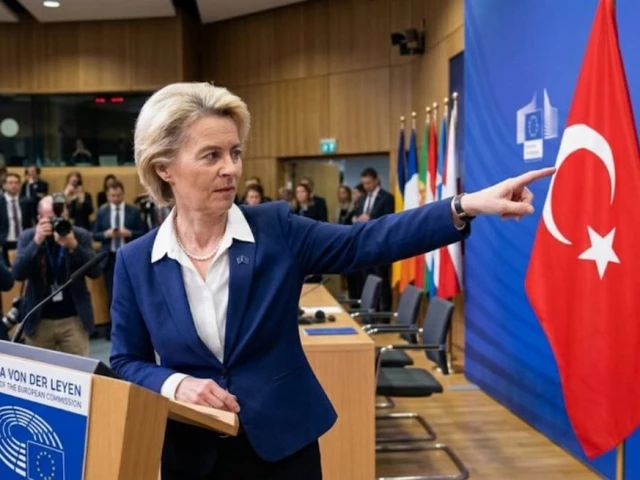
BRUSSELS – Members of the European Parliament (MEPs) Rudi Kennes and Marc Botenga have stressed that European Commission President Ursula von der Leyen’s remarks linking Türkiye with Russia and China risk dividing the world into opposing blocs, arguing instead that the European Union operates within a multipolar order.
Speaking at an event marking the 80th anniversary of the German newspaper Die Zeit in Hamburg, von der Leyen reiterated her support for EU enlargement and the need for a more unified European geopolitical position. She stated that the EU must “succeed in completing the European continent so that it is not influenced by Russia, Türkiye or China”, a formulation that quickly drew attention for grouping Türkiye alongside Russia and China.
Commission Clarification
The European Commission later clarified the remarks, stressing that Türkiye remains an “unquestionably important partner” for the EU. A spokesperson underlined Ankara’s role in key areas, including migration management, economic cooperation, and strategic connectivity initiatives such as the Trans-Caspian Middle Corridor, while also highlighting Türkiye’s status as a NATO ally and EU candidate country. The commission emphasised that the reference reflected broader geopolitical considerations rather than a direct equivalence among the countries mentioned.
‘They Are Losing Power’
Speaking exclusively to Anadolu, Belgian MEP Rudi Kennes said that current global geopolitical alignments were linked to coordinated efforts by Western powers and allied states to advance broader strategic objectives.
“I think the comment she made is also contributing to what’s actually happening today in the world, and that is all support from all these countries, like the US and all these complicit states, to the cult project Greater Israel,” he told Anadolu.
Kennes further argued that tensions involving countries such as Iran, Russia and China were interconnected within this framework, adding that Western influence was declining in the face of a “multipolar world order.”
“They’re (Europe) losing power. They’re knowing it. They cannot play the sheriff in the world anymore, because now we have a multiple world, not just them as so-called sheriff of the world. And this is just desperate what they are doing now,” he noted.
“The only thing today they can do these European leaders, is hopefully that big brother on the other side of the ocean will be able to stay in power. But they’re losing,” Kennes added.
Von der Leyen ‘Dividing the World Between Us and Others’
Another Belgian lawmaker, Marc Botenga, also criticised the remarks on Türkiye, saying that her framing risks oversimplifying international relations and “dividing the world” into opposing camps.
“It’s an extremely weird statement, because also it’s not true,” he said, noting that describing global actors in rigid categories of allies and opponents does not reflect the EU’s existing economic and diplomatic ties. He pointed out that the EU maintains significant trade relations and cooperation frameworks with China, while also engaging with Türkiye across multiple areas, despite political differences.
“Türkiye still is formally a candidate member state, but more globally, I think the problem with Ursula von der Leyen’s comments are that she’s dividing the world between us and others, as if there’s some kind of purity test, as if she wants to conquer the rest of the continent,” Botenga said.
‘A Dangerous View of the World’
He warned against what he described as a “purity test” approach to foreign policy, saying the world should not be divided into those who fully agree with the EU and those who are treated as adversaries.
“We should not be dividing the world between: ‘We fully agree with you, so you’re a friend, or we have differences, so you’re an enemy.’ That’s a very, very dangerous view of the world to have,” Botenga said.
Analysis: A Controversial Framing
Von der Leyen’s remarks, grouping Türkiye — a NATO ally and EU candidate country — with Russia and China, were always likely to draw criticism. The subsequent clarification from the European Commission, emphasising Türkiye’s importance as a partner, suggests that the Commission recognised the political sensitivity of the original formulation.
The criticism from MEPs Kennes and Botenga reflects a broader debate about the EU’s foreign policy orientation. Kennes’s argument that Europe is “losing power” and can no longer “play the sheriff” captures a sense of decline. Botenga’s warning against a “purity test” approach to foreign policy — dividing the world into friends and enemies — is a caution against ideological rigidity.
As the EU navigates a multipolar world, the question is whether it will adopt a pragmatic, engagement-oriented foreign policy or a more confrontational, bloc-based approach. Von der Leyen’s remarks, even if clarified, suggest a tendency towards the latter. The criticism from within the European Parliament suggests that not all MEPs agree.