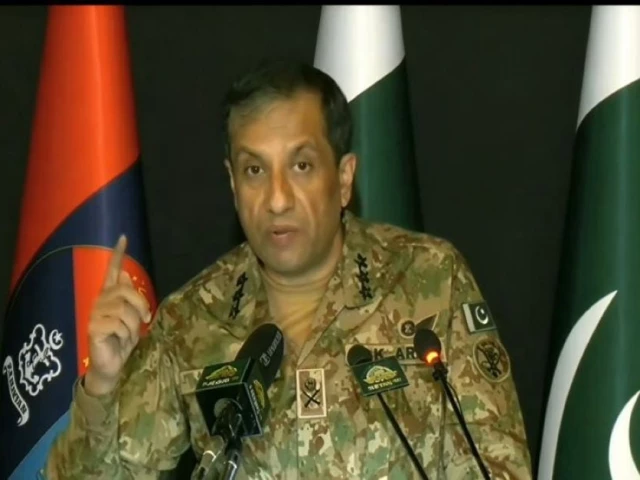
RAWALPINDI – Director General of Inter-Services Public Relations (ISPR) Lt Gen Ahmed Sharif Chaudhry on Thursday said that Pakistan inflicted a crushing defeat on an enemy five times larger across all fronts in Marka-e-Haq. Addressing a press conference marking one year since the completion of the 2025 conflict with India, he congratulated the nation and declared that Pakistan had ground India’s pride into the dust.
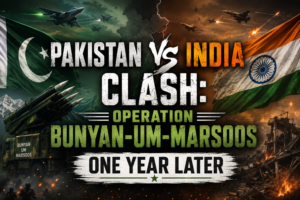
The term “Marka-e-Haq” refers to the 2025 conflict with India, which began with the April 22 Pahalgam attack and concluded with a ceasefire on May 10 following Operation Bunyanum Marsoos.
“We have always said that no one’s father can harm Pakistan. We were ready then, and we are ready now; if anyone has any doubt, we have shown them one episode of it,” Lt Gen Chaudhry said.
Multi-Domain Victory
Pakistan defeated the enemy on every front and changed the nature of warfare during Marka-e-Haq, the DG ISPR stated. Pakistan achieved success in multi-domain warfare across air, land, sea, and cyber domains.
“We inflicted a humiliating defeat on India across all fronts,” he added, addressing the press conference accompanied by senior officers of the Pakistan Navy and Pakistan Air Force.
India’s ‘Terrorism Drama’ Buried Forever
Lt Gen Chaudhry said India had long propagated a false narrative accusing Pakistan of involvement in terrorism and had conducted false flag operations for this purpose. Allegations were levelled against Pakistan within minutes of the Pahalgam incident without investigation.
He further added that India’s “terrorism drama” has been buried forever, calling India itself the biggest terrorist. He challenged India to identify which terrorist camp it targeted, and said that India orchestrates terrorism against its own people to blame others.
The DG ISPR said India was facilitating terrorism and that all terrorist incidents in Pakistan involved India and Afghanistan. He added that Afghanistan’s “so-called” foreign minister sought assistance from India.
No Evidence of Pahalgam Attack
He also pointed out that India has failed to produce evidence regarding the Pahalgam incident. He noted that an FIR was registered within ten minutes of the event, yet a year later, no proof has surfaced.
Hindutva Ideology
Lt Gen Chaudhry said that what happened in Marka-e-Haq is known not just in Pakistan, but by every child in India. He advised India to speak the truth, adding that Hindutva ideology is being imposed on minorities in India.
Indian politicians appeared more like warriors than statesmen, and India’s professional military had been compromised by politics. India is using Fitna-al-Khawarij and Fitna-al-Hindustan out of frustration over its defeat, he said. (The term Fitna al-Khawarij is used by the state to refer to terrorists affiliated with the banned TTP.)
Nuclear Stability
Pakistan was the principal contributor to regional stability and efforts for peace, stressing that war between two nuclear states would be madness, he added.
A Glimpse of Power on August 14
He announced that a “small glimpse” of Pakistan’s power potential would be shown to the public on August 14, so that “they cannot say later that they weren’t told.” He vowed to defend Pakistan’s security and sovereignty at all costs.
Kashmir and Manipur
He also added that Kashmir is not India’s internal matter but a globally recognised dispute with pending UN resolutions. India is committing atrocities against Muslims in Kashmir and citizens in Manipur.
He further said that “one Pakistan and another Field Marshal appear in India’s dreams day and night.”
Pahalgam Attack and Marka-e-Haq
On April 22, 2025, escalation between Pakistan and India began when an attack in Pahalgam killed 26 people. India immediately blamed Pakistan for the incident. However, Pakistan categorically rejected the Indian blame.
In response, India undertook a series of hostile actions the next day, on April 23, 2025, including suspending the 65-year-old Indus Waters Treaty (IWT), cancelling visas for Pakistani citizens, closing the Wagah-Attari border crossing, ordering the shutdown of the Pakistan High Commission in New Delhi, and reducing diplomatic staff at each other’s embassies.
The May 7 Strikes and Pakistan’s Response
Tensions further escalated in the early hours of May 7, 2025, when missile strikes hit six cities in Punjab and Azad Jammu and Kashmir (AJK), destroying a mosque and killing dozens of civilians, including women, children, and the elderly.
In a swift military response, Pakistan’s armed forces shot down Indian warplanes, including three Rafale jets. The confrontation intensified again in the early hours of May 10, 2025, when India targeted several Pakistani airbases with missile strikes. In retaliation, Pakistan launched Operation Bunyanum Marsoos, damaging Indian military installations, including missile storage sites, airbases, and other strategic targets.
On May 10, 2025, US President Donald Trump announced that a ceasefire had been reached following intense overnight diplomatic efforts. Minutes later, the agreement was confirmed separately by Pakistan’s Foreign Minister Ishaq Dar and the Indian foreign secretary.
Analysis: A Message of Strength
The DG ISPR’s press conference on the first anniversary of Marka-e-Haq is a message of strength to both domestic and international audiences. The claim that Pakistan defeated an enemy “five times larger” reinforces the narrative of military prowess.
The emphasis on multi-domain warfare — air, land, sea, cyber — signals that Pakistan’s military has modernised across all branches. The mention of “homegrown kill chain” and cyber capabilities suggests indigenous technological development.
The challenge to India to produce evidence of the Pahalgam attack — and the claim that India’s “terrorism drama” has been buried — is a continuation of the blame game that has characterised the conflict.
The announcement of a “glimpse” of power on August 14 — Pakistan’s Independence Day — is a promise of future capability demonstrations.
As Pakistan marks the anniversary, the message to India is clear: the armed forces are ready. The message to the Pakistani people is equally clear: your military has defended you.