May 7, 2025, is a date that will be remembered in the history of South Asia. It was the day India launched strikes inside Pakistan, triggering a chain of events that led to the first major conventional military confrontation between the two nuclear-armed neighbors since 1971.
One year later, Pakistan is commemorating “Maarka-e-Haq” (The Battle for Truth), and new details about Operation Bunyan-um-Marsoos—Pakistan’s retaliatory response—are finally emerging.
The name itself carries weight. “Bunyan-um-Marsoos” is an Arabic phrase from the Holy Quran, specifically Surah As-Saff, which translates to “a solid wall cemented with molten lead” . It describes believers who stand firm and united in the face of adversity. For Pakistan’s military leadership, that is exactly what the operation represented: an unbreakable defense.
So, what actually happened? Who struck first? And what is the “8-0” score that Pakistani officials are now talking about? Let me break it all down for you.
How It All Started – The Pahalgam Incident
Every conflict has a trigger. This one began with bloodshed in Indian Illegally Occupied Jammu and Kashmir (IIOJK).
On or around early May 2025, a terror attack in the tourist town of Pahalgam resulted in the deaths of 26 Indian tourists . India wasted no time in pointing fingers across the border.
India’s Accusation: The Indian government claimed that Pakistan-based militant groups were responsible. They demanded action.
Pakistan’s Response: Islamabad denied any involvement. Pakistan’s leadership, including Prime Minister Shehbaz Sharif, urged India to conduct a neutral, transparent inquiry into the attack . They argued that without credible evidence, India had no right to blame Pakistan.
Despite calls for diplomacy and investigation, India did not wait .
India Strikes First – “Operation Sindoor”
On May 7, 2025, India launched “Operation Sindoor” . Unlike the 2019 Balakot strikes (which targeted what India claimed were militant camps deep inside Pakistan), these strikes directly hit civilian-adjacent areas.
The Targets: According to Pakistani officials, India attacked several locations, including Muzaffarabad, Kotli, Sialkot, Shakargarh, Muridke, and Ahmed Pur East .
The Casualties: Pakistan claims that these strikes resulted in the martyrdom of 31 innocent civilians, including women and children, while 57 others were injured .
This was a red line. Attacking civilian populations changed the nature of the conflict. Pakistan had to respond—not just with diplomatic condemnations, but with military force.
On the night of May 8-9, India reportedly attempted drone strikes as well. Pakistan claims to have neutralized 90 drones during this phase .
Pakistan Strikes Back – Operation Bunyan-um-Marsoos
On May 10, 2025, Pakistan launched Operation Bunyan-um-Marsoos . The name was chosen deliberately. According to military sources, Chief of Defence Staff Field Marshal Syed Asim Munir offered Fajr prayer and recited Surah As-Saff before the operation commenced .
The Scope of the Operation
Unlike India’s limited strikes, Pakistan’s response was multi-domain. According to state-run Radio Pakistan and security sources, the operation targeted key Indian military infrastructure across the border :
- Airbases Destroyed: Udhampur, Pathankot, Adampur, Sirsa, Bhatinda, Halwara, Jammu, and Barnala airfields were reportedly hit.
- Strategic Sites: A BrahMos missile storage site in the Beas area and another in Nagrota were destroyed.
- Air Defenses: Pakistan claimed that JF-17 Thunder aircraft fired hypersonic missiles to destroy India’s S-400 air defense system in Adampur—a system worth approximately $1.5 billion .
- Cyber Warfare: In a modern twist, Pakistan also claimed to have launched a cyber attack that made 70% of India’s electricity grid dysfunctional .
The “8-0” Claim – The Largest Dogfight Since 1971
The most dramatic part of the operation was the air battle. According to Air Vice Marshal Tariq Ghazi (Deputy Chief of Air Staff Projects), the Pakistan Air Force (PAF) engaged in the largest dogfight between India and Pakistan since 1971, involving up to 125 jets .
During a press conference in Rawalpindi on May 6, 2026 (marking the one-year anniversary), AVM Tariq Ghazi announced what he called an “8-0” score .
The claimed kills include:
- 4 x Dassault Rafale (India’s most advanced fighter jet)
- 1 x Sukhoi Su-30 MKI
- 1 x MiG-29
- 1 x Mirage 2000
- Additionally, Pakistan claimed to have destroyed an “extremely expensive multi-role unmanned aerial system” (a high-end drone) .
*”We shot down eight Indian aircraft during Operation Bunyan-um-Marsoos and now we are 8-0.”*
— Air Vice Marshal Tariq Ghazi, Pakistan Air Force
The Aftermath – A Year of Commemoration
May 2026 has been marked by a series of events celebrating what Pakistan calls a “glorious victory.”
Political and Military Unity
Punjab Assembly Speaker Malik Muhammad Ahmad Khan called the operation a “historic milestone” that crushed the adversary’s arrogance. He announced a special session of the Punjab Assembly to pay tribute to the armed forces .
Federal Parliamentary Secretary Barrister Danyal Chaudhry stated that the operation was a symbol of national unity, driven by the leadership of Prime Minister Shehbaz Sharif and Field Marshal Asim Munir .
The “10-15 Percent” Warning
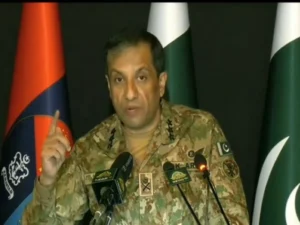
Perhaps the most striking statement came from DG ISPR Lieutenant General Ahmed Sharif Chaudhry. During the same press conference, he issued a warning to India that sent a clear message:
*”What you saw during Maarka-e-Haq was only 10 to 15 percent of our overall power potential.”*
— Lt Gen Ahmed Sharif Chaudhry, DG ISPR
He added that a “small glimpse” of this full capability would be showcased during Pakistan’s August 14 military parade—so that “no one could later claim they had not been warned” .
Summary Table: Operation Bunyan-um-Marsoos Timeline
Frequently Asked Questions (FAQ)
1. What does “Bunyan-um-Marsoos” mean?
It is an Arabic phrase from the Holy Quran (Surah As-Saff) meaning “a solid wall cemented with molten lead.” It symbolizes unwavering unity, strength, and resilience in the face of an enemy .
2. Did Pakistan really shoot down 8 Indian jets?
The Pakistan Air Force officially claims this “8-0” score, including 4 Rafale jets . These are Pakistan’s claims. India has not confirmed these losses. As with all military conflicts during high tensions, independent verification is extremely difficult.
3. How did the conflict in May 2025 start?
It began with the Pahalgam attack in Indian Illegally Occupied Jammu and Kashmir, where 26 tourists were killed. India blamed Pakistan without presenting evidence. On May 7, 2025, India launched strikes inside Pakistan, killing 31 civilians. Pakistan responded on May 10 with Operation Bunyan-um-Marsoos .
4. What is Maarka-e-Haq?
“Maarka-e-Haq” translates to “The Battle for Truth.” It is the name given by Pakistan to the entire conflict, emphasizing that Pakistan fought to defend its sovereignty and civilians against unprovoked aggression and false allegations .
5. Did other countries get involved?
The conflict remained bilateral. However, international bodies called for restraint. Pakistan claims it effectively projected its position diplomatically, while India faced criticism for failing to provide evidence for its allegations .
Conclusion: A Shift in the Balance of Power?
One year after the smoke cleared, the narrative in Pakistan is one of unapologetic triumph.
Several key takeaways emerge from the one-year commemorations:
First, the “8-0” air superiority claim is meant to send a clear message: the PAF is not just a defensive force; it is capable of dominating Indian airspace in a conflict. The claim of destroying four Rafales—India’s crown jewel fighter jet—is particularly significant.
Second, the admission that Pakistan only used “10-15 percent” of its capability is a psychological warfare tactic. It is designed to deter India from attempting a similar misadventure in the future. If India thought it was facing Pakistan’s full might, the DG ISPR just told them they were wrong .
Third, the cyber domain has entered the game. Pakistan’s claimed cyber attack on India’s power grid, along with the destruction of the S-400 system, suggests that future wars between these neighbors will look very different from the past .
As Field Marshal Syed Asim Munir reportedly said: “Pakistan humesha zindabad” (Pakistan will always live) .
Whether or not you believe the specific numbers, one thing is clear: the events of May 2025 have fundamentally changed how both nations view their military calculus. The “wall of lead” has been built. And according to Islamabad, it is here to stay.