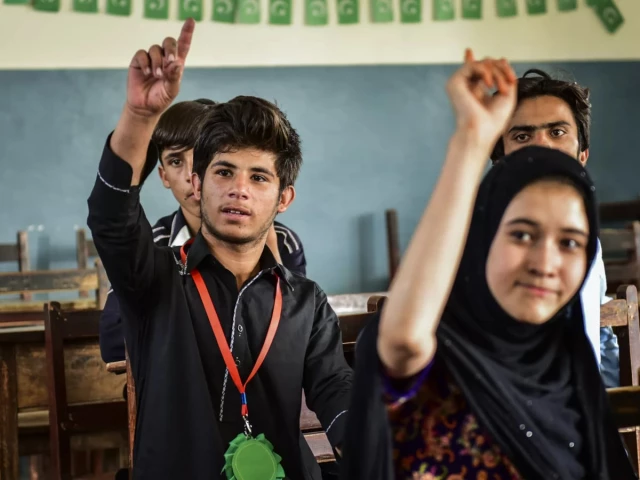
A new academic study has presented a detailed picture of the challenges, aspirations, and frustrations facing young people in Balochistan, highlighting a generation that remains hopeful for education, employment, and peace despite years of inequality, underdevelopment, and political uncertainty.
The research, titled Voice of Balochistan’s Youth: Identity, Development and Geopolitical Perspectives, was published in the Social Science journal Contemporary Journal of Social Science Review and conducted by researchers from major universities in the province.
The study was led by Dr Siraj Bashir Baloch from the University of Balochistan, Nomeen Kassi from BUITEMS, and Dr Farah Naseer from Sardar Bahadur Khan Women’s University.
Researchers gathered data through surveys and direct communication with young people across Balochistan to better understand their social, economic, and political perspectives.
According to the findings, the province’s youth are highly aware of global developments and increasingly connected through digital platforms, yet they remain deeply frustrated by limited opportunities and weak governance structures.
“The youth of Balochistan are not a problem to be managed, they are a resource being wasted,” Dr Siraj Bashir Baloch said while discussing the study’s conclusions.
“What we found is a generation that is aware, motivated, and capable, but systemically denied the conditions it needs to thrive. That is not a youth crisis. That is a governance crisis,” he added.
The report identified social media as the dominant source of information among young people in the province. According to the study, Facebook accounted for 62% of news and information consumption among respondents, while X remained a major platform for political discussion. Instagram was found to be particularly popular among younger users and female participants.
Traditional media sources such as newspapers accounted for only a small portion of information consumption, reflecting a broader shift toward digital engagement among the province’s youth.
However, researchers warned that the rapid spread of misinformation on platforms such as WhatsApp and YouTube was shaping public perceptions and distorting understanding of complex political and geopolitical issues.
The study strongly recommended introducing digital literacy programmes to help young people critically evaluate online content and reduce the influence of misinformation.
At the centre of youth frustration, the report found, was the widening gap between aspirations and reality.
A majority of respondents expressed dissatisfaction with employment opportunities, educational standards, healthcare services, and uneven access to development resources across the province.
Researchers argued that these grievances reflected deeper institutional weaknesses and long-standing governance challenges in Balochistan.
The report also explored how geopolitical developments influence youth perceptions in the province, particularly regarding China, the United States, and regional politics.
According to Nomeen Kassi, young people’s views on foreign powers are closely connected to their own lived experiences of exclusion and underdevelopment.
“When young people in Balochistan look outward, at China or the United States, their perceptions are not formed in a vacuum,” Kassi said.
“A youth who has never benefitted from development will view every foreign actor with suspicion, and rightly so,” she added.
The China-Pakistan Economic Corridor emerged as one of the study’s most debated topics.
While some respondents viewed China as a key development partner for Pakistan, many questioned whether local communities in Balochistan were receiving meaningful benefits from large-scale infrastructure projects linked to CPEC.
The study recommended reserving at least 80% of jobs in CPEC-related projects for local Baloch youth and called for greater transparency, public consultation, and community participation in development planning.
Perceptions of the United States were also divided. Some respondents associated America with educational opportunities and international exposure, while others criticised Washington’s regional policies and viewed them as inconsistent or interventionist.
India, however, received overwhelmingly negative responses, largely shaped by regional security tensions and long-standing political narratives.
The report also highlighted important gender-related findings.
Dr Farah Naseer stressed that female respondents demonstrated distinct aspirations, online behaviour, and experiences of exclusion compared to male participants.
“We keep talking about Balochistan’s youth as if they are one undifferentiated mass,” she said.
“But the data shows that female respondents have distinct platform preferences, distinct aspirations and distinct experiences of exclusion. Any policy that does not account for gender is going to fail half the population before it even begins.”
Despite the serious concerns raised in the report, researchers said the findings should not be interpreted as a sign of hopelessness or radicalisation among the province’s youth.
Instead, the study concluded that most young people in Balochistan remain focused on constructive goals such as education, employment, dialogue, and civic participation.
A majority of respondents supported peaceful solutions and dialogue over violence in resolving conflicts, suggesting that the youth population remains open to stability and reconciliation if meaningful opportunities are provided.
“These young people are not asking for revolution,” Dr Baloch said. “They are asking for a job, a degree and a government that listens.”
The report urged both provincial and federal authorities to increase investment in human development, improve governance structures, establish formal youth councils, and introduce district-specific development programmes tailored to local needs.
It also called on China to complement infrastructure investment with greater support for schools, healthcare facilities, water projects, scholarships, and exchange programmes for young people in Balochistan.
“CPEC can still be a story of shared prosperity,” Kassi concluded. “But right now, for too many young people in Balochistan, it reads as a story written by others about a future that never arrives for them.”