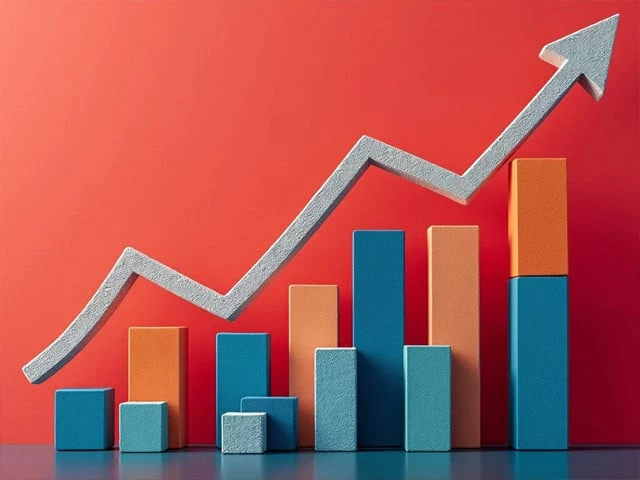
ISLAMABAD, May 14, 2026 — Pakistan’s economy grew 3.7% in the outgoing fiscal year 2025-26, missing the annual target of 4.2% and dashing hopes of higher growth due to slowing activity in the industry and construction sectors, which has contributed to higher unemployment in the country .
The provisional growth rate, approved by the National Accounts Committee (NAC) on Wednesday, is also lower than the State Bank of Pakistan’s estimates of up to 4.8% for the fiscal year . However, it was close to the predictions of the International Monetary Fund (IMF) and the Asian Development Bank .
Per Capita Income and Economic Size
Despite missing the growth target, the nation’s per capita income jumped to **1,901∗∗—anincreaseof150 over the previous year—due to higher foreign remittances, improved economic growth, and a largely stable exchange rate .
According to the Planning Ministry, based on the population projection of the 2023 census, per capita income in rupee terms stands at Rs533,629 , which is Rs44,511 higher than last year .
The overall size of the economy reached $452.1 billion in fiscal year 2025-26, making Pakistan the 42nd largest economy in the world . In rupee terms, the economy stands at Rs126.9 trillion .
Sectoral Breakdown: Services Led, Industry Slowed
The 3.7% growth rate was driven primarily by the services sector , followed by industry and agriculture:
| Sector | Growth Rate (FY26) | Previous Year |
|---|---|---|
| Services | 4.1% | — |
| Industry | 3.5% | — |
| Agriculture | 2.9% | 1.53% |
The NAC also revised upward the quarterly GDP growth rates for the first and second quarters and approved the third quarter growth rate of 4% .
Agriculture Sector: Modest Improvement
The agriculture sector showed improvement over last year, growing at 2.9% compared to 1.53% in FY25 . Key crop performance included:
| Crop | Production (FY26) | Production (FY25) | Growth |
|---|---|---|---|
| Wheat | 29.6 million tons | 28.4 million tons | +4.6% |
| Rice | 10.0 million tons | 9.7 million tons | +2.8% |
| Sugarcane | 89.5 million tons | 84.2 million tons | +6.2% |
| Cotton | 7.1 million bales | — | -0.5% |
| Maize | 8.8 million tons | 9.1 million tons | -2.7% |
Important crops showed modest growth of 0.7% due to a mixed trend in production. Other crops, including gram, potato, mangoes, banana, turmeric, and chilies, grew by 2.43% following a 19.74% increase in the previous year .
Livestock increased by 3.75% (up from 3%), while forestry and fishing posted normal growth rates .
Industry Sector: High Costs Take a Toll
The industry sector grew by only 3.51% provisionally, “significantly lower than the previous year,” according to the Planning Ministry . The sector is suffering from:
- High taxation
- High energy prices
- High cost of borrowing
- Uncertain economic policies
Mining & quarrying posted modest growth of just 0.4% despite an increase in coal production, due to decreased production of natural gas, crude oil, and other minerals .
Large-scale manufacturing (LSM) grew by 6.11% with a mixed trend. Positive contributions came from food, tobacco, petroleum products, rubber products, electrical equipment, automobiles, transport equipment, furniture, and football .
However, the electricity and gas output contracted by 10.63% , primarily due to a high base effect, lower energy subsidies, and slower growth in output of WAPDA and other companies .
The construction industry grew by 5.7% (down from 8.8% last year), driven by construction-related expenditures from both the private sector and general government .
The government also reduced subsidies by 25%, from Rs1.2 trillion to Rs893 billion .
Services Sector: Steady Growth
The services industry showed growth of 4.1% during the outgoing fiscal year, with positive contributions from:
- Wholesale and retail trade
- Transport and storage
- Information and communication
- Public administration and social security
- Education
Policy Context: Stabilization Takes a Toll
Pakistan has been implementing economic stabilization policies for the past four years, which have “taken a heavy toll on the national output and contributed to increase in poverty, unemployment and income inequality,” according to the Planning Ministry .
For the next fiscal year 2026-27, the government has already committed to the IMF to continue on the stabilization path and has given a written commitment to produce a Rs2.8 trillion primary budget surplus .
Revised Quarterly Growth Rates
The NAC revised quarterly GDP growth rates as follows:
| Quarter | Growth Rate |
|---|---|
| Q1 (July-September 2025) | Revised upward |
| Q2 (October-December 2025) | Revised upward |
| Q3 (January-March 2026) | 4.0% (approved) |
| Q4 (April-June 2026) | Provisional (included in annual figure) |
Global and Regional Context
At $452 billion, Pakistan’s economy remains the 42nd largest globally . The growth rate of 3.7% places Pakistan below regional peers like India (projected 6-7%) and Bangladesh (projected 5-6%) but ahead of Afghanistan .
The economic challenges are compounded by ongoing regional instability, including the Middle East war that has disrupted global supply chains and energy markets, affecting import-dependent economies like Pakistan .
The government is expected to present its annual budget for fiscal year 2026-27 in early June, where it will outline spending priorities, revenue targets, and continued compliance with IMF program conditions .
Economists will be watching for:
- Measures to revive industrial growth
- Energy sector reforms to address circular debt and high tariffs
- Strategies to boost exports and reduce the trade deficit
- Social safety net expansions to cushion the impact of stabilization policies on vulnerable populations
The Planning Ministry will release final GDP figures after the completion of the fourth quarter data, though provisional figures are typically close to final numbers .