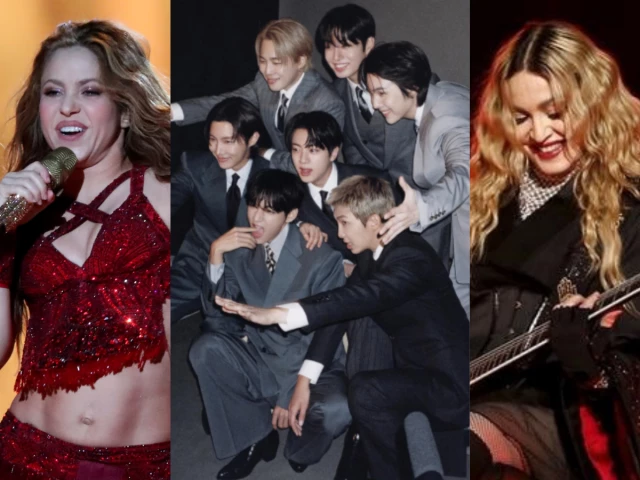
In a historic pivot that marries global sports with stadium-filling pop spectacle, FIFA has officially confirmed that Madonna, Shakira, and BTS will co-headline the first-ever halftime show during the 2026 World Cup final.
The performance is scheduled to take place on Sunday, July 19, at MetLife Stadium in East Rutherford, New Jersey — home of the NFL’s New York Giants and New York Jets. For the first time in the tournament’s 96-year history, the final match will pause for an 11-minute, Super Bowl-style musical interlude.
The announcement arrived via a promotional social media video featuring Coldplay frontman Chris Martin alongside beloved characters from Sesame Street and The Muppets. The whimsical clip also included a FaceTime call with BTS, confirming the K-pop superstars’ involvement.
FIFA’s move signals an aggressive push to blend football’s biggest night with mainstream entertainment — a formula that has powered the Super Bowl to become one of the most-watched musical events on the planet.
A Trio of Titans: What Each Headliner Brings
The three acts represent distinct continents, eras, and fan bases — a deliberate strategy to capture a truly global audience.
Shakira: The FIFA Veteran Returns
Shakira is no stranger to World Cup glory. The Colombian superstar previously delivered Waka Waka (This Time for Africa), the official anthem of the 2010 tournament in South Africa — still one of the most-viewed World Cup songs in history.
For 2026, Shakira has already released Dai Dai, her official FIFA World Cup track featuring Burna Boy. The song’s Afrobeat-infused rhythm is already climbing global charts. Her Las Mujeres Ya No Lloran world tour is scheduled to cut through North America around the time of the final, making the halftime appearance a natural peak.
Madonna: The Icon Returns to Form
At 67, Madonna remains one of the best-selling female artists of all time. She will release her 15th studio album, Confessions II, on July 3 — just over two weeks before the final. The album follows her 2005 masterpiece Confessions on a Dance Floor and already features the singles Bring Your Love (with Sabrina Carpenter) and I Feel So Free.
For FIFA, booking Madonna lends the halftime show a sense of legacy and gravitas. For Madonna, performing on football’s biggest stage offers a promotional blast radius that no single tour date could match.
BTS: The Global Army Arrives
The K-pop phenomenon has returned. BTS recently released their sixth studio album, ARIRANG, their first group project since completing mandatory South Korean military service. The group has also launched the ARIRANG WORLD TOUR earlier this year.
BTS brings an unprecedented digital fanbase — the “ARMY” — that spans virtually every country with a World Cup broadcast. Their inclusion guarantees that the halftime show will dominate social media trends across Asia, the Americas, and Europe simultaneously.
The Brains Behind the Show: Global Citizen and Chris Martin
The halftime show is being organized by Global Citizen, the international advocacy organization known for large-scale festival events, in partnership with Chris Martin.
Proceeds and awareness from the performance will support the FIFA Global Citizen Education Fund, a new initiative aiming to raise $100 million for children’s education and access to football worldwide. The partnership aligns with FIFA’s broader push to frame the 2026 tournament — hosted across the US, Canada, and Mexico — as a socially conscious event.
Chris Martin, who has long advocated for Global Citizen’s mission, served as the creative bridge between FIFA and the three headliners. His involvement lends the project musical credibility beyond pure commercial ambition.
From the Super Bowl to the World Cup: A Long-Overdue Shift
The NFL’s Super Bowl halftime show has been a cultural institution since Michael Jackson’s 1993 performance. It has since featured Prince, Beyoncé, Rihanna, Dr. Dre, and countless others. The audience routinely exceeds 100 million viewers in the US alone — plus tens of millions more globally.
FIFA has historically resisted the halftime-show format, citing football’s continuous flow and the absence of traditional commercial breaks. The 11-minute window for 2026 suggests a carefully choreographed production that will not disrupt the match’s rhythm excessively.
Industry analysts view this as a competitive response. The World Cup final already draws an estimated 1.5 billion viewers globally — dwarfing the Super Bowl’s reach. Adding a high-profile halftime show could push that number even higher, especially among younger and female demographics.
“This is FIFA finally realizing that the final is not just a match — it’s a global television event with no equal,” says a music industry consultant quoted in the announcement’s aftermath. “A halftime show turns it into a festival.”
What This Means for the 2026 Tournament
The 2026 World Cup is already historic. It will be the first edition featuring 48 teams (up from 32) and the first co-hosted by three nations: the United States, Canada, and Mexico. Matches will span 16 cities, from Vancouver to Mexico City to Miami.
Adding a Super Bowl-style halftime show to the final transforms MetLife Stadium into a one-night global stage that rivals the Olympics’ opening ceremony.
For broadcasters, the change is enormous. Advertisers who previously avoided the final due to a lack of natural breaks may now clamor for slots around the halftime performance. For fans in stadiums, the 11-minute show offers a bathroom-and-concession window unlike any previous World Cup final.
For the artists, the stakes are equally high. No halftime show in football history has ever reached a live audience of this size. A flawless performance could define a legacy. A technical failure would be seen by over a billion people.
📊 Short Analysis: Why FIFA Is Finally Doing This
Three forces converged to make the 2026 halftime show a reality:
1. The North American Host Factor
The US, Canada, and Mexico are accustomed to sports entertainment spectacles. The NFL, NBA, and MLB all prioritize in-game entertainment. FIFA is adapting to the host region’s expectations.
2. Declining Linear TV Attention Spans
Younger viewers consume highlights, memes, and musical moments — not 90-minute halves. A halftime show creates shareable content designed for TikTok, YouTube Shorts, and Instagram Reels.
3. The Global Citizen Model
By tying the show to a $100 million education fund, FIFA insulates itself from criticism that the event is purely commercial. The philanthropic angle allows FIFA to claim social impact alongside entertainment.
The risk is execution. An 11-minute show with three major acts requires military-grade choreography, seamless audio transitions, and zero technical glitches. One misfired microphone or delayed entrance could dominate headlines for the wrong reasons.
Nevertheless, the announcement has already achieved its first goal: global conversation. Madonna, Shakira, and BTS fans are now planning World Cup final watch parties — many of whom had never previously cared about a football match.