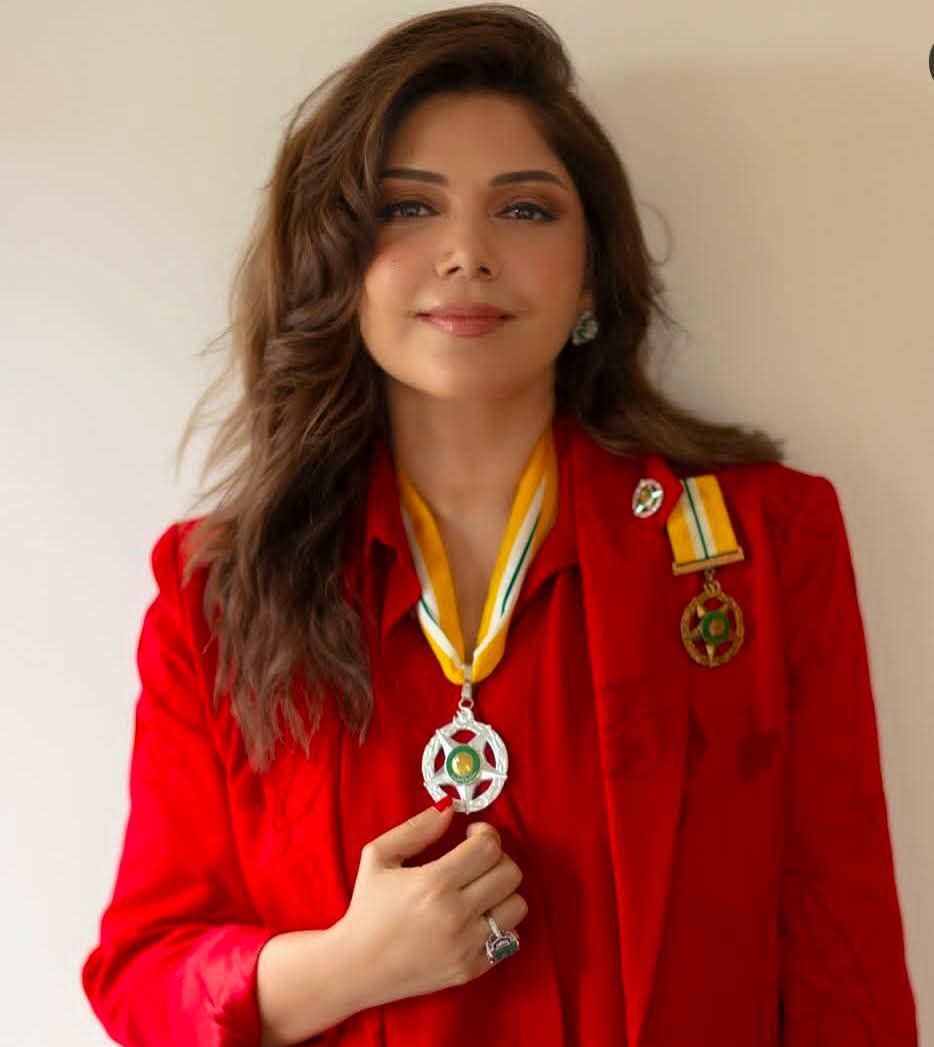
ISLAMABAD – Renowned Pakistani singer and philanthropist Hadiqa Kiani has described her latest civil award as “unbelievable,” expressing deep gratitude after being conferred the Sitara-i-Imtiaz — the country’s third-highest civilian honor — in a prestigious ceremony at Aiwan-e-Sadr on Wednesday.
The award comes nearly two decades after Kiani first received the Tamgha-i-Imtiaz, making the latest recognition a deeply personal milestone. In an emotional Instagram post following the ceremony, the vocalist behind chart-topping anthems like Boohey Barian and Saari Raat said she felt “deeply honoured and humbled.”
“It feels unbelievable because it comes 20 years after I first received the Tamgha-i-Imtiaz,” Kiani wrote, adding that she deliberately wore red to the ceremony — just as she had two decades ago.
The singer dedicated the honour to her son, her listeners, her supporters, and her family.
“I share this honour with my son, my listeners, supporters, family and everyone who has been part of this journey over the years,” she said.
Kiani’s career spans over two decades, during which she has not only dominated Pakistan’s music industry but also built a reputation as a humanitarian. She is the founder of Mera Ghar, a non-profit housing and rehabilitation project for women and children affected by the 2005 earthquake and subsequent floods.
A Night of National Recognition: Full List of Civil Award Winners
Kiani was among dozens of Pakistanis and foreign nationals who received civil awards for exceptional contributions across literature, arts, sports, and public service.
Pakistan’s Highest Honour: Nishan-i-Imtiaz
President Asif Ali Zardari presented the Nishan-i-Imtiaz — Pakistan’s highest civil award — to two literary giants:
- Atta ul Haq Qasmi (literature)
- Irfan ul Haq Siddiqui (literature)
Hilal-i-Imtiaz Recipients
The second-highest civilian honour went to:
- Zehra Nigah (poetry) – the acclaimed poet known for her powerful Urdu verse
- Asghar Nadeem Syed (playwriting) – a veteran dramatist of Pakistan Television (PTV)
- Shahid Afridi (cricket) – the former all-rounder and captain
- Shehroz Kashif (mountaineering) – for scaling some of the world’s highest peaks
- Malik Ata Muhammad Khan (equestrian sports) – posthumous recognition
Sitara-i-Imtiaz Recipients (Arts & Culture)
In addition to Hadiqa Kiani, the following received the Sitara-i-Imtiaz:
- Irfan Ahson (photography)
- Hamra Abbas (visual arts)
- Sana Mir (cricket) – former Pakistan women’s national team captain, awarded separately at a ceremony in Peshawar
- Fazila Qazi (acting) – presented in Karachi
- Savera Nadeem (acting) – presented in Karachi
Pride of Performance & Tamgha-i-Imtiaz
Other notable awardees included:
- Rashid Waheed Khawaja and Zahid Ahmed (acting) – President’s Pride of Performance Award
- Mohsin Nawaz (shooting) – Tamgha-i-Imtiaz
- Waseem Ahmed (artist) – Tamgha-i-Imtiaz
- Jamshid Ali Khan (arts, direction, production) – Pride of Performance (Peshawar ceremony)
- Aminullah Daudzai (literature and poetry) – Pride of Performance (Peshawar)
- Muhammad Hamza Khan (squash) – Tamgha-i-Imtiaz (Peshawar)
- Mukhtiar Naz Taj Mastani (music) – Pride of Performance (Karachi)
- Qazi Shujaat Qadri (naat khawan) – Tamgha-i-Imtiaz (Karachi)
Separate Ceremonies in Peshawar and Karachi
While the main ceremony took place in Islamabad, President Zardari delegated authority to provincial governors to confer awards in their respective regions.
Peshawar Ceremony
Governor Faisal Karim Kundi presented the Sitara-i-Imtiaz to Sana Mir, the former Pakistan women’s cricket captain who led her team to multiple international victories and remains a global ambassador for women’s sports in Pakistan.
Karachi Ceremony
Governor Nehal Hashmi conferred the Sitara-i-Imtiaz on veteran television actors Fazila Qazi and Savera Nadeem, both of whom have decades of contributions to Pakistan’s drama industry.
Posthumous Bravery Award: Sitara-i-Shujaat
In a poignant moment during the Islamabad ceremony, the president also posthumously conferred the Sitara-i-Shujaat (Star of Bravery) on an unnamed civilian who sacrificed his life earlier this week while foiling a suicide attack in Attock’s Jand tehsil.
The recognition marks a rare instance of a civilian bravery award being announced during the main Independence Day-week civil honours ceremony, underscoring the gravity of the threat averted.
📊 Short Analysis: Why This Year’s Civil Awards Matter
Pakistan’s civil awards list has occasionally faced criticism for being politically influenced or repetitive. However, the 2026 cohort stands out for several reasons:
1. Gender Representation
Women dominated key categories. Hadiqa Kiani, Zehra Nigah, Sana Mir, Fazila Qazi, Savera Nadeem, and Hamra Abbas represent a broad cross-section of Pakistani excellence — from pop music to classical poetry to women’s sports.
2. Regional Balance
Ceremonies in Islamabad, Peshawar, and Karachi ensured that awardees from Khyber Pakhtunkhwa and Sindh were honoured locally, reducing travel burdens and decentralizing recognition.
3. Arts Over Politics
Unlike previous years where bureaucrats and politicians featured prominently, the 2026 list leans heavily toward artists, athletes, and cultural figures. This signals a potential shift in how the state defines “service to the nation.”
4. The Hadiqa Kiani Arc
Kiani’s emotional response — “unbelievable” — reflects a genuine sentiment. Twenty years between Tamgha and Sitara is unusually long for an artist of her stature. Many observers had expected her to receive the Hilal-i-Imtiaz directly. The delay, however, made Wednesday’s recognition more meaningful to her and her fanbase.
For Pakistan’s entertainment industry, the ceremony was a rare moment of unified celebration. Singers, actors, poets, and athletes stood side by side — a reminder that national pride, for one evening, transcended the country’s usual political fractures.