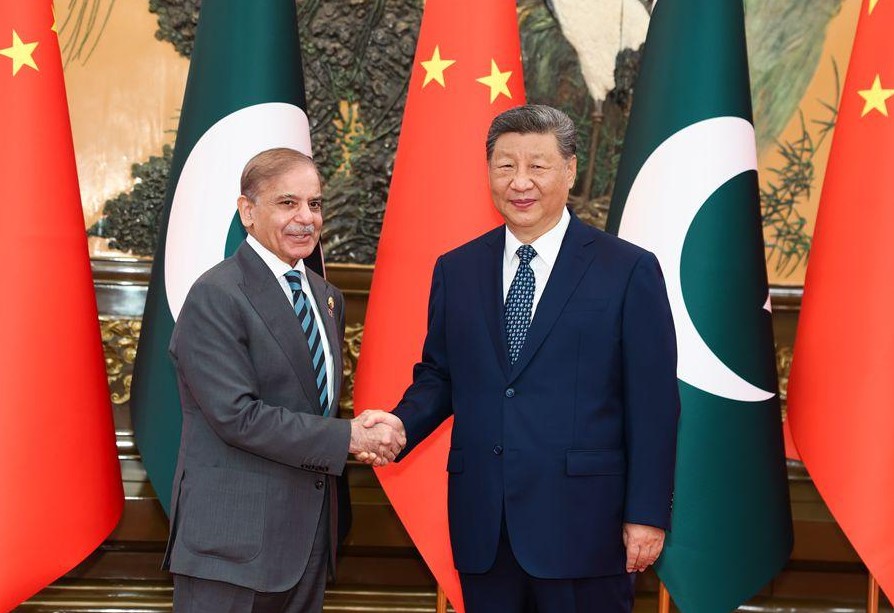
Pakistan and China have reached what both sides described as a “new broad consensus” on strengthening their All-Weather Strategic Cooperative Partnership following Prime Minister Shehbaz Sharif’s four-day official visit to China.
In a detailed joint statement issued Tuesday at the conclusion of the visit, Islamabad and Beijing pledged to accelerate efforts toward building an “even closer China-Pakistan Community with a shared future in the new era.”
The visit marked the 75th anniversary of diplomatic relations between the two countries and included high-level meetings with Chinese President Xi Jinping and Premier Li Qiang.
Pakistan-China Partnership Declared More Strategic Than Ever
According to the joint communique, both countries emphasized that their relationship had gained even greater strategic significance amid rapidly changing global conditions.
The statement described Pakistan-China friendship as:
- “Rock solid”
- Built on mutual trust
- Strengthened through decades of cooperation
- Resistant to changing regional and international dynamics
Both sides agreed to:
- Maintain high-level exchanges
- Expand practical cooperation
- Deepen defense and security collaboration
- Increase coordination on regional and international issues
China Backs Pakistan’s Sovereignty and Security
Beijing reiterated its “unwavering support” for Pakistan’s sovereignty, territorial integrity, stability, and economic development.
Pakistan, in return, reaffirmed strong support for the:
- One-China principle
- China’s stance on Taiwan
- Chinese positions on Xinjiang, Hong Kong, Xizang, and the South China Sea
Islamabad also strongly opposed any form of “Taiwan independence.”
CPEC 2.0 Expansion Takes Center Stage
A major focus of the visit was the future expansion of the China-Pakistan Economic Corridor under the framework of “CPEC 2.0.”
Both countries agreed to:
- Accelerate high-quality Belt and Road cooperation
- Convene the next Joint Cooperation Committee meeting
- Expand industrial and infrastructure development
- Improve regional connectivity
Gwadar and Karakoram Highway Projects Prioritized
The joint statement confirmed plans to:
- Advance the Karakoram Highway Thakot-Raikot realignment project
- Expand the strategic role of Gwadar Port as a regional connectivity hub
- Strengthen land connectivity through the Khunjerab Pass
Both sides also welcomed participation of third parties in CPEC projects under mutually agreed frameworks.
China Supports Pakistan’s Mediation Efforts in Middle East
The statement highlighted Pakistan’s growing diplomatic role in regional peace initiatives.
China praised Pakistan’s efforts in:
- Facilitating temporary ceasefire discussions between the US and Iran
- Hosting the Islamabad Talks
- Supporting regional de-escalation efforts
Pakistan, meanwhile, endorsed President Xi Jinping’s four-point peace proposals for the Middle East and supported early implementation of a five-point peace initiative for Gulf stability.
Afghanistan and Counterterrorism Cooperation
The two countries also discussed regional security challenges involving Afghanistan.
Both sides agreed to:
- Enhance coordination on Afghanistan
- Prevent terrorist groups from using regional territory for attacks
- Oppose double standards in counterterrorism
The statement specifically referenced:
- Tehreek-e-Taliban Pakistan
- Eastern Turkistan Islamic Movement (ETIM)
China also announced support for establishing a China-Pakistan Security Partnership.
Pakistan-China Cooperation Expands Into AI and Space
One of the most notable developments involved new cooperation in:
- Artificial intelligence
- Digital economy
- Scientific innovation
- Space exploration
- Agriculture
- Energy
- Information technology
Pakistani Astronauts to Train in China
In a significant symbolic breakthrough, China confirmed it would welcome two Pakistani astronauts for training.
Beijing also stated it hoped a Pakistani astronaut would become:
“The first foreign astronaut for the early entrance into the China Space Station.”
Pakistan additionally endorsed China’s proposal for establishing a World Artificial Intelligence Cooperation Organisation focused on global AI governance.
Economic and Agricultural Cooperation Deepens
The two sides announced expanded cooperation in:
- Mining
- Oil and gas
- Agriculture
- Industrial parks
- Supply chain security
- Financial systems
China also pledged support for Pakistani agricultural development and market access for Pakistani exports.
Pakistan praised the successful training of 1,000 young Pakistani agricultural technicians in China.
Kashmir and Global Governance Discussed
The joint statement reiterated China’s longstanding position that the Jammu and Kashmir issue should be resolved peacefully according to:
- UN Charter principles
- Relevant UN Security Council resolutions
- Bilateral agreements
Both sides opposed unilateral actions and emphasized dialogue and diplomacy for regional stability.
The countries also reaffirmed support for:
- Multilateralism
- UN-centered international order
- Multipolar global governance
Shehbaz Praises China’s Development Model
Before departing Beijing, Prime Minister Shehbaz Sharif praised China’s economic transformation and called it a model for the developing world.
“The world should learn from China’s enviable journey of overcoming development challenges, poverty, unemployment, diseases, and other obstacles,” he said.
Describing bilateral ties, Shehbaz remarked:
“The roots of the tree of Pakistan-China friendship are very deep.”
Pakistan-China Alliance Expands Beyond Traditional Cooperation
The latest joint statement demonstrates that Pakistan-China relations are increasingly evolving beyond infrastructure and defense cooperation into a broader strategic alignment involving:
- Regional diplomacy
- Global governance
- Technology
- Security
- Artificial intelligence
- Space collaboration
At a time of growing geopolitical polarization, both countries appear intent on strengthening a long-term partnership centered around multipolar diplomacy and economic connectivity.
For Pakistan, the expansion of CPEC 2.0 and advanced cooperation sectors offers opportunities for investment, technology transfer, and strategic balancing.
For China, Pakistan remains:
- A key Belt and Road partner
- A gateway linking South Asia, Central Asia, and the Middle East
- An important regional security ally
The emphasis on AI, digital governance, and space cooperation also signals that the partnership is moving into areas that could shape future global technological competition.