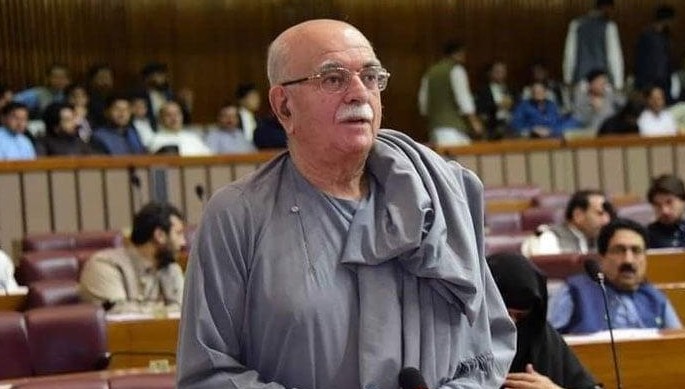
Mehmood Khan Achakzai, leader of the opposition alliance Tehreek Tahaffuz Ayeen-e-Pakistan (TTAP), has warned that opposition parties — including Pakistan Tehreek-e-Insaf (PTI) — may withdraw from parliamentary forums if what he described as harsh treatment of former prime minister Imran Khan continues.
Speaking during a television interview on Monday, Achakzai suggested the country’s political situation was approaching a breaking point and indicated that a boycott of assemblies was becoming increasingly likely.
“I fear that if the current attitude towards Imran Khan continues, we will not be able to stay in the assembly,” he said.
Achakzai Warns of Major Political Escalation
The veteran Pashtun nationalist leader strongly criticized the legal cases and possible future proceedings involving Imran Khan.
Questioning the basis of the allegations against the jailed former premier, Achakzai asked:
“What has he done? Has he committed murders?”
He also referred to discussions regarding the possibility of military court proceedings.
“You want to try him in a military court. Tell me if he is a general or a colonel,” Achakzai remarked.
The comments come amid continuing political tensions between the PTI opposition and the federal government over:
- Imran Khan’s imprisonment
- Election-related disputes
- Parliamentary legitimacy
- Judicial proceedings
- Restrictions on opposition activities
PTI Withdrawal From Assemblies No Longer ‘Hypothetical’
Achakzai suggested that withdrawal from legislatures was now being seriously considered inside PTI leadership circles.
“If the PTI’s central committee suggests quitting the assemblies in Punjab, Sindh and the Centre, and only running the government in Khyber Pakhtunkhwa, it will be implemented,” he said.
When asked whether he feared such a recommendation from PTI leadership, Achakzai responded:
“I don’t fear it, I can see it coming.”
The remarks indicate growing frustration within opposition ranks over what they describe as shrinking political space and increasing pressure on party leadership.
Opposition Says Parliamentary Space Shrinking
Achakzai argued that parliamentary institutions had become ineffective if opposition leaders were unable to even secure access to Imran Khan.
He claimed the opposition was being pushed toward a boycott rather than voluntarily choosing one.
“We will have no option but to withdraw from the assemblies and parliamentary committees,” he said.
The opposition leader also alleged selective accountability within Pakistan’s political and judicial systems.
He claimed:
“Criminals and murderers are free” while Imran Khan remained imprisoned.
Political Arithmetic Could Shift
Achakzai additionally warned that a PTI withdrawal from legislative bodies could significantly affect parliamentary politics.
“There are 50 to 60 PTI seats in the assembly. What will you do if the PTI pulls out?” he asked.
A mass resignation or boycott by PTI lawmakers could potentially:
- Disrupt parliamentary proceedings
- Weaken legislative legitimacy
- Trigger political instability
- Intensify confrontation between government and opposition
However, no formal announcement regarding resignations has yet been issued by PTI leadership.
PTI’s History of Assembly Boycotts
PTI has previously used resignations and parliamentary boycotts as political pressure tactics.
Following political upheaval after Imran Khan’s removal from office in 2022, PTI lawmakers resigned from the National Assembly before later returning through by-elections and subsequent political processes.
Political analysts note that another withdrawal could create:
- Constitutional complications
- Governance challenges
- Electoral uncertainty
- Increased polarization
Khyber Pakhtunkhwa Remains PTI Stronghold
Achakzai’s comments specifically referenced the possibility that PTI might continue governing only in Khyber Pakhtunkhwa while abandoning assemblies elsewhere.
PTI currently maintains political influence in KP, where it has remained one of the country’s strongest electoral forces.
Observers say maintaining control of KP while boycotting federal institutions could become part of a broader pressure strategy against Islamabad.
Political Climate Remains Highly Polarized
Pakistan’s political environment remains deeply divided amid:
- Imran Khan’s legal cases
- Opposition-government tensions
- Economic difficulties
- Security concerns
- Debate over electoral legitimacy
The possibility of renewed parliamentary boycotts could further complicate efforts to stabilize the political system.
Military Court Debate Intensifies
Achakzai’s remarks also highlight ongoing controversy surrounding discussions about trying civilians in military courts.
Human rights groups, legal experts, and opposition parties have repeatedly raised concerns regarding:
- Due process
- Civil liberties
- Constitutional rights
- Transparency of military trials
The issue remains one of the most politically sensitive aspects of Pakistan’s current legal and constitutional debate.
Analysis: Opposition Threat Signals Rising Political Confrontation
Achakzai’s warning reflects growing pressure inside the opposition alliance as frustration mounts over Imran Khan’s imprisonment and PTI’s broader political treatment.
While no final decision on resignations has been announced, the rhetoric suggests the opposition is increasingly willing to escalate confrontation through institutional withdrawal.
For PTI, exiting assemblies could:
- Mobilize supporters politically
- Challenge parliamentary legitimacy
- Increase pressure on the government
However, analysts caution that boycotting legislatures also carries significant risks, including:
- Loss of parliamentary influence
- Reduced institutional leverage
- Political fragmentation
The comments additionally underscore how Pakistan’s political crisis continues shifting beyond ordinary parliamentary competition into broader debates over judicial independence, civil-military relations, and constitutional governance.
Whether PTI ultimately withdraws or remains engaged within parliamentary structures may become one of the defining political questions in the coming months.