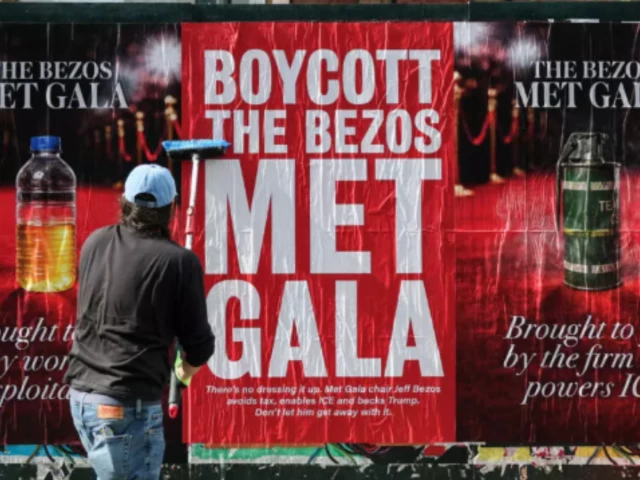
NEW YORK – A provocative poster campaign opposing Amazon founder Jeff Bezos’s involvement in the upcoming Met Gala has appeared across New York City streets and subways, calling for a boycott of the star-studded event. The campaign, launched by a group that previously targeted Elon Musk, takes aim at Bezos’s business practices, including allegations of poor working conditions for Amazon drivers and his company’s contract with US Immigration and Customs Enforcement (ICE).
The posters, which began surfacing Wednesday, depict striking images intended to draw attention to what activists call Bezos’s “toxic” influence. One poster shows a bottle filled with urine on a red carpet—a direct reference to widespread reports that some Amazon drivers have been forced to urinate in bottles due to lack of bathroom breaks. Another portrays Bezos in an ICE uniform, highlighting Amazon’s cloud computing contract with the agency leading President Donald Trump’s immigration crackdown.
‘Everyone Hates Elon’ Expands Target
Behind the campaign is a group founded in Britain called “Everyone Hates Elon.” However, a spokesperson stressed that the organization “also targets other billionaires” beyond Elon Musk, the world’s richest person. Speaking on condition of anonymity due to fears of retaliation, the spokesperson said: “I think it feels really powerful to take action. I think it’s speaking to a need that people have to stand up to some of these people that are controlling our lives.”
The group claims to have raised more than 14,000 pounds ($19,000) to fund its New York campaign, primarily from small donations averaging just 10 pounds.
Bezos and Sanchez as Met Gala Co-Chairs
The Met Gala, scheduled for May 4, is one of the most high-profile fundraising events in the fashion and entertainment calendar, drawing A-listers from film, music, sports, and business. This year, Bezos and his wife, Lauren Sanchez Bezos, are lead sponsors and honorary co-chairs of the event, which benefits the Metropolitan Museum of Art’s Costume Institute.
The billionaire couple’s prominent role has drawn sharp criticism from activists who argue that Bezos’s business empire—spanning Amazon, Blue Origin, and The Washington Post—embodies the very inequalities the event’s glamour often obscures.
A History of Met Gala Controversy
The Met Gala has long been a lightning rod for criticism over displays of immense wealth. Previous editions have drawn protests over economic inequality, environmental concerns, and the war in Gaza. This year’s boycott call adds a new dimension, focusing specifically on Bezos’s labor practices and his company’s ties to federal immigration enforcement.
Amazon has faced persistent allegations of harsh working conditions in its warehouses and delivery networks, including quotas that drive injuries and a lack of basic amenities for drivers. The company has repeatedly defended its practices, noting that it has invested in safety improvements and created millions of jobs.
A Coordinated Pressure Campaign
The New York posters are the latest in a series of actions targeting Bezos’s public image. Activists have previously staged demonstrations outside Amazon’s annual shareholder meetings and called for a breakup of the company on antitrust grounds. The Met Gala boycott effort seeks to leverage the event’s high visibility to amplify these longstanding grievances.
The group behind the campaign has not disclosed whether it plans additional actions leading up to May 4, but the spokesperson hinted at “more surprises” for the red carpet.
Analysis: Activism Meets High Fashion
The anti-Bezos Met Gala boycott campaign reflects a growing trend of using cultural events as platforms for political activism. The Met Gala, with its unparalleled media coverage and celebrity attendance, offers a global stage for protesters seeking to hold powerful figures accountable.
For Bezos, who has cultivated a public image as a space entrepreneur and philanthropist (through initiatives like the Bezos Earth Fund), the campaign threatens to overshadow his role as a patron of the arts. The juxtaposition of lavish gowns and protests over worker treatment highlights the deep social divisions that persist even as the economy recovers from the pandemic and global conflicts.
The group’s success in raising $19,000 from small donations demonstrates that grassroots organizing can still generate resources for targeted campaigns. Whether the boycott will meaningfully affect attendance or donations to the Metropolitan Museum of Art remains uncertain, but the posters ensure that the conversation about Bezos’s legacy will follow him onto the red carpet.
As the May 4 event approaches, the clash between celebrity glamour and social justice is poised to become one of the most talked-about aspects of this year’s Met Gala.