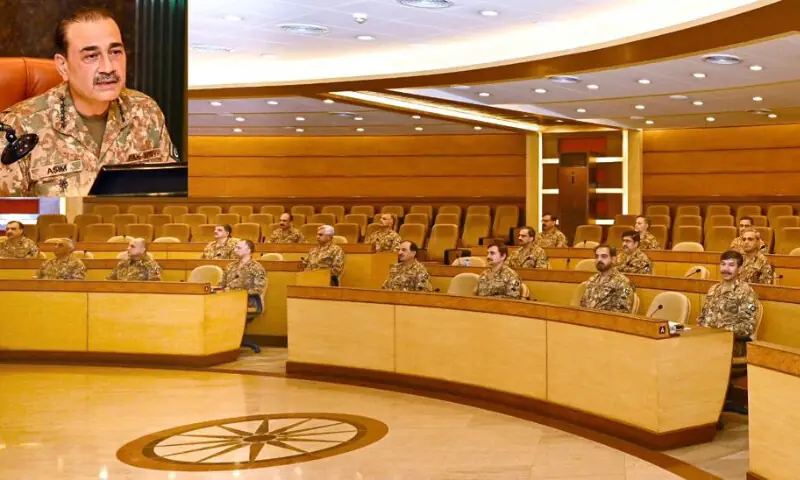
RAWALPINDI – The army’s top brass on Tuesday condemned attacks on Saudi Arabia’s energy infrastructure amid the ongoing US-Israeli war on Iran as “an unnecessary escalation,” according to the military’s media affairs wing. The development came as Chief of Defence Forces and Chief of Army Staff Field Marshal Asim Munir presided over the 274th Corps Commanders’ Conference (CCC) at General Headquarters (GHQ).
The forum appreciated the “hectic efforts” taken by the government to bring an end to the war in the Middle East, “echoing the call for restraint, dialogue, and de-escalation, reaffirming Pakistan’s commitment to principled diplomacy and constructive engagement,” according to a statement by Inter-Services Public Relations (ISPR).
“The forum reiterated Pakistan’s role as a responsible regional stakeholder, actively contributing to peace and stability as a regional security stabiliser,” the statement said.
Condemnation of Attacks on Saudi Arabia
The statement added that the forum noted with “concern and vehemently condemned the latest attacks on Saudi Arabia’s petrochemical and industrial complex as an unnecessary escalation which spoils sincere efforts to resolve the conflict through peaceful means.”
The forum noted that the restraint and calibration exhibited by the kingdom, despite “grave provocations,” enabled mediation and diplomatic resolution. However, it added that such “unwarranted aggressions have serious repercussions, to spoil the ongoing peaceful options and conducive environment.”
Earlier in the day, the Foreign Office had also condemned the attacks on Saudi Arabia’s energy facilities, terming the attacks as “a dangerous escalation” that undermined regional peace and stability.
It should be noted that Pakistan and Saudi Arabia signed a “Strategic Mutual Defence Agreement” in Riyadh last year, pledging that any attack on either nation would be treated as an act of aggression against both.
Review of Internal and External Security
The corps commanders’ conference also undertook a comprehensive review of the prevailing internal and external security environment, “reaffirming that all terrorist proxies operating on behest of Indian and other external sponsors, along with their facilitators and abettors, will be pursued and eliminated, relentlessly, and without exception.”
The statement said that the pace of Operation Ghazab lil-Haq, launched against the Afghan Taliban on February 26, would be maintained till the “culmination of terrorists’ safe heavens and use of the Afghan soil against Pakistan is decisively brought to an end.”
Rejection of Indian Allegations
The forum categorically rejected “persistent disinformation, baseless allegations, and false flag narratives attributed to India, noting that such tactics stand discredited internationally.”
“The forum expressed concern over continued human rights violations by Indian authorities in Indian Illegally Occupied Jammu and Kashmir, and noted the recent spate of fake encounters at various locations to cover up extrajudicial killings,” the statement said.
CDF Munir’s Remarks
In his remarks, CDF Munir expressed his satisfaction and commended the armed forces for their unwavering professionalism, operational excellence, and steadfast commitment towards the defence of the country and sustained, intelligence-based counter-terrorism operations.
“He underscored that through the synergy of the government, armed forces, and the people, Pakistan continues to consolidate security gains, strengthen economic resilience, and enhance its regional and global standing,” the statement said.
He also directed commanders to maintain the highest standards of operational readiness, professionalism, and adaptability, expressing full confidence in the armed forces’ ability to counter all forms of threats and to ensure the sovereignty and territorial integrity of Pakistan.
Tribute to Martyrs
At the outset of the meeting, the forum offered Fateha for the martyrs of the armed forces, law enforcement agencies, and innocent civilians who laid down their lives in defence of the motherland. “Paying solemn tribute to their unmatched sacrifices, the Forum reaffirmed that their legacy remains the bedrock of Pakistan’s national security,” the statement said.
Analysis: A Delicate Diplomatic Balancing Act
The corps commanders’ condemnation of attacks on Saudi Arabia as an “unnecessary escalation” reflects Pakistan’s delicate diplomatic balancing act. While Pakistan has positioned itself as a mediator between the US and Iran, its strategic partnership with Saudi Arabia—formalized through the “Strategic Mutual Defence Agreement”—requires it to condemn attacks on the kingdom.
The timing of the condemnation is significant. Pakistan has been actively mediating between the US and Iran, with reports of a ceasefire framework being shared with both sides. Iranian attacks on Saudi energy facilities could undermine those mediation efforts by hardening Saudi Arabia’s position and complicating Pakistan’s role as an honest broker.
The forum’s appreciation of Saudi Arabia’s “restraint and calibration” suggests that the kingdom has not retaliated for the attacks, a decision that the Pakistani military leadership believes has enabled diplomatic resolution. The warning that “unwarranted aggressions” could spoil “peaceful options” is a direct message to Iran about the consequences of continued attacks on Gulf states.
The corps commanders’ reaffirmation of the pace of Operation Ghazab lil-Haq indicates that Pakistan remains focused on counter-terrorism operations along the Afghan border, despite the diversion of international attention to the Middle East.
For the army’s top brass, the message is clear: Pakistan will defend its strategic interests, maintain its partnership with Saudi Arabia, and continue its counter-terrorism operations, even as it seeks to mediate an end to the Middle East conflict. Whether Iran heeds the warning about “unnecessary escalation” remains to be seen.