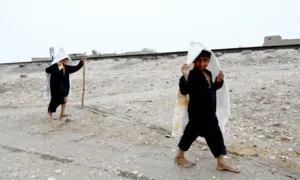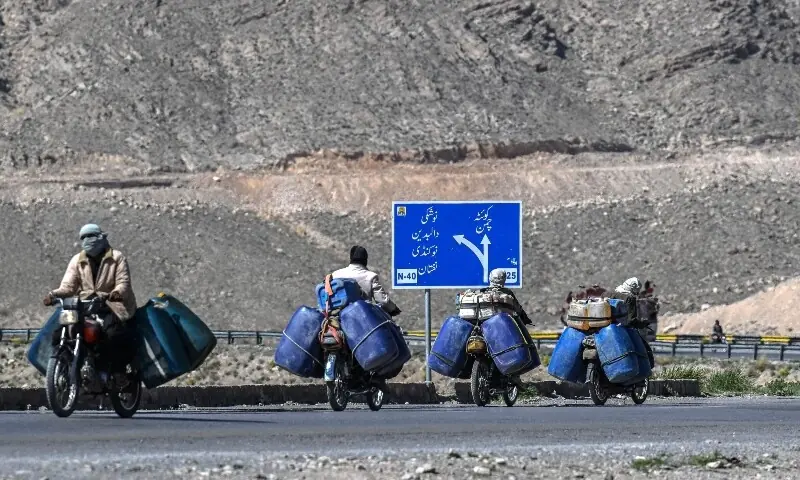
QUETTA – The Balochistan government on Saturday fixed the price of Iranian smuggled petrol at Rs280 per litre and announced that strict action would be taken against those charging more than this rate. The decision came after sellers of Iranian petrol raised prices following the federal government’s announcement of higher rates for imported petroleum products.
A meeting presided over by Chief Minister Mir Sarfraz Bugti decided that Iranian petrol would be sold in Balochistan at a fixed price announced by the provincial government, officials said.
“The Iranian petrol will be sold only in Balochistan, and it will not be allowed to be sent out of the province,” said Kalat Deputy Commissioner Munir Ahmed Durrani, adding that nobody would be allowed to charge more than the fixed rate.
Justification for Lower Price
Durrani said there was no justification for selling Iranian petrol at the rate announced by the federal government for imported petroleum products. Iranian petrol, which enters Balochistan through informal channels, is typically sold at significantly lower prices than legally imported fuel due to subsidies in Iran and the absence of taxes and levies applied to formal imports.
The federal government recently increased petrol prices to a record Rs458.4 per litre, raising the petroleum levy to Rs161 per litre. In contrast, Iranian petrol has historically been available for Rs200-250 per litre in border areas of Balochistan.
Crackdown on Overcharging
People involved in the Iranian petrol business had increased prices soon after the federal government announced higher rates for imported petrol, charging between Rs300 and Rs360 per litre. The provincial government’s intervention aims to bring these prices down and protect consumers from exploitation.
“The authorities will start strict checks and will take legal action against those found selling Iranian petrol at higher prices,” Durrani warned.
Legal and Economic Implications
The decision to regulate the price of smuggled Iranian petrol is unusual, as it effectively legitimizes a black market trade that operates outside Pakistan’s formal economy. Iranian petrol enters Balochistan through informal channels across the long, porous border between the two countries.
The provincial government’s move reflects the economic reality that many consumers in Balochistan rely on cheaper Iranian fuel, particularly given the sharp increase in prices of legally imported petrol. By fixing the price and restricting sales to within the province, the government appears to be attempting to regulate rather than eliminate the trade.
However, the decision may create tensions with the federal government, which has historically sought to curb smuggling and protect formal import channels. The federal government collects significant revenue through petroleum levies and taxes on legally imported fuel.
Consumer Impact
For consumers in Balochistan, the fixed price of Rs280 per litre represents significant savings compared to the federally set price of Rs458.4 per litre. However, the restriction that Iranian petrol cannot be sent out of the province means that consumers in other provinces will not benefit from the lower price.
The decision may also affect the economics of smuggling, as the profit margin for those transporting Iranian petrol across the border will now be regulated.
Analysis: A Pragmatic Response to Economic Pressure
The Balochistan government’s decision to fix the price of smuggled Iranian petrol is a pragmatic response to the economic pressures facing the province. With legally imported petrol now priced at a record Rs458.4 per litre, many consumers in Balochistan simply cannot afford the formal market.
By regulating rather than prohibiting the trade in Iranian petrol, the provincial government is acknowledging an economic reality: the demand for cheaper fuel will not disappear, and attempting to eliminate smuggling entirely may be impractical given the length of the border and the scale of the trade.
The decision to restrict sales to within Balochistan suggests an attempt to limit the impact on federal revenues while providing relief to the province’s residents. Whether the federal government will accept this arrangement, or take action to enforce formal import channels, remains to be seen.
For the people of Balochistan, the fixed price offers some relief from the fuel price shock that has affected the rest of the country. But it also highlights the deep economic divides between provinces and the lengths to which provincial governments must go to protect their citizens from federal policies.