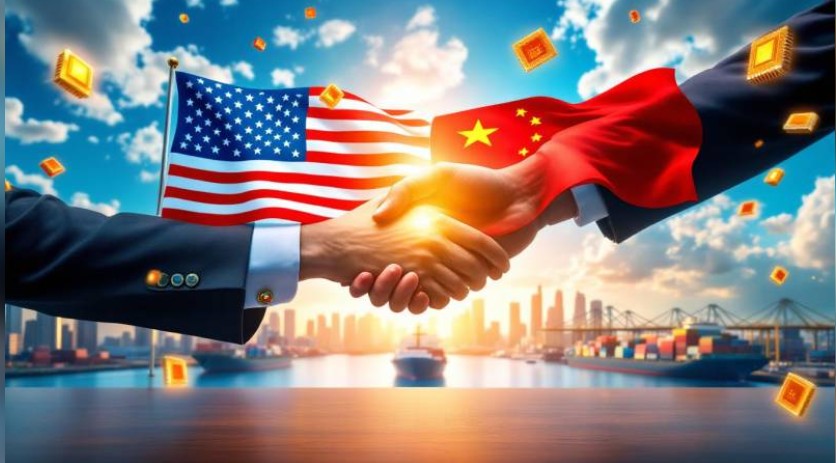
BEIJING: China on Thursday condemned new trade investigations announced by the United States against dozens of countries, including China, describing them as “political manipulation” and rejecting the premise of “overcapacity” as a “false proposition” .
US President Donald Trump’s administration launched two separate probes on Wednesday under Section 301 of the Trade Act of 1974. The first investigates excess industrial capacity in 16 major trading partners, while the second, covering more than 60 countries, targets imports allegedly made with forced labor .
China’s Official Response
Chinese Foreign Ministry spokesman Guo Jiakun addressed the probes during a regular press conference on Thursday, stating:
- On Overcapacity: “The so-called ‘overcapacity’ is a false proposition. China opposes using it as an excuse for political manipulation” .
- On Tariff Measures: “China opposes any form of unilateral tariff measures. Tariff and trade wars do not serve the interests of any party” .
- On Resolution: Both sides should resolve relevant issues “through consultation on the basis of equality, respect and mutual benefit” .
Details of the US Investigations
US Trade Representative Jamieson Greer announced the probes would focus on economies that “exhibit structural excess capacity and production in various manufacturing sectors” .
Countries targeted in the excess capacity probe :
| Region | Countries/Territories |
|---|---|
| Asia | China, India, Japan, South Korea, Taiwan, Vietnam, Thailand, Malaysia, Cambodia, Singapore, Indonesia, Bangladesh |
| Europe | European Union (with Germany and Ireland specifically cited), Switzerland, Norway |
| North America | Mexico |
Canada, the second-largest US trading partner, was notably excluded from the list .
The USTR’s official notice specifically cited China’s electric vehicle sector, noting that despite domestic capacity outstripping demand, top EV maker BYD is “aggressively expanding” its overseas manufacturing footprint . The notice also pointed to large US trade surpluses with Germany and Ireland as evidence of EU excess capacity, and cited Singapore’s semiconductor sector despite its trade deficit with the US .
Forced Labor Probe
Greer announced a separate Section 301 investigation into goods produced with forced labor, covering shipments from more than 60 countries . The US has already restricted imports from China’s Xinjiang region under the Uyghur Forced Labor Protection Act, and the new probe could expand such actions to other countries .
Washington alleges Chinese authorities have established labor camps for ethnic Uyghurs, allegations Beijing denies .
Legal and Diplomatic Context
The investigations follow a February 20 Supreme Court ruling that struck down Trump’s previous global tariffs imposed under emergency economic powers . The administration has since imposed temporary 10% tariffs until July 24 while working on more durable measures .
Greer said he hopes to conclude the Section 301 investigations, including proposed remedies, before the temporary tariffs expire in July . A swift timeline has been set, with public comments accepted through April 15 and a public hearing scheduled around May 5 .
The probes come as US officials led by Treasury Secretary Scott Bessent prepare to meet Chinese counterparts in Paris to set the stage for President Trump’s planned visit to Beijing at the end of March .
International Reactions
Several targeted countries have responded:
- Japan is scrutinizing details of the probe but will continue implementing its existing trade agreement with the US
- South Korea will seek to prevent unfavorable treatment for its exporters
- Taiwan noted its recent reciprocal trade agreement with the US establishes consensus on covered issues
- Thailand has formed a working group to prepare documents and be “as ready as possible”
- Indonesia stated its agreement with the US remains the main guideline for bilateral trade relations