ISLAMABAD – Prime Minister Shehbaz Sharif on Friday announced a Rs135 per litre cut in diesel and Rs12 per litre in petrol prices for the week ending April 17 to pass on the impact of ease in global prices following a two-week ceasefire between the United States and Iran.
The ex-depot price of high-speed diesel (HSD) has now been fixed at Rs385.54 per litre against Rs520.35, showing a 26 per cent or Rs135 per litre decrease. HSD is considered the most inflationary item given its use in freight transportation. On the other hand, petrol price has been cut by around 3 per cent to Rs366.58 per litre for the next week from Rs378.41, down by Rs11.83.
The price of kerosene was also reduced by Rs17.33 to Rs450.15 per litre and that of light diesel oil (LDO) by Rs25.31 to Rs369.72 per litre.
Correction in Pricing Formula
Informed sources said the reduction in the diesel price was not purely because of a fall in global rates, but chiefly because of the correction in the pricing formula that entailed undue benefit to local refineries as the spread between the local and imported products expanded as the war prolonged. It was pointed out that more than 70 per cent of diesel was produced locally, but its price parity calculation with the Middle East provided substantially higher financial take to local refineries. The correction helped reduce diesel rates substantially greater than petrol, they said.
Tax Rates Unchanged
In doing so, the tax rates were kept unchanged on all products. The government currently charges about Rs39 per litre on HSD in the shape of Rs36 customs duty and climate support levy. The total tax on petrol amounts to Rs107 per litre, including Rs81 petroleum levy, Rs24 customs duty, and Rs2.5 climate levy. The government also charges about Rs21 per litre petroleum levy on kerosene and about Rs16 per litre on LDO, officials said.
Official Notification
Separately, Deputy Prime Minister and Foreign Minister Ishaq Dar shared the notification for the new prices on X, according to which the price of kerosene has also been reduced by Rs17.33 per litre to Rs450.15 and that of light diesel oil by Rs25.31 per litre to Rs369.72.
PM’s Televised Address
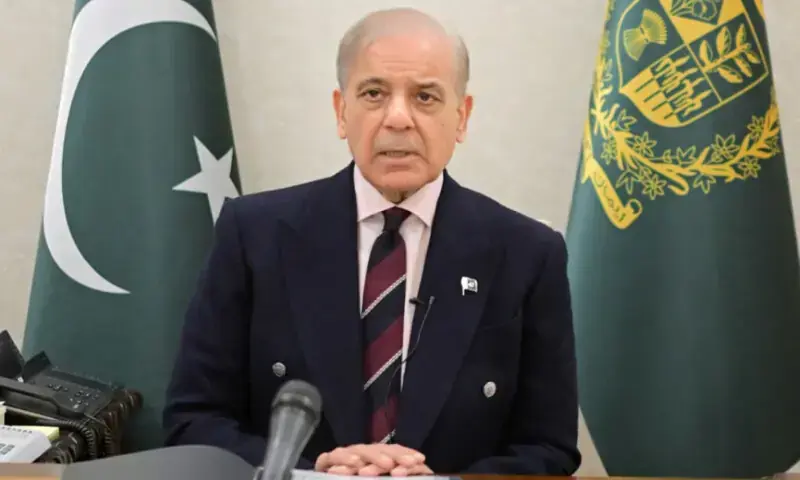
In a televised speech ahead of US-Iran talks beginning on Saturday, the prime minister said he had been advised to retain part of the fall in the international prices to recoup part of Rs129 billion the government had spent on fuel subsidy over the past month.
“I rejected the proposal without wasting a moment” because he had personally witnessed how the people of Pakistan had absorbed the sudden skyrocketing price hike with patience, the prime minister said, adding that it was now his moral and political duty to give back each rupee of reduction in fuel prices.
He said the cut in diesel price was also important to ensure that farmers did not face losses while wheat harvest had already begun, and this would also add food inflation for the common people.
Targeted Subsidies to Continue
He said that not only the reduction in petrol and diesel rates but the targeted subsidy announced by the government without cooperation and contribution of the provincial government for two-wheelers, public transport, and agriculture would continue. The prime minister said his priority remained the general public throughout the tough times to protect them from inflation and provide a better future to the next generation.
Price History
Petrol and diesel rates have gone up from Rs266 and Rs281 per litre, respectively, after the US-Israel attacked Iran on February 28, sending shockwaves to the global energy markets. The latest reduction brings some relief to consumers, particularly in the agricultural and transport sectors.
Analysis: A Welcome Relief
The Rs135 per litre cut in diesel prices is a significant reduction that will have a direct impact on transportation costs and, by extension, food prices. With wheat harvest underway, the timing is particularly important for farmers.
The prime minister’s decision to reject advice to retain part of the price reduction to recoup subsidy costs reflects a political calculation that passing on the full benefit to consumers is essential. The government had already spent Rs129 billion on fuel subsidies over the past month, and the decision to forgo additional revenue will put further pressure on the fiscal deficit.
The correction in the pricing formula for diesel, which accounts for more than 70 per cent of local production, addresses an anomaly that had allowed local refineries to benefit disproportionately during the war. The reduction in diesel prices is therefore a combination of lower global prices and a more equitable pricing formula.
For consumers, the reduction is welcome news after weeks of record-high fuel prices. Whether the ceasefire holds and prices continue to decline remains to be seen. For now, Pakistanis can breathe a small sigh of relief.