INTRODUCTION
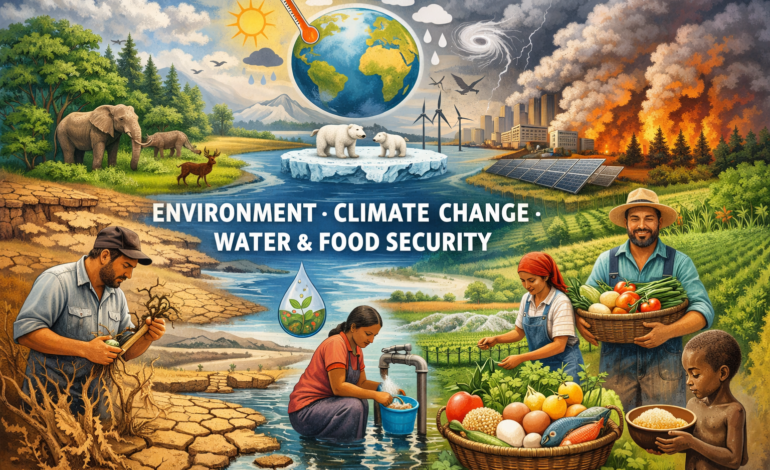
Pakistan is confronting mounting challenges related to environmental sustainability, water availability, and food security. These pressures have intensified in recent years due to the accelerating impacts of climate change, underscoring the urgent need for decisive and coordinated action. This chapter presents a comprehensive assessment of Pakistan’s current environmental, water, and food security landscape. It highlights the Government of Pakistan’s policy responses and strategic initiatives aimed at mitigating climate change impacts, improving water-use efficiency, promoting sustainable agriculture, reducing greenhouse gas emissions, addressing water pollution and land degradation, and strengthening integrated water management systems. In addition, it outlines key measures being undertaken to enhance resilience, rehabilitate critical infrastructure, and safeguard national food security.
SITUATION ANALYSIS
Pakistan is ranked as the eighth most climate-vulnerable country according to the Climate Risk Index 2021. This vulnerability is projected to intensify, as Pakistan’s temperature is expected to rise by 5.3°C—significantly higher than the global average increase of 3.7°C under the same Representative Concentration Pathway (RCP) scenario.
Climate change acts as a significant risk multiplier for developing countries like Pakistan, amplifying existing socio-economic vulnerabilities and drivers of instability. These impacts pose serious threats to national security, particularly in the domains of water, food, and energy security. Pakistan has already experienced severe climate-induced events, including frequent heatwaves, floods, and prolonged droughts. Climate variability and the likelihood of extreme weather events are increasing, as evidenced by the unprecedented floods of 2022, which affected approximately 33 million people nationwide. According to the Post-Disaster Needs Assessment (PDNA), the floods resulted in damages exceeding USD 14.9 billion and economic losses of approximately USD 15.2 billion, equivalent to 4.8% of FY2022 GDP.
Rapid population growth, combined with weak water resource governance, has placed Pakistan on the brink of a water security crisis. Per capita surface water availability has declined sharply—from 5,260 cubic meters per year in 1951 to nearly 1,000 cubic meters in 2016. Projections indicate a further decline to approximately 860 cubic meters by 2025, effectively transitioning Pakistan from a water-stressed to a water-scarce country.
The increasing frequency and severity of droughts over the past decade pose immediate threats to food security. Reduced crop yields and declining livestock productivity have undermined rural livelihoods, heightening the risks of hunger and poverty among vulnerable populations. Persistent drought conditions also accelerate land degradation and deplete groundwater reserves, intensifying water stress and limiting access to safe drinking water. Climate-induced shocks—including heatwaves, floods, and droughts—are severely impacting Pakistan’s largely subsistence-based irrigated agriculture sector. As a result, Pakistan imported USD 1.77 billion worth of wheat over the past two years, exacerbating imported inflation and highlighting the fragility of food supply chains, particularly in light of disruptions caused by the Ukraine conflict. These developments underscore the critical importance of strengthening domestic food self-sufficiency.
Effective disaster risk mitigation requires early identification of hazards and a robust disaster governance framework. Pakistan has established institutions such as the National Disaster Management Authority (NDMA) and Provincial and District Disaster Management Authorities, while the Federal Flood Commission oversees flood control measures. The National Disaster Risk Management Framework provides a five-year action roadmap. Despite these institutional arrangements, significant gaps remain in disaster preparedness and response, particularly at the district and community levels, highlighting the need for a more comprehensive and integrated disaster governance architecture.
Achieving national climate mitigation and adaptation goals necessitates a comprehensive National Climate Finance Framework. Climate-related risks—including extreme weather events, air pollution, and environmental degradation—are projected to reduce Pakistan’s GDP by 18–20% by 2050. Estimates suggest that USD 348 billion will be required for climate response investments between 2023 and 2030. Furthermore, full implementation of Pakistan’s Nationally Determined Contributions (NDCs) is expected to require nearly USD 200 billion.
STRATEGIC VISION AND PRIORITIES
Climate-Responsive Public Investment
Pakistan is integrating climate considerations into public investment planning by screening development projects for climate impacts and revising Public Investment Manuals accordingly. Green budget tagging is being implemented to track climate-related expenditures, while the comprehensive 4RF Strategy has been developed to guide flood recovery and systemic resilience.
Climate Finance
The Government has intensified climate diplomacy to mobilize international finance for a just transition toward climate resilience. At COP27, Pakistan successfully advanced the climate justice agenda and emerged as a pathfinder country for the Loss and Damage Fund. A climate conference in Geneva further mobilized development finance for resilience-building. In parallel, a Disaster Risk Financing Strategy is under development, exploring instruments such as parametric insurance, catastrophe bonds, and climate and nature performance bonds.
Resilient Cities
Efforts are underway to strengthen air and water pollution control through climate-smart municipal services. Nature-Based Solutions (NbS) and green infrastructure are being prioritized in disaster-prone areas to support flood control, groundwater recharge, and urban resilience. Community engagement, green building codes, and improved land-use planning form integral components of this strategy.
Food Security
The modernization of irrigation and drainage systems aims to deliver climate-resilient, flexible, and demand-responsive services. A key priority is bringing 20.3 million acres of uncultivated but fertile land under climate-smart agriculture to ensure long-term food security.
Water Governance
Strengthening groundwater governance through Provincial Water Acts and rationalizing water pricing are central to improving water security. The development of a comprehensive water pricing policy and promotion of public–private partnerships are intended to enhance conservation and efficiency.
Climate Technology and Innovation
Investment in climate research and innovation will be expanded, with targeted funding for emerging technologies such as green hydrogen, decentralized energy storage, and climate-resilient solutions, supported by regional and global collaboration.
Community-Based Resilience
Community-led adaptation initiatives focus on capacity building, awareness, and nature-based interventions to enhance flood risk management, disaster preparedness, and climate resilience at the local level.

Dr. Farhan